Whalefall Puts a Diver Inside a Sperm Whale. Here’s What a Whale’s Stomach Really Does.
Whalefall opens October 16 with Austin Abrams sealed inside a sperm whale and an hour of air. Nobody has ever been swallowed by one, but the stomach the movie built is close to the real thing: a first chamber that is pure muscle, acid only one door down, and squid beaks by the thousand. We read the whale anatomy and the human kind, so you come out knowing how yours works.
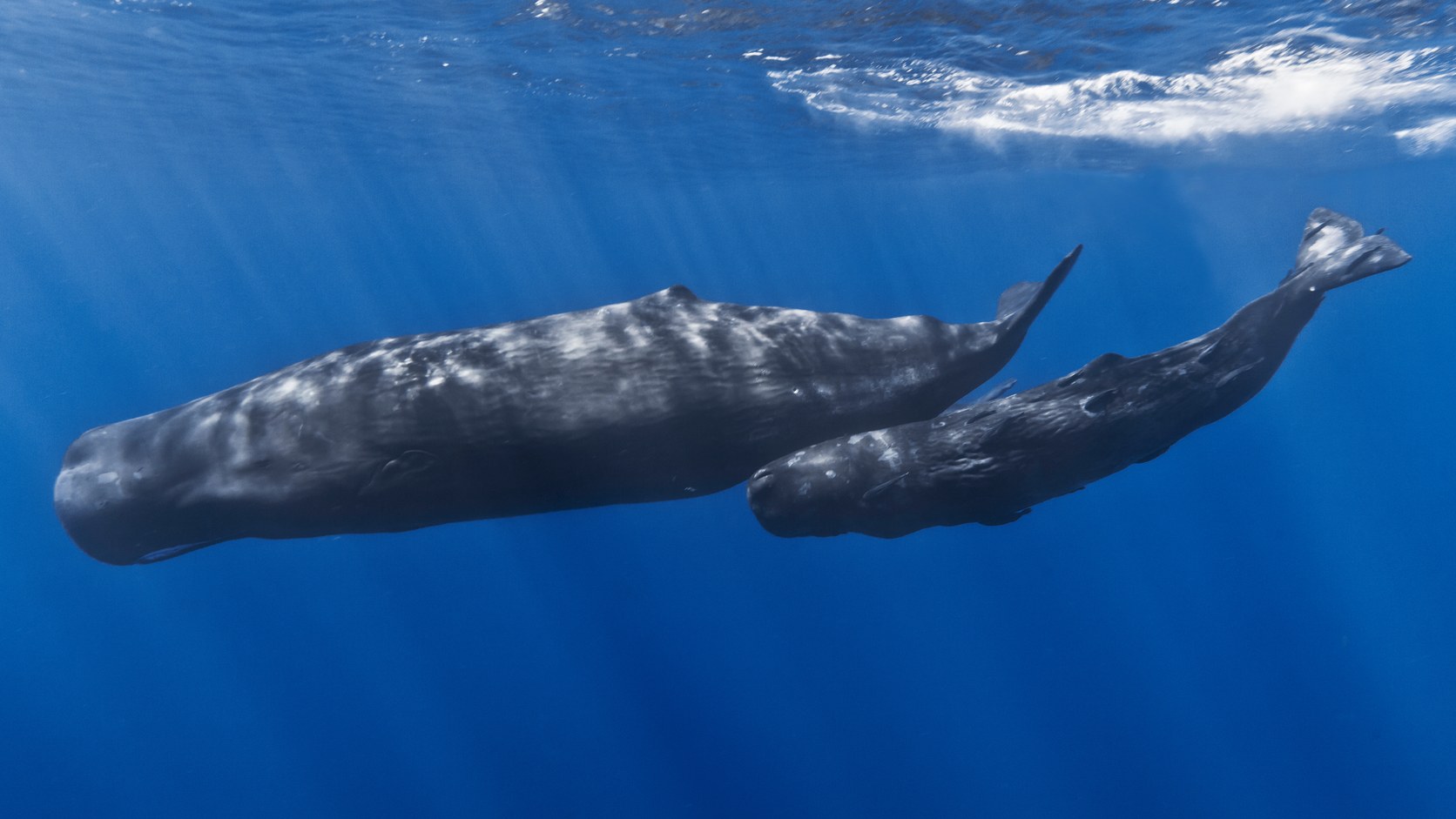
No, Whalefall is not a true story. The 20th Century Studios film, in US theaters from October 16, 2026, adapts Daniel Kraus's 2023 novel about a scuba diver (Austin Abrams) swallowed by a sperm whale with one hour of oxygen left. The biology behind it is real. Whales and dolphins have a row of stomach chambers: the first is a muscular forestomach with no digestive glands, which grinds unchewed food, and the acid-making cells sit in the second, main stomach, according to the 2018 veterinary textbook Pathology of Wildlife and Zoo Animals; a Mount Sinai anatomist counts four chambers in a sperm whale. Squid beaks cannot be digested and are vomited; the rare ones that slip through become ambergris, found in about one whale in 100. No person has been documented swallowed by a sperm whale, the only whale with a throat wide enough, and a humpback that briefly held a Cape Cod diver in its mouth on June 11, 2021 spat him out. Your own stomach runs at a fasting pH of 1.7, holds about 35 millilitres at rest and roughly a litre at a stretch, and still has 24 percent of a test meal two hours in, protected from its own acid by a mucus-bicarbonate layer.
At the London premiere on October 5, at Cineworld Leicester Square, Austin Abrams summed up the summer he spent sitting alone in a slime-covered whale stomach on a sound stage: “I feel like it was the wildest thing I’ve ever done,” he told the Press Association. On Friday, October 16, the stomach comes to US theaters. Whalefall, from 20th Century Studios, follows a diver who goes looking for his late father’s remains off the California coast and is swallowed by “a massive sperm whale,” “with only one hour of oxygen left,” in the studio’s words. The premise is fiction. The organ is not. We read the whale anatomy, the ledgers of what sperm whales eat and the human studies, so you come out knowing what a sperm whale’s stomach would really do, and what yours is doing right now.
The movie: Whalefall (20th Century Studios) opens in US theaters October 16, 2026: a diver swallowed by a sperm whale “with only one hour of oxygen left,” in the studio’s words. Not a true story; the biology is.
The whale: the book says 80 feet and 60 tons; The Hollywood Reporter says 60 feet and 45 tons; real males top out near 52 feet and 45 tons, per NOAA Fisheries.
The stomach: whales and dolphins have a muscular, gland-free first chamber, then a glandular main stomach with the acid-making cells, then connecting chambers (Pathology of Wildlife and Zoo Animals, 2018); a Mount Sinai anatomist counts four chambers in a sperm whale.
The squid: 28,738 cephalopods came out of 17 sperm whale stomachs in a 1993 Azores study; the beaks are vomited, and the few that slip through become ambergris, found in about one whale in 100 (Clarke, 2006).
Has it happened? No documented case. Only a sperm whale has a throat wide enough, the experts say; a humpback briefly held a Cape Cod diver in its mouth on June 11, 2021 and spat him out.
Your stomach: fasting pH 1.7 (Dressman et al., 1990); 35 millilitres at rest (Mudie et al., 2014); about 1.1 litres before discomfort (Geliebter, 1988); 24% of a test meal left after two hours (Tougas et al., 2000).
Sources: 20th Century Studios, the Press Association, The Hollywood Reporter, NOAA Fisheries, Popular Science, PubMed abstracts read October 13, 2026. Educational, not medical advice.
The premise: A diver, a whale, one hour of air, and three months of homework behind it
Daniel Kraus wrote the 2023 novel and co-wrote the screenplay with director Brian Duffield. The idea began with a clip, he told Gizmodo in 2022: “In November 2020, I saw this video of two kayakers who briefly landed in the mouth of a humpback whale.” His friend Mary Roach, author of the digestion book Gulp, had once put the question to a whale scientist; the answer, as Kraus relayed it, “had been yes, provided that it was a large sperm whale.” He then did “about three months of intense interviews with whale scientists and diving experts,” he told NPR’s The Sunday Story. The book’s jacket copy has the diver “pulled into the first of its four stomachs.”
How big is the whale? Kraus’s site calls it “an eighty-foot, sixty-ton sperm whale,” and Wētā Workshop, which did the design, research and practical fabrication for the film’s whale effects, uses the same 80-foot, 60-tonne figure. The Hollywood Reporter’s June preview made it “the colossal 60-foot, 45-ton creature.” The studio settles for “massive.” Real ones, per NOAA Fisheries, run from 40 feet and 15 tons for females to 52 feet and 45 tons for males, so the movie’s whale is a big one even for its species. It is a film about a bad day, not an average one.
The first chamber: A giant muscle, not an acid bath
Whales and dolphins do not have one stomach bag; they have a row of them. The veterinary textbook Pathology of Wildlife and Zoo Animals (2018), in its cetacean chapter by Judy St. Leger, Stephen Raverty and Alexandria Mena, gives the floor plan: stomach anatomy varies by species “but generally consists of a large, usually conical and muscular forestomach with no distinct sphincter at the entry from the esophagus.” That first chamber is nonglandular: no acid, no enzymes. Next comes the main stomach, “a smaller, generally round structure with a deep red-brown folded, glandular mucosa,” lined with the gastric glands whose parietal cells make hydrochloric acid and whose chief cells make pepsin, the protein-cutting enzyme. Then come connecting chambers and a pyloric stomach whose lining, the chapter says, produces “primarily mucus.”
What the first chamber is for is spelled out in a 2022 study of dolphin stomachs in Veterinary Sciences by Barbara Biancani and colleagues: the forestomach “is mainly an enlargement of the esophagus, and it has a muscular and very distensible wall,” and it “is essential for grinding, squeezing and compressing unchewed food.” How many chambers in a sperm whale? Joy Reidenberg, a comparative anatomist at the Icahn School of Medicine at Mount Sinai, told Popular Science in September that a sperm whale’s stomach is divided into four, the first lined with thick, muscular tissue. Kraus’s diver lands in that one: by our reading, a grinding room with no acid in it.
The first chamber of a sperm whale’s stomach is a giant muscle, not an acid bath. The acid waits one door down.
That is the room the filmmakers built. At New York Comic Con on October 9, Laughing Place reported, Duffield described rolling up a yoga mat and sliding a Barbie doll inside to work out the shape, then watching endoscopies and whale autopsies with Wētā Workshop in New Zealand; the result was a 360-degree stomach set that could roll, in which, Duffield told Gold Derby’s panel audience, Abrams “had two months of performing by himself.” “The whale’s heart is beside the stomach, so throughout the movie it is beating and the stomach is reacting to the beats,” Duffield told Empire, as reported by Syfy. In all, the team built six stomachs, an oesophagus and a whale mouth, the Press Association reported.
The squid ledger: Beaks by the thousand, and the perfume that starts in a whale’s gut
What a sperm whale’s stomach does all day is process squid. For a 1993 paper in Philosophical Transactions of the Royal Society B, Malcolm Clarke, Helen Martins and Phil Pascoe examined the stomach contents of 17 sperm whales taken off the Azores between 1981 and 1984: 28,738 cephalopods and 16 fish, a typical squid of 400 to 450 grams, and not one stomach empty. Takehiko Kawakami’s 1980 review of sperm whale food in the Scientific Reports of the Whales Research Institute put a full stomach at under 300 kilograms and recorded a 10.5-metre, 184-kilogram giant squid taken from sperm whale stomachs off the Azores in 1955.
The beaks are the wonder. A squid’s beak is hard chitin and a sperm whale cannot digest it. Robert Clarke, in a 2006 paper in the Latin American Journal of Aquatic Mammals titled The Origin of Ambergris, wrote that indigestible material, “that is, squid beaks and pens,” is “regularly vomited by sperm whales,” because “the intestine and rectum can only deal with liquid faeces.” Now and then some slip through, and faecal matter is “precipitated on the indigestible material to form a smooth concretion” that long incubation among the gut’s bacteria turns into ambergris. It occurs, Clarke wrote, “in about one in 100 sperm whales,” and “the largest find weighed 455kg and sold for” 23,000 pounds in 1914. The base note of the old perfumes began as a squid beak in a whale’s gut.
The throat: Could a sperm whale swallow a person? The experts’ answer, and the Cape Cod case
Every scientist asked gives the same two-part answer: anatomically, only a sperm whale; in practice, no. Phil Clapham, a retired whale biologist, wrote in a 2021 column in the Vashon-Maury Island Beachcomber that when Mary Roach asked him whether a whale could have swallowed Jonah, he told her “the only one with a gullet large enough to accommodate a human being is the sperm whale,” and that survival inside “is exceedingly unlikely”; that explanation, he wrote, made it into her book. Shane Gero, lead biologist of Project CETI, told Popular Science: “To my knowledge, no one has ever been eaten by a sperm whale.” Anatomically, “maybe you could shove a slender human down the throat of a very large, male sperm whale,” but “Would it happen? Very unlikely. Certainly not with scuba gear and a scuba tank making the human that much bigger.” We found no measured width of a sperm whale’s oesophagus in the literature; the figures online are uncited estimates, so we do not print them.
The closest anyone has come involved a different whale. On June 11, 2021, Michael Packard, a 56-year-old lobster diver, was about 45 feet down off Provincetown, Massachusetts, when, as he told WBZ-TV after leaving Cape Cod Hospital, “all of a sudden I felt this huge bump, and everything went dark.” “Then I realized, oh my God, I’m in a whale’s mouth,” he said. The humpback surfaced, shook its head and spat him out after about 30 seconds by his estimate, the Associated Press reported. A humpback’s throat is roughly the size of a human fist and stretches to about 15 inches, National Geographic reported that week, and Nicola Hodgins of Whale and Dolphin Conservation called Packard “engulfed as opposed to swallowed.”
Your stomach: The human version: pH 1.7, 35 millilitres at rest, a litre of room and a two-hour clock
Now the stomach you own: one chamber that does the whale’s first-chamber job and second-chamber job in one room. For a 1990 study in Pharmaceutical Research, Jennifer Dressman and colleagues at the University of Michigan recorded the pH inside the stomachs of young, healthy adults with swallowed radio capsules: in the fasted state the median was 1.7. A meal pushed it briefly to a median peak of 6.7, close to neutral, “then declined gradually back to the fasted state value over a period of less than 2 hr.”
The size is the surprise. The empty stomach of 12 healthy volunteers held 35 millilitres of resting fluid, a couple of tablespoons by our arithmetic, when Deanna Mudie and colleagues measured it by MRI for a 2014 study in Molecular Pharmaceutics; a 240-millilitre glass of water took it to 242, half of that had emptied in 13 minutes, and it was back to baseline in 45. Yet the same organ stretches: for a 1988 study in Physiology & Behavior, Allan Geliebter filled a balloon in the stomachs of four lean adults until they rated the discomfort 10 out of 10, at a mean of 1,100 millilitres. Between the two tablespoons and the litre is a reflex called accommodation, the wall relaxing to make room, the human cousin of the whale’s “very distensible” forestomach.
The clock: for a 2000 multicentre study in the American Journal of Gastroenterology, Gerald Tougas and colleagues fed 123 healthy volunteers a low-fat egg meal tagged with a tracer and scanned them. The median share still in the stomach was 69 percent after one hour, 24 percent after two and 1.2 percent after four; more than 10 percent left at four hours is the study’s line for delayed emptying, a protocol a 2008 consensus of two US societies adopted as the standard test. Our digestion timeline follows the meal from there.
And the question the whale raises applies to you: why does an organ full of acid not digest itself? Because, as Adrian Allen and Gunnar Flemström wrote in a 2005 review in the American Journal of Physiology, the lining secretes bicarbonate, the stuff of baking soda, into a layer of mucus gel stuck to its own surface, creating “a pH gradient with a near-neutral pH at the epithelial surfaces,” “the first line of mucosal protection against luminal acid,” while the mucus is “a barrier to luminal pepsin.” Under normal conditions, they conclude, that is sufficient: acid against living tissue all day, held off by slime and baking-soda chemistry.
The hour: Why a real diver would not get 60 minutes, and why that is the point
A sperm whale’s stomach has no air in it, and the whale does not wait around: NOAA Fisheries says sperm whales hunt “during deep dives that routinely reach depths of 2,000 feet and can last for 45 minutes.” Gero summed up the chambers in four words: “There are acids and gases.” Reidenberg: “Most people, unless they have protection and air, couldn’t survive this situation.” The film gives its diver a tank and an hour. That is the whole premise, and we will not say what he does with it.
What the whale people want you to carry out of the theater is not fear. “This whale is not Jaws,” Kraus told NPR. “The whale in the book is not nefarious. It’s not a man-eater. Whales would never purposely eat a human.” Gero, who has spent his career among sperm whales, told Popular Science: “I’ve never seen any kind of aggression from a sperm whale. These are gentle giants of the deep.”
Facts to carry: Whalefall opens in US theaters on October 16, 2026, with a diver inside a sperm whale and one hour of air; a cetacean’s first stomach chamber is a muscular, gland-free forestomach and the acid-making cells sit in the second (Pathology of Wildlife and Zoo Animals, 2018); squid beaks are vomited, and the rare ones that slip through become ambergris in about one whale in 100; no person has been documented swallowed by a sperm whale; your own stomach runs at a fasting pH of 1.7, holds 35 millilitres at rest and about a litre at a stretch, and still has 24 percent of a test meal two hours in. Nothing here describes any real person’s health. 20th Century Studios, Wētā Workshop, the filmmakers, the actors, Daniel Kraus, the scientists quoted and the outlets named had no involvement in this article. It is educational, describes what the cited studies and sources say, and is not medical advice.