America’s No. 1 Halloween Candy Now Comes in Two Bags. Only One Is in the Aisle
M&M’s is America’s No. 1 Halloween candy again, and since August it has been two bags: the original, with Red 40, Yellow 5, Yellow 6, Blue 1 and Blue 2, and an Amazon-only bag colored with beet juice, turmeric, carotenes and spirulina, with no blue and no brown. We read both labels to the last clause: same serving, same 140 calories, same 17 grams of added sugar; only the color chemistry changes. Then we read the Red 40 gut study everyone quotes, which was in mice.
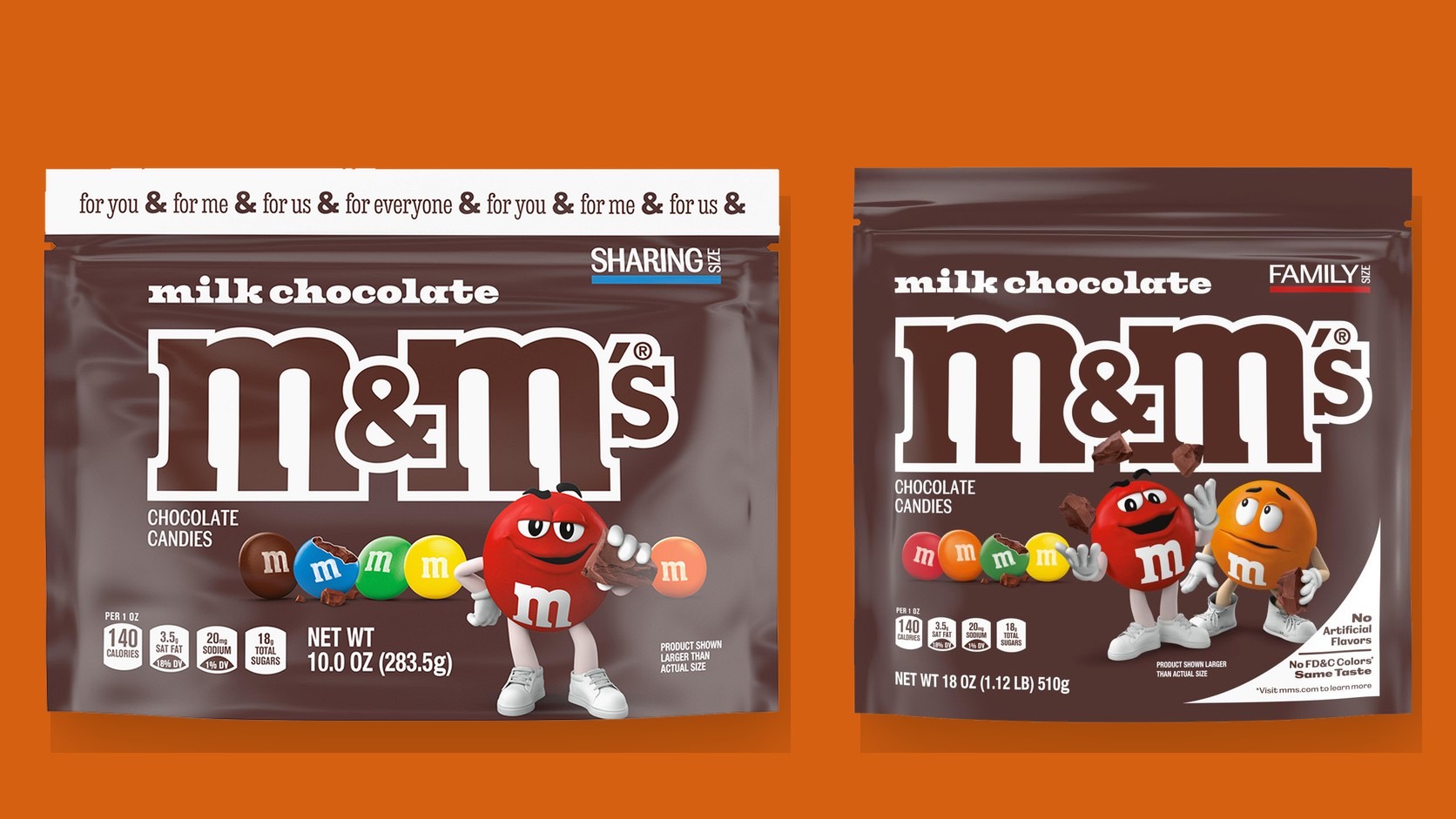
M&M's is the most popular Halloween candy of 2026 by CandyStore.com's projected-pounds ranking, and since August 13, 2026, Milk Chocolate M&M's comes in two bags. The one in stores lists Red 40, Yellow 5, Yellow 6, Blue 1 and Blue 2 (plus their lakes). The "No FD&C Colors" bag, sold on Amazon, lists "colors added," which the listing names as beet juice concentrate, beta-apo-8'-carotenal, beta-carotene, calcium carbonate, spirulina extract and turmeric oleoresin; it has no blue or brown pieces, which Mars aims to add by 2028. Both panels read 140 calories, 18 g sugars with 17 g added (34% DV) per 1 oz. The Red 40 gut study (Nature Communications, 2022) was in mice; its once-a-week mice did not become more susceptible to colitis. The FDA still authorizes Red 40.

The Halloween aisle is up, and the bag at the end of it looks like it has since 1941: brown, with the red one grinning. This week CandyStore.com published its 2026 ranking and M&M’s is America’s No. 1 Halloween candy again. What the aisle does not say is that since August there have been two bags of Milk Chocolate M&M’s. One lists Red 40, Yellow 5, Yellow 6, Blue 1 and Blue 2. The other is colored with beet juice, turmeric, carotenes and spirulina, has no blue and no brown, and is sold on Amazon. We read both labels, then the one gut study, in mice, that gets quoted every time Red 40 comes up.
Google already finishes the sentence: dye free m&ms where to buy, dye free m&ms amazon, m&ms without red 40, is red 40 bad for you, m&ms ingredients list. So: both panels side by side, where each bag is, and what the research measured.
The ranking: No. 1 by the pound, and how that was counted
CandyStore.com’s page, updated September 30, has M&M’s holding the top spot from its last ranking in 2024. Sour Patch Kids climbs to No. 2 and ties M&M’s for the most states won, ten each; Skittles is No. 3; NERDS Gummy Clusters enters at No. 5. It is measured in pounds, from Halloween-season sales in every state from 2008 through 2025, its own bulk orders plus data from major manufacturers and distributors, projected forward, recent seasons weighted more. The page says: “It is not a count of 2026 sales.” NBC Philadelphia carried the list on Thursday. From the National Retail Federation’s September survey: $13.5 billion on Halloween this year, $4.1 billion of it candy.
The second bag: What Mars said, and when
The second bag was announced in a Mars statement dated July 24, 2025: four products without FD&C colors in 2026, “available on Amazon in the summer of 2026,” and a promise: “M&M’S will continue to have red, yellow, orange, green, blue and brown.” On August 13, 2026, ABC News reported the new bags on Amazon from that Thursday and named the color sources: beet juice for red, turmeric for yellow, turmeric with beet juice and spirulina for green, beta-carotene and carotenals for orange. Mars’s August statement, as carried by the trade press, describes the M&M’s as “a blend of Red, Orange, Green and Yellow,” says the initial bag “will not include Blue and Brown,” and says the originals “will still be available.”
Blue is the holdout. Mars’s Claire Hewitt told ABC: “Blue is the challenge because there aren’t very many blue vegetables.” Fox Business, citing The Wall Street Journal, reported in June that Mars aims for all six colors by 2028 and that a red, orange and yellow mix was rejected because, as the Journal put it, “the sunset vibes were too strong.” The FDA’s own tracker of company pledges, current to September 15, lists the Mars entry as “Complete.”
The labels: Two ingredient lists, read to the last clause
The original is on mms.com’s own product page for the Sharing Size bag: milk chocolate (sugar, chocolate, skim milk, cocoa butter, lactose, milkfat, soy lecithin, salt, natural flavor), sugar, cornstarch, then less than 1 percent of corn syrup, dextrin, “colors (includes blue 1 lake, yellow 6, red 40, yellow 5, blue 1, yellow 6 lake, red 40 lake, yellow 5 lake, blue 2 lake, blue 2),” carnauba wax and gum acacia. The dye-free bag’s ingredient statement, photographed on the Amazon listing, is the same list word for word until that clause, which now reads “less than 2% of: corn syrup, dextrin, colors added, carnauba wax, gum acacia.” The six sources, beet juice concentrate, beta-apo-8’-carotenal, beta-carotene, calcium carbonate, spirulina extract and turmeric oleoresin, are named in the listing’s copy and photo gallery, not on the ingredient statement. That is our reading of the listing.
The Nutrition Facts are the same panel twice. Both bags: a 1-ounce serving of about 32 pieces, 140 calories, 5 grams of fat with 3.5 saturated, 20 milligrams of sodium, 21 grams of carbohydrate, under a gram of fiber, 18 grams of sugars of which 17 are added, 34 percent of the Daily Value, 1 gram of protein. The only digit that moves is iron, 0.5 milligrams on the original and 0.4 on the new bag. The stake is narrow: the swap changes what makes the shell red and green, not the sugar, the fat or the calories, and it adds none of the fiber our Halloween candy fiber ranking found M&M’s short of. A handful is a third of a day’s added sugar in either bag.
| Line on the label | Original bag | No FD&C Colors bag |
|---|---|---|
| Colors | Red 40, Yellow 5, Yellow 6, Blue 1, Blue 2 and their lakes | “Colors added”: beet juice, carotenes, spirulina, turmeric, calcium carbonate |
| Everything else on the list | Identical | Identical |
| Per 1 oz (32 pieces) | 140 cal, 18 g sugars, 17 g added | 140 cal, 18 g sugars, 17 g added |
| Iron | 0.5 mg | 0.4 mg |
| Colors in the bag | Red, orange, yellow, green, blue, brown | Red, orange, yellow, green |
| Where it is sold | Stores and online | Amazon only (\$9.49 for 18 oz on October 9) |
Where each bag is: the original is the one in the aisle, and mms.com’s own shop lists only the six-color blends. Mars has named one outlet, Amazon, where the listing on October 9 showed an 18-ounce family bag at $9.49, or two for $18.98, shipped and sold by Amazon.com. We found no store listing and Mars has announced none. One small thing: the original’s green is Yellow 5 plus Blue 1 and the new bag’s is turmeric, beet and spirulina, and food color of any kind is an ordinary reason for a green poop the morning after.
The science: What the Red 40 gut study found, in mice
The study behind every “Red 40 and your gut” video is a December 2022 paper in Nature Communications from McMaster University, and it is a study in mice; the title says so. The design, in mice: the animals were given Allura Red AC, the chemical name for Red 40, for 12 weeks at a dose the authors describe as found in commonly consumed dietary products, then challenged with chemicals that induce colitis. In mice fed the dye daily, the colitis was worse, colonic serotonin rose, the gut barrier was weaker and the microbiome shifted; transferring that microbiome into germ-free mice made their colitis worse too. In mice lacking the enzyme that makes gut serotonin, the dye changed nothing.
Two details rarely make the video: the authors also fed the dye once a week for 12 weeks, which they call “more akin to a typical human exposure,” and in mice on that schedule it did not influence susceptibility to colitis. Exposure in early life, in mice, did prime them for worse colitis later. The abstract closes with the line that should travel with any finding in mice: “it remains unknown whether AR has similar effects in humans.” McMaster’s press release on the work in mice called the dye a “possible dietary trigger” for inflammatory bowel disease and left the word mice out of its headline. A 2023 author correction fixed one sentence about barrier genes; the main findings in mice stand.
In mice, the once-a-week dose, the arm the authors call closest to how people actually eat, did not make colitis more likely.
The FDA: Red 3 is out, Red 40 is still authorized
From the FDA’s own pages: on January 15, 2025, the agency revoked Red No. 3, a dye in neither M&M’s bag, under the Delaney Clause, because it caused cancer in male rats by a mechanism the FDA says does not occur in humans; food makers have until January 15, 2027. On April 22, 2025, HHS and the FDA announced a plan to phase out all petroleum-based dyes: begin revoking Citrus Red 2 and Orange B, and work “with industry” to remove the six remaining ones, Green 3, Red 40, Yellow 5, Yellow 6, Blue 1 and Blue 2, “by the end of next year.” Since then: on July 22, 2026, the FDA issued a final order revoking Orange B and proposed revoking Citrus Red 2. Red 40 and the other five remain authorized; the phase-out is voluntary, tracked on the pledge page above.
That gap is why dyes turned up in Thursday’s NBC News story about a MAHA scorecard. The activists’ card says the administration broke more than 85 percent of its food and environment promises; NBC lists the dye item among those counted as partially kept, noting the FDA “asked food companies to voluntarily phase out certain dyes and banned two others that were not widely used.” A White House spokeswoman said the administration is “axing artificial ingredients in our food supply”; an HHS spokesperson said the secretary’s reforms are “grounded in science, transparency, and accountability.” For a bag of candy: dye-free M&M’s exist because Mars chose to make them, not because the law changed.
Facts to carry into the aisle: M&M’s is No. 1 by projected pounds; the bag in stores lists Red 40, Yellow 5, Yellow 6, Blue 1 and Blue 2; the Amazon-only bag lists “colors added” from beet, turmeric, carotenes and spirulina; both bags are 140 calories and 17 grams of added sugar an ounce; the Red 40 gut study was in mice, and its once-a-week mice were fine; the FDA has not banned Red 40. The other Halloween label worth a minute is the sugar-free kind, which has a medical paper named after it. Mars, Amazon, CandyStore.com, Mondelēz International, The Hershey Company, Ferrara and McMaster University had no involvement in this article. It is educational, describes what the cited labels, statements, FDA pages and study say, and is not medical advice.