Probiotic Pills Are Up 287% Among Adults and 786% Among Under-20s Since 2009. Fiber Intake Barely Moved
Six University of Michigan gastroenterologists put the national nutrition survey’s supplement question next to its food diary for the first time. Fourteen years of data say Americans got four to nine times more likely to take a probiotic while eating no more fiber — still about half the density the old guidelines asked for, and the new guidelines no longer ask for a number at all.
A research letter in Clinical Gastroenterology and Hepatology (online September 7, 2026; University of Michigan; NHANES 2009 to 2023, seven cycles, 62,700 supplement respondents and 54,776 dietary respondents) reports that probiotic supplement use rose from 1.8 percent to 6.96 percent among adults (+287 percent) and from 0.63 percent to 5.58 percent among people under 20 (+786 percent), stable through 2013-2014 and then rising sharply across all groups, while dietary fiber density barely changed: adults fell from 8.52 to 8.26 grams per 1,000 calories and under-20s rose from 7.37 to 7.97, all far below the 14 g per 1,000 kcal benchmark of the 2020-2025 Dietary Guidelines; intake of foods high in live microbes rose a statistically real but practically nil 0.001 points a year. Probiotic users ate slightly more fiber than non-users (1.12 g per 1,000 kcal after adjustment), so the survey cannot prove people swapped plants for pills, only that the country got far more likely to take the pill while no more likely to eat the plant. The 2025-2030 Dietary Guidelines contain no fiber target; the NIDDK still advises 22 to 34 grams a day. The AGA's 2020 guideline recommends probiotics for IBS, Crohn's, ulcerative colitis and C. difficile treatment only in clinical trials and against them for children with acute gastroenteritis, and a June 2026 Nature Microbiology survey of 352 pharmacy products found 36 species under 70 brands with no clear link between species and marketed benefit. By contrast, fiber relieved constipation in 66 versus 41 percent of trial participants (RR 1.48, best above 10 g a day for four weeks) and improved IBS symptoms in 52 versus 44 percent (psyllium RR 1.53). The study is cross-sectional and self-reported with no health outcomes measured. Educational, not medical advice.

Somewhere around 2014, Americans decided their gut bacteria needed help, and they chose the aisle rather than the produce section. That is the finding of a research letter from six University of Michigan gastroenterologists, published online in Clinical Gastroenterology and Hepatology on Sunday, that put the national nutrition survey’s supplement questions next to its food diary for the first time. Between the 2009–2010 survey and the 2021–2023 one, the share of adults taking a probiotic supplement went from 1.8 percent to 6.96 percent, an increase of 287 percent; among people under 20 it went from 0.63 percent to 5.58 percent, an increase of 786 percent. Over the same fourteen years, the amount of fiber in the American diet, the one dietary input with the deepest evidence for gut bacteria, did not meaningfully change, and in adults it edged down.
“We have known that probiotic supplement use is increasing across all ages, but this is the first time we have looked closely at it in relation to other microbiome-focused health behaviors,” lead author Kira L. Newman, a clinical assistant professor of internal medicine, said in the university’s release. “Dietary fiber and fresh produce have well-established health benefits for the gut microbiome. However, our findings suggest that people are not making changes to what they eat, even though an increasing number are concerned enough about their microbiome to take a probiotic supplement.” It is a small paper with a large implication, and it is worth reading precisely, because the precise version is both more and less damning than the headline.
What was measured: A 30-day pill question and a 24-hour food diary, 62,700 people at a time
| 2009–2010 | 2021–2023 | Change | |
|---|---|---|---|
| Probiotic supplement use, adults 20+ | 1.8% | 6.96% | +287% |
| Probiotic supplement use, under 20 | 0.63% | 5.58% | +786% |
| Fiber density, adults | 8.52 g per 1,000 kcal | 8.26 g per 1,000 kcal | Down slightly (P = .009) |
| Fiber density, under 20 | 7.37 g per 1,000 kcal | 7.97 g per 1,000 kcal | Up slightly (P = .0166) |
| Benchmark used | 14 g per 1,000 kcal (2020–2025 Dietary Guidelines); no group came close | ||
| Live-microbe food score | +0.001 point per year on a 3-point scale | ||
The National Health and Nutrition Examination Survey asks a representative sample of Americans, every two years, what supplements they took in the last 30 days and what they ate in the last 24 hours. The Michigan team pulled seven cycles, from 2009–2010 through the cycle that ran from August 2021 to August 2023, and as Patient Care Online summarised the paper, identified probiotics “by searching reported supplement ingredients for probiotic bacteria and related terms.” That gave 62,700 respondents standing in for roughly 243 million people, of whom 50.2 percent took at least one supplement and 3.8 percent took a probiotic across the whole period; use “remained relatively stable through 2013–2014 before rising sharply across age and demographic groups.” On the food side, 54,776 respondents had a usable diary, and every food was scored low, medium or high for live microbes by its estimated colony-forming units per gram, the category that captures yogurt, kefir, kimchi and raw produce. About 26 percent had eaten at least one high-microbe food the previous day; 31 percent had eaten only low-microbe foods.
The fiber measure needs one sentence of translation, because it is not the number on a cereal box. The paper reports fiber density, grams per 1,000 calories, which is how the 2020–2025 Dietary Guidelines set the target: 14 grams for every 1,000 calories eaten, so 28 grams on a 2,000-calorie day. Adults in the survey went from 8.52 to 8.26 grams per 1,000 calories, a small decline that reached statistical significance; people under 20 went from 7.37 to 7.97, a small rise. Neither group came within a third of the benchmark at any point. In the adjusted model, fiber density fell by 0.05 grams per 1,000 calories a year, and the live-microbe food score rose by 0.001 points a year on a three-point scale, a change the authors treat as statistically real and practically nil. In grams, USDA’s latest intake tables put the average American adult at 16.3 grams of fiber a day, and everyone aged two and up at 15.9; USDA’s economists calculated the 2017–2018 diet at 8.1 grams per 1,000 calories, or 58 percent of the recommendation. The country has been at roughly half the target for as long as the target has existed, and the probiotic boom happened on top of that, not instead of it.
The substitution question: The pill-takers eat slightly better, which makes the picture stranger, not simpler
The obvious reading — people bought a capsule instead of eating a vegetable — is the one the data cannot quite support, and the authors are careful about it. Probiotic users in the survey ate more fiber than non-users, 1.35 grams per 1,000 calories more, narrowing to 1.12 grams after adjusting for age, sex, race and household income, and they ate more high-microbe foods too. That is the profile of someone who cares about their gut across the board, not someone trading one thing for another. What the paper flags is the trend inside that group: the release notes “these beneficial diet habits may be decreasing, even among probiotic users, as supplements are potentially used as a substitute for higher-quality diets.” A survey that photographs a different set of people every two years cannot prove substitution in any one of them; it can show that the country got four to nine times more likely to take the pill while getting no more likely to eat the plant, and that is what it shows.
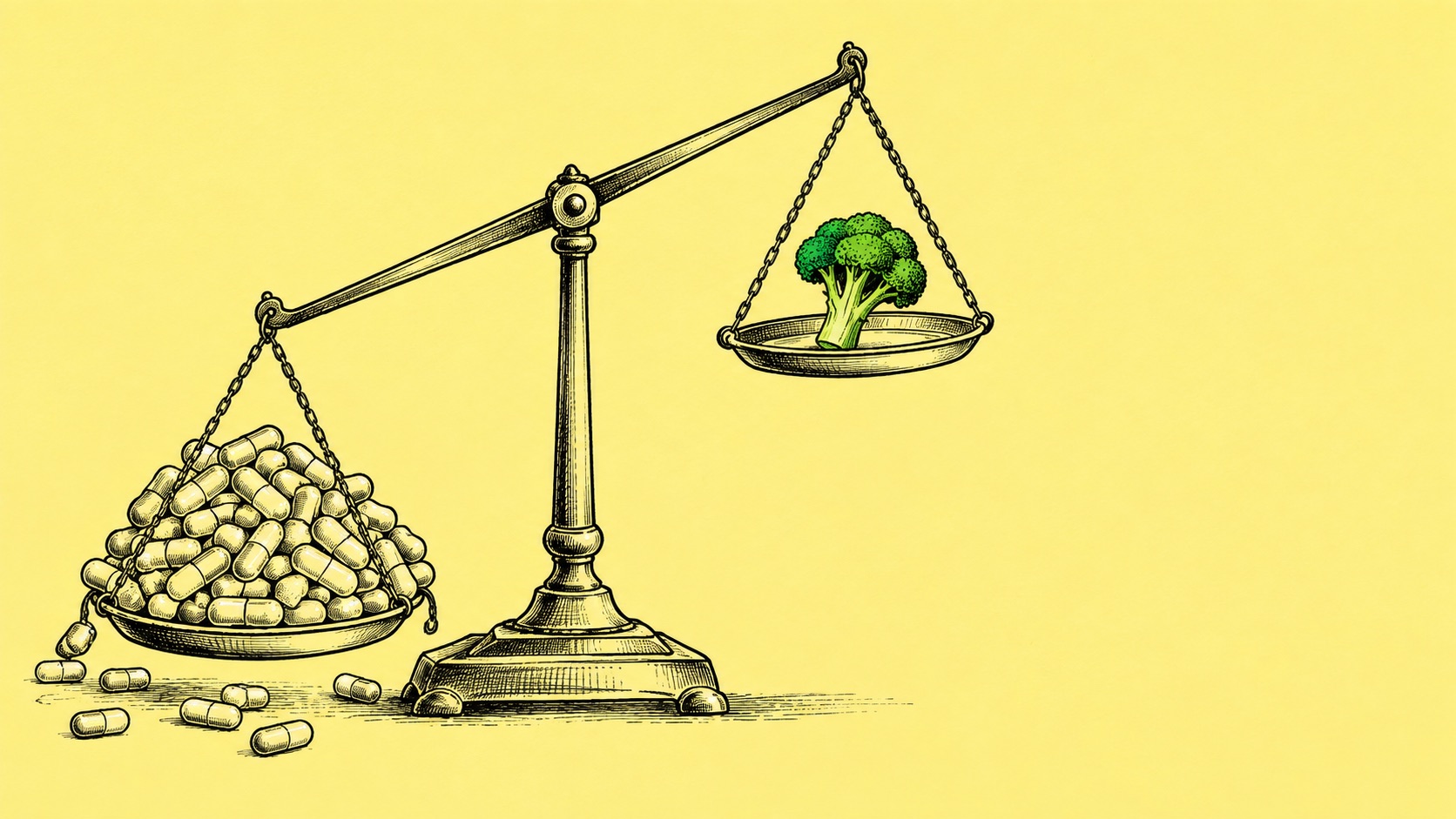
Adults are almost four times as likely to take a probiotic as in 2009, and people under 20 almost nine times. The fiber in their diets is still at roughly half the recommended density.
The benchmark itself has, meanwhile, gone missing. The 2025–2030 Dietary Guidelines, a ten-page document, mention fiber twice: a bullet to prioritise fiber-rich whole grains, and a “Gut Health” box saying that vegetables, fruits, fermented foods such as sauerkraut, kimchi, kefir and miso, and high-fiber foods support a diverse microbiome. There is no gram target and no grams-per-1,000-calorie target anywhere in it; the 14-gram standard the Michigan paper measured against is the previous edition’s. If you want a personal number, our calculator still uses the density approach the old guidelines did, scaled to your own calorie needs, and the National Institute of Diabetes and Digestive and Kidney Diseases still puts adults at 22 to 34 grams a day depending on age and sex.
What the guidelines say about the pill: The specialists’ own verdict, and 352 products in three pharmacies
The release’s line that use rose “despite official guidelines suggesting limited benefits” refers to the American Gastroenterological Association’s 2020 guideline, written by a panel that includes gastroenterologists like the paper’s authors, and it is more specific than “limited.” For irritable bowel syndrome, Crohn’s disease, ulcerative colitis and the treatment of C. difficile infection, it recommends probiotics “only in the context of a clinical trial”: not against them, but no recommendation, because the evidence was not there. For children with acute infectious gastroenteritis, it suggests against them. It recommends specific strains, conditionally, in three narrow settings: preventing C. difficile during antibiotics, pouchitis after colectomy, and preterm low-birth-weight infants. The guideline also noted that the industry is “largely unregulated” and that 3.9 million American adults were using pro- or prebiotics in 2015, four times the 2007 figure; the Michigan paper is, in effect, that sentence extended eight years, into a US probiotic supplement market that Grand View Research sized at $2.52 billion in 2024.
What is actually in the bottles is its own study. In June, University of Virginia researchers catalogued 352 unique probiotic products from the shelves of CVS, Walgreens and Walmart for a paper in Nature Microbiology: 36 species across 70 brand names, more than half of the products containing a single species, and two of them, Lactobacillus rhamnosus and L. acidophilus, in 46 percent of everything sold. The researchers found no clear link between which species a product contained and the benefit its label marketed. That is a label survey, not a lab test, and it says nothing about whether any given product works; it says that the category people are buying four to nine times as often is, from the outside, mostly the same two organisms under seventy names. We have read the trials behind the best-marketed capsule, a liquid, the strains tested for mood, and this week a gummy and a soda carrying the same spore; the pattern, every time, is real but small trials at doses the products rarely disclose.
What fiber has that the capsule does not: The trials that would make a supplement famous
Set the two evidence bases side by side and the asymmetry is the story. For constipation, a 2022 meta-analysis of 16 randomised trials in 1,251 people found that fiber supplements produced a response in 66 percent of people against 41 percent on control, a risk ratio of 1.48, with the best results from psyllium and pectin at more than 10 grams a day for at least four weeks, and with more flatulence as the honest cost. For IBS, a review published in Gastroenterology last month pooled 30 trials in 1,904 people and found fiber improved symptoms in 52 percent against 44 percent, with psyllium specifically at a risk ratio of 1.53. Those are modest effects with confidence intervals, from independent investigators, on the outcome patients care about, in the conditions the AGA could not recommend a probiotic for. And they are effects of one nutrient, which is the point Newman makes about supplements generally: “A diet with plenty of vegetables, fruits, legumes, and whole grains provides not just fiber, but also a wealth of other beneficial vitamins, minerals and plant-derived compounds. This helps support a diverse range of beneficial gut microbes. Prebiotic supplements alone do not contain the same variety or richness. It’s like picking one color out of a rainbow.”
The paper has the limits of its design and states them: it is cross-sectional, so it cannot follow one person from the produce aisle to the supplement aisle; supplement use is self-reported; a single day’s food diary is noisy; survey response rates have fallen; and no health outcome was measured, so nothing here says the probiotic-takers are worse off. What it measures is a national habit, and the habit is clear. If you are adding fiber, the constipation trials say the dose that works is more than 10 grams a day for a month, added gradually, with water, per the NIDDK; which fiber matters less than getting there. If you are taking a probiotic, the honest question is the one the AGA asked: for which condition, which strain, and in which trial. The rise in the first number and the flatness of the second suggest most people have not asked it. This article is educational, describes the cited studies, and is not medical advice.