Culture Pop’s New Sparkling Apple Reads 12 g Sugar, 0 g Added. Both Are True. The Number the Can Never Prints Is the Probiotic Count
The Nantucket Nectars founder’s probiotic soda put out a fall apple flavour on Monday, sweetened with nothing but apple juice and carrying the same Bacillus subtilis strain as the Lemme gummy. The label is honest and the arithmetic is worth doing anyway: how 12 grams of sugar reads as zero added, and why the one number that would settle the probiotic question is not on the can.
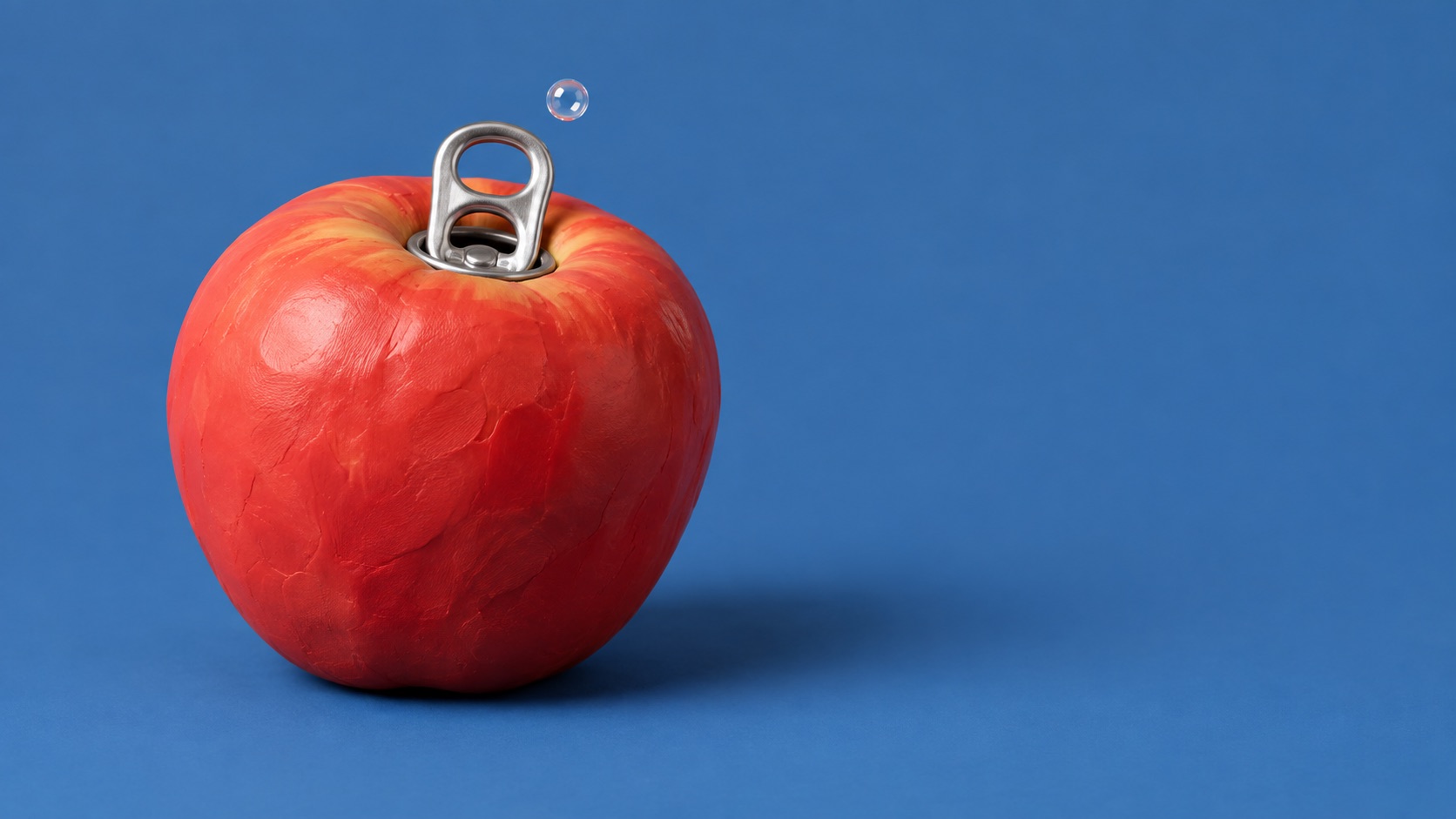
Culture Pop Sparkling Apple, launched September 8, 2026 as a limited edition at $29.99 per twelve, is a 12-ounce, 50-calorie probiotic soda with 12 grams of total sugars and 0 grams of added sugars, sweetened only with organic apple juice concentrate, flavoured with cinnamon and clove, and carrying Bacillus subtilis DE111. Both sugar numbers are correct: under 21 CFR 101.9, sugar from juice concentrate counts as "added" only in excess of what the same volume of 100 percent juice would contain, and a can of straight apple juice would carry roughly 40 grams, so the 12 grams are labelled natural even though the body meets them as sugar; the can is not making a health claim, the label category is a legal one. Apple sugar is fructose-heavy (5.73 g fructose to 2.63 g glucose per 100 g of juice, USDA) with about 0.5 percent sorbitol, which is why apple juice is a fructose-malabsorption trigger for a minority; prorated to this can that is roughly 7 grams of fructose, within most adults' absorption range. The probiotic count is not published: the brand says only "billions of CFUs of live probiotics at the time of canning," with no end-of-shelf-life figure; the strain's supplier, ADM, bases label claims on a minimum of 1 billion CFU at end of shelf life, but that is the supplier's floor, not a Culture Pop disclosure. DE111's human trials are small and almost all authored or funded by its maker: the one bowel-habit trial (50 adults, 1 billion CFU for 90 days) is not on PubMed and reports no p-values; ileostomy studies at 5 billion CFU showed the spores germinate in the small intestine within three hours with "limited detectable effect on the microbiome"; a four-week pilot found perceived gut health "largely unaffected." No independent trial has tested the strain on bloating, and none in a soda. Educational, not medical advice.

Part of our tracker: Prebiotic sodas →
Tom First co-founded Nantucket Nectars in a Cape Cod boat-supply store in 1989, sold it to Cadbury Schweppes, and in 2020 started Culture Pop Soda, a juice-sweetened probiotic soda that the company says is on track to pass $25 million in sales this year. On Monday it released its first fall flavour, a limited-edition Sparkling Apple in a gold can, with cinnamon and clove — “a hint of chai,” the product page says — at $29.99 for twelve online and on shelves at Albertsons, Wegmans, H-E-B, Giant, Stop & Shop and the rest of the supermarket list. In First’s words, “it’s somewhere between a crisp apple and a sparkling cider: refreshing, not too sweet and full of apple flavor. I think fall officially starts the minute you open a Culture Pop Sparkling Apple.”
It is a good can with an unusually honest ingredient list, and it makes two claims that deserve a closer read than a fall launch usually gets. The label says 12 grams of sugar and 0 grams of added sugar, which sounds like a contradiction and is not; the rule that makes both true is worth knowing for every juice-sweetened drink on the shelf. And the can promises live probiotics without ever saying how many, from a strain, Bacillus subtilis DE111, that we have already met this week in a Kardashian gummy. The two questions are the same question: what, exactly, is in the can, in numbers.
The label: Twelve grams of sugar, zero added, and why the rule says so
| Culture Pop Sparkling Apple | Olipop Caramel Apple | Poppi Sour Apple | |
|---|---|---|---|
| Type | Probiotic (Bacillus subtilis DE111) | Prebiotic fiber | Prebiotic fiber |
| Calories | 50 | 50 | 35 |
| Total sugars | 12 g | 5 g | 5 g |
| Added sugars | 0 g | 1 g | 3 g |
| Fiber | Not listed | 9 g | 3 g |
| Sugar source | Organic apple juice concentrate only | 9% juice; 1 g added | Organic cane sugar (second ingredient); 3 g added |
| Live cultures | “Billions of CFUs … at the time of canning”; no count | None claimed | None claimed |
| Storage | Shelf-stable | “Keep refrigerated” | Shelf-stable |
| Price | $29.99 per 12 (brand site) | $35.99 per 12 (brand site) | Limited edition |
The Sparkling Apple panel reads: 50 calories, 12 grams of carbohydrate, 12 grams of total sugars, 0 grams of added sugars, 5 milligrams of sodium, no protein, and no fiber line at all. Ingredients: carbonated filtered water, organic apple juice concentrate, natural flavors, malic acid, organic cinnamon, organic clove, live probiotic (Bacillus subtilis). That is the whole list. The launch release is explicit that there is “no stevia, no refined sugar and no artificial or high-intensity sweeteners”; every gram of sweetness is apple. It is also the sweetest can the brand makes: Orange Mango & Lime, a core flavour, is 45 calories and 8 grams of sugar.
So how does 12 grams of sugar become zero added? Because of a definition. FDA’s labelling rule counts as added sugars “sugars from concentrated fruit or vegetable juices that are in excess of what would be expected from the same volume of 100 percent fruit or vegetable juice of the same type” — and only those. Concentrate that is diluted back to no more than the strength of ordinary juice is treated, for the label, like juice, and FDA’s consumer page says added sugars “do not include naturally occurring sugars that are found in milk, fruits, and vegetables.” The arithmetic checks out. USDA’s reference apple juice carries about 11 grams of sugar per 100 grams, so a 12-ounce can of straight apple juice would hold roughly 40 grams of sugar and 165 calories; this can holds 12 and 50, about the sugar of a can that is three-tenths juice by strength and the rest water and bubbles. Nothing about that is deceptive. It is just that the word “added” is doing legal work, not biological work: your gut does not read the label, and the 12 grams arrive as sugar.
For scale, the American Heart Association puts the daily ceiling on added sugar at 25 grams for women and 36 for men. Culture Pop’s 12 grams do not count toward that number, by definition, but if you counted them the way your body does, one can is half a woman’s daily allowance. A can of ordinary cola is around 39 grams; Olipop’s apple, which we read last week, is 5 grams of sugar and 9 grams of fiber. Different products solving different problems: Olipop is engineering the sugar out and the fiber in, Culture Pop is refusing to engineer at all, and the trade-off is on the label.
The apple part: Fructose, sorbitol and who notices
Apple sugar is not an even mix. Per 100 grams, USDA lists apple juice at 5.73 grams of fructose, 2.63 of glucose and 1.26 of sucrose — more than twice as much fructose as glucose. That ratio is the reason apples and apple juice sit on the high-FODMAP list; Monash University’s guidance is that “consuming foods that are high in fructose but low in glucose (for example, honey, apples and high-fructose corn syrups) can cause fructose malabsorption,” because glucose is what helps the gut absorb fructose. The classic breath-test study in ten healthy adults found the capacity to absorb fructose on its own “ranges from less than 5 g to more than 50 g,” with one person malabsorbing at 15 grams and all but two at 50. Apple juice also carries sorbitol, a sugar alcohol the small intestine handles badly; a 1988 Pediatrics study put it at about 0.5 percent of the juice and found excess breath hydrogen, the marker of malabsorption, “in approximately 50% of those ingesting apple juice.” Those were children drinking full-strength juice.
Twelve grams of sugar, zero added: both numbers are true, and the word doing the work is a legal one. The number the can never prints is the probiotic count.
Prorate that to this can and the picture is modest: roughly 7 grams of fructose, 3 of glucose and well under a gram of sorbitol in 12 ounces, which is within the absorption range of most adults and a plausible trigger for the minority whose threshold sits low or who have IBS. If apple juice or cider has ever given you the familiar afternoon bloat, this can is the same sugar at about a third of the strength, plus carbonation. If it has not, the sugar in this can is the least interesting thing in it.
The probiotic part: The same strain as the gummy, and the count the can does not print
The live culture is “Deerland’s DE111 probiotic strain called Bacillus subtilis,” per the brand’s FAQ, which says the strain “has been shown to support gastrointestinal health and to help reduce gas and bloating.” B. subtilis is a spore-former, which is the whole reason it can live in a shelf-stable soda: the FAQ says “our probiotic remains viable under a wide temperature and pH range, via stability testing,” the soda “is not fermented,” and it needs no refrigeration. That much is engineering fact and it distinguishes Culture Pop from kombucha, which is fermented, and from the prebiotic sodas, which contain no bacteria at all. The count is where the label goes quiet. The FAQ says each can “contains 45 – 50 calories and billions of CFUs of live probiotics at the time of canning,” and that is the only number, on the can, the site, or the release: a plural, measured at the moment the can was sealed, with nothing said about the end of a shelf life the brand describes as long.
The supplier is more specific, in a document written for manufacturers rather than drinkers. ADM’s DE111 food-and-beverage sheet says “label claims are based on a minimum of 1 billion CFU at the end of shelf-life,” and its supplement sheet says the spores “remain stable over 24 months at 25°C.” That is the supplier’s floor for anyone using its strain, not a disclosure by Culture Pop, and the two are not the same thing; the brand may well exceed it, and does not say. FDA’s file on the strain, a 2019 “generally recognized as safe” notice, contemplates foods delivering “at least 1 × 10⁶ CFU/serving and no more than 1 × 10¹⁰ CFU/serving throughout the shelf-life,” a range that spans four orders of magnitude, which is exactly why a number on the can would matter.
Then the evidence, which for DE111 is real, small and almost entirely the maker’s. The only trial of bowel habit is a 2017 study by five Deerland scientists: 50 adults with “occasional gastrointestinal irregularity,” one capsule of 1 billion CFU or placebo a day for 90 days, stools self-rated on the Bristol chart; the authors concluded the dose “may improve occasional constipation and diarrhea.” It appeared in a journal not indexed on PubMed, reports no p-values, and its registry entry has no results posted. The germination work is better: an ileostomy study in 11 people, partly Deerland-funded and with four Deerland employees as authors, showed DE111 spores “germinate in the small intestine of humans within 3 h of ingestion” — at 5 billion CFU, five times the dose the bowel trial used — and the follow-up analysis of the same samples found ingestion “had limited detectable effect on the microbiome, with the main change being its increased presence.” The trials that asked people how their gut felt were quiet: a four-week pilot, Deerland-funded, found “overall perceived gastrointestinal health, microbiota, and circulating and fecal markers of inflammation” were “largely unaffected by DE111”; an eight-week study in day-care children found “no significant changes of the overall microbiome equilibrium”; twelve weeks in college baseball players found “no effect on body composition, performance, hormonal status, or gut permeability.” The one trial reporting fewer loose stools used a cocktail of several Bacillus strains, not DE111 alone. No independently funded trial has tested the strain on bloating or gas at any dose, and none has tested it in a soda.
View this post on Instagram
The bottom line: A clean can, a real strain, and one line the label could add
Culture Pop Sparkling Apple is a 50-calorie apple soda sweetened with nothing but apple, carrying a genuine, spore-forming, shelf-stable probiotic strain that has been shown to survive the stomach and wake up in the small intestine. Those are both real things and neither is common in a soda aisle full of stevia and cane sugar. What the can does not tell you is how much sugar your body will treat as sugar (12 grams, the label’s zero notwithstanding) and how many of the bacteria are alive when you drink it (the brand says billions at canning and nothing after). The second is the easier fix, and it is one line: a CFU count at end of shelf life, the way supplements print it. Until then, the honest expectation is a pleasant, lightly sweet apple soda whose probiotic is a plausible passenger rather than a proven effect; the trials that would tell you more are the maker’s, small, and mostly find nothing changing. If you drink it for the apple, you are drinking it for the right reason. Culture Pop had no involvement in this article, which is educational, describes the cited label and studies, and is not medical advice.