How Doughlicious Went Gluten-Free After an Unexpected Discovery
Kathryn Bricken started Doughlicious with an ice-cream scoop in her garage. She built the dough on oats for their fiber, then found out her oats were gluten-free. Here is what that means for anyone with celiac disease, and how she got here.
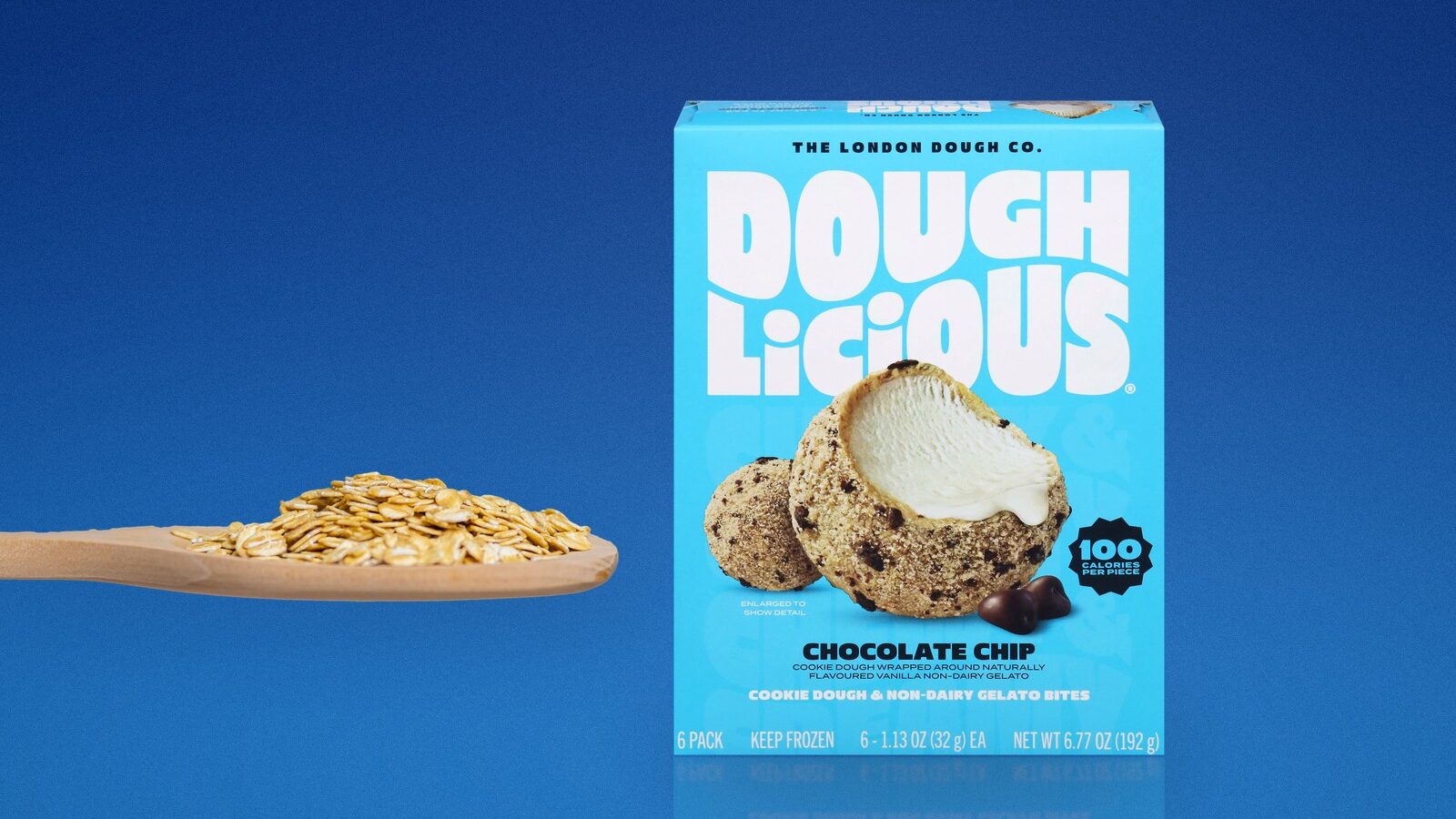
Doughlicious is gluten-free because founder Kathryn Bricken built her cookie dough on oats for their fiber, found out the oats she was using were gluten-free and made the whole line gluten-free. Its boxes carry the seal of the Gluten-Free Certification Program, a facility-audited standard endorsed by Beyond Celiac, and the label lists gluten-free oats, gluten-free oat flour and rice flour. Specialty gluten-free oats are grown and processed apart from wheat, barley and rye and are widely accepted as safe for people with celiac disease, though a small portion react to oats themselves. The label also notes the bites are made in a facility that processes milk, eggs and tree nuts.
Long before there was a factory, there was an ice-cream scoop. Kathryn Bricken, a Miami-born mother of three, started what became Doughlicious as a side project, balling cookie dough with an ice-cream scoop in her garage. Today Doughlicious makes more than a million cookie dough and gelato bites a week, and the boxes sit in Whole Foods, Target and Kroger freezers across the country. Along the way, after an unexpected discovery, she made the whole line gluten-free.
The gluten-free part was never the plan. She wanted oats in the dough for their fiber, found out the oats she had chosen were gluten-free, and decided the rest of the recipe should follow. For anyone who lives with celiac disease, that is the part worth knowing about, so we read the box, the certification on it and what “gluten-free oats” actually means.
The product: frozen cookie dough and gelato bites, ready-to-bake cookie dough and cookie skillets, made by Doughlicious, The London Dough Co., in its own factory in London and, since this year, a U.S. facility in Cincinnati, Ohio.
The gluten-free part: founder Kathryn Bricken built the dough on oats for their fiber, found out her oats were gluten-free and made the whole line gluten-free; the boxes carry the seal of the Gluten-Free Certification Program, the facility-audited standard Beyond Celiac endorses.
The founder: Miami-born, a former Capitol Hill staffer and mother of three, who says she was 50 when she “really started growing” the company.
The scale: more than a million bites a week, a team of about 50, and shelves at Whole Foods, Target, Kroger and select Costco stores in the U.S.
Sources: the founder on the Kara Goldin Show; Fortune, April 26, 2026; the Chocolate Truffle box; Beyond Celiac; the company’s releases. Read November 3, 2026. Educational, not medical advice.
The discovery: Oats for the fiber, gluten-free by surprise
Oats were in her cooking long before the company. As a child, she told Kara Goldin’s podcast, she made pancakes “with oats rather than white flour,” because, she said, they were better for her. When she built her cookie dough, the oats came with her. She wanted “really good ingredients,” she said, “and again, bring those oats in, which are high fiber.”
Then came the surprise. “I figured out that the oats that I was using were actually gluten free,” she said, and from there she decided to make the whole product gluten-free. She is clear that it was not the starting point. Her line for it is that Doughlicious is “the most amazing tasting cookie that happened to be gluten free.” The Chocolate Chip box says it in a sentence on the back, signed with her first name: the company’s “gluten-free certified snacks” are made in London, England, with renewable electricity.
Why the oats matter: What gluten-free oats are, and what the seal checks
Celiac disease is, in the words of the National Institute of Diabetes and Digestive and Kidney Diseases, “a chronic digestive and immune disorder that damages the small intestine,” set off by gluten, the protein in wheat, barley and rye. About 2 million people in the United States have it, and the treatment is a gluten-free diet. That makes oats a tricky grain. Oats do not contain gluten, but Beyond Celiac explains that “mills that process oats also handle gluten-containing grains,” so ordinary oats can pick it up along the way. “Specialty gluten-free oats are grown, harvested and processed in a way that keeps them away from other grains,” the group says, which is why they are widely accepted as safe for people with celiac disease. It adds one honest caveat: a small portion of people with celiac react to oats themselves, because of a protein called avenin, so anyone unsure should check with their doctor.
The Doughlicious label lists gluten-free oats, gluten-free oat flour and rice flour, and the back of the box carries the seal of the Gluten-Free Certification Program. Beyond Celiac endorses that program, now run by the standards body BRCGS as its Global Standard Gluten-Free. It was created in 2011 by the Allergen Control Group and the Canadian Celiac Association, and Beyond Celiac brought it to the U.S. in 2014. It is a facility-based certification: rather than relying only on testing the finished food, auditors look at “ingredient sourcing to employee training, cleaning practices, cross-contact controls.” A gluten-free label in the U.S. means less than 20 parts per million of gluten, the level celiac experts consider safe for most people. For a dessert made with oats, that is exactly the kind of checking a celiac shopper hopes for. Our reads of Ritz’s gluten-free crackers and Julia Brower’s essay on living with celiac disease cover more of what that life looks like.
The box: Cookie dough on the outside, gelato in the middle
Each bite is a ball of cookie dough wrapped around gelato and rolled in cookie crumb, sold six to a box and eaten straight from the freezer after a minute or two to soften. The Chocolate Truffle box we read is non-dairy, made with a gluten-free oat drink base, and carries the Vegetarian Society’s Vegan Approved mark alongside the gluten-free seal. Each 32-gram piece lists 100 calories and 1 gram of fiber. One label line is worth reading if you manage other allergies: the bites are made in a facility that also processes milk, eggs and tree nuts.
View this post on Instagram
How it got here: A garage, a side project and a factory of her own
Bricken’s first career was in Washington, Fortune reports, first as a legislative correspondent on Capitol Hill and then in health care policy for a senator. After she had twins, followed by another baby soon after, she began baking decorative cakes and cookies while her children slept. When the family moved to London in 2008, she noticed that British shelves had biscuits, not the soft, gooey American-style cookies she grew up with, and friends kept asking her to bake American-style chocolate chip cookies. Doughlicious reached UK shops in 2017.
The turning point was a decision to make it herself. She tried an outside manufacturer for four months and was not happy with the result. “So I took out a room in a larger factory, and I decided I was going to do it myself,” she told Goldin. “I hired one person to help me, and bought a machine, bought mixers, and did everything myself.” The company still makes its own bites: in London and, as of this summer, at a new U.S. headquarters and manufacturing facility in Cincinnati, Ohio. Fortune put the team at about 50 this spring. And she was, by her own account, 50 when she really started growing the business. “Women aren’t done at 50,” she said.
Whole Foods was one of her first stockists in the UK. When the chain’s incoming chief executive asked to see “a factory and a farm” on a UK visit, she recalled, “we were chosen as the factory.” The U.S. followed: Whole Foods, then Target nationwide in October 2024, Kroger in November 2025 and a 25-pack at select Costco stores this August. In October the company added Poppable Minis at Whole Foods, and its frozen advent calendar returns to Target this season, with a door made in collaboration with the candy brand Rotten. Along the way the products have collected more than 20 Great Taste awards.
View this post on Instagram
The short version: A cookie that happened to be gluten-free
Doughlicious went gluten-free because its founder wanted oats for their fiber and discovered they were gluten-free oats. The company then made the whole line gluten-free and certified it under a facility-audited program that Beyond Celiac endorses. For most people with celiac disease, certified gluten-free oats are considered safe; a small number react to oats themselves and should ask their doctor. The rest of the story is a founder who did the work herself, from a garage to her own factories, which now turn out more than a million bites a week. This article is educational, describes what the cited label, interviews and organizations say, and is not medical advice.
How we checked this: Sources and method
Kathryn Bricken’s quotes are from her interview on the Kara Goldin Show, checked against the episode transcript on November 3, 2026. Her biography, the garage, the weekly output and the team size are from Fortune’s April 26, 2026 profile. The label details are from the back and side panels of the Chocolate Truffle box (UPC 5060502402806). The certification and oats guidance are from Beyond Celiac’s own pages, and the celiac figures from NIDDK. Retail dates and the Cincinnati facility are from the company’s releases; the award count was reported by Forbes. Gut Health Times has no commercial relationship with Doughlicious.