Why Is Everyone Suddenly Drinking Kefir?
Lifeway, the Chicago company that put kefir in American supermarkets, just reported the highest quarterly sales in its history and its 27th straight quarter of growth. We read the bottle, the FAQ and the four human trials that matter. The best evidence is for your stomach.
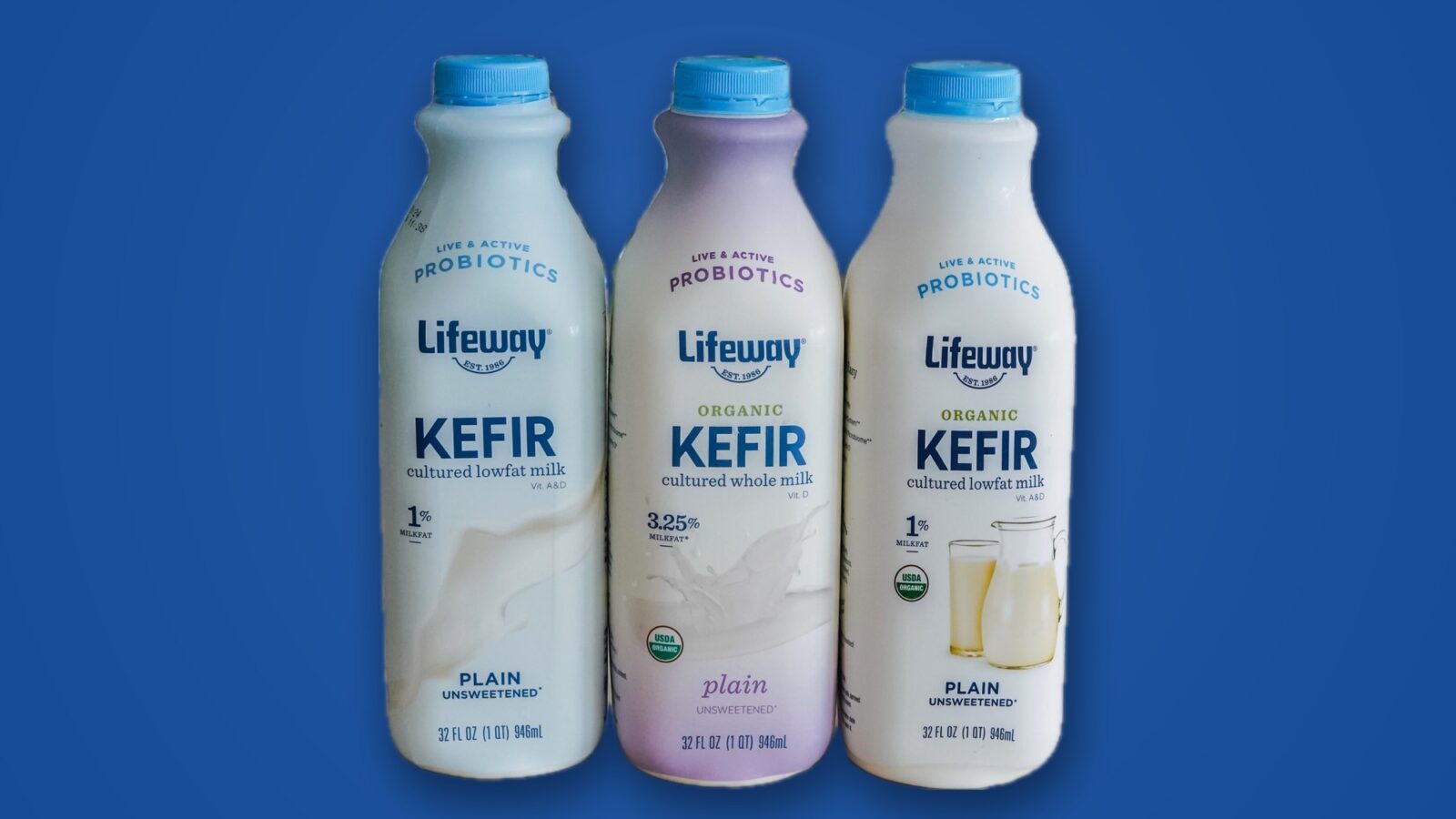
Kefir is milk fermented with a mixed culture of bacteria and yeasts. Lifeway’s Plain Whole Milk Kefir lists five ingredients and, per cup, 10 g of protein, 9 g of sugars with none added and 390 mg of calcium; the bottle says 12 live and active cultures and the company’s FAQ puts the count at 50 billion CFU per 8-ounce serving. In human trials kefir cut the gas of lactose maldigestion by 54 to 71 percent against milk, helped a small pilot group with chronic constipation, and was part of the fermented-food diet that raised microbial diversity in Stanford’s 2021 study; a 2026 review of eight human studies calls the microbiome changes modest and the immune evidence limited. Lifeway’s August 13, 2026 release reported second-quarter net sales of $66.9 million, up 24.1 percent, its 27th consecutive quarter of growth.

The bottle sits in the door of the fridge next to the oat milk, a quart of something tangy and faintly fizzy that most Americans could not have pronounced twenty years ago, and the company that makes it has just had the best three months in its history. Lifeway Foods told investors on August 13 that it sold $66.9 million of kefir, farmer cheese and the rest in the second quarter of 2026, up 24.1 percent on the year before, “the highest quarterly net sales in Company history,” and the 27th quarter in a row it had grown. Twenty-seven quarters is nearly seven years. The first half of the year came in at $129.9 million, up 29.9 percent. Julie Smolyansky, the chief executive, called it “sustained, volume-led performance,” which in plain English means more people are buying more bottles, not the same people paying more for them.
So kefir is having a moment, and it is worth asking two questions at once: what is it, and does it do the thing the front of the bottle says it does? The whole-milk plain bottle Lifeway sells at Costco carries the words “for gut health” on the front, over “12 probiotic cultures” and “50 billion CFUs.” We read the label, the company’s own FAQ and the four human studies that matter, and the honest answer is more interesting than the slogan: the best evidence for kefir is about the stomach, and it is better than most of the fermented aisle can claim.
The company: Lifeway Foods of Morton Grove, Illinois, started in 1986 in a family basement outside Chicago by Michael Smolyansky, a Kyiv-born immigrant who arrived in 1976; his daughter Julie Smolyansky has run it since 2002.
The growth: second-quarter 2026 net sales of $66.9 million, up 24.1 percent on a year earlier and the highest quarterly sales in the company’s history; 27 straight quarters of year-over-year growth; first-half sales of $129.9 million, up 29.9 percent, all per the company’s August 13, 2026 release.
The bottle (Plain Whole Milk Kefir, 1 cup): 10 g protein, 9 g sugars with 0 g added, 390 mg calcium (30 percent of the Daily Value), five ingredients, “12 live and active probiotic cultures”; the brand’s FAQ puts the count at 50 billion CFU per 8-ounce serving, fermented 14 to 18 hours after pasteurization.
The gut evidence: a 15-person trial found kefir cut the gas of lactose maldigestion by 54 to 71 percent against milk; a 20-person pilot found more frequent, softer stools in chronic constipation; Stanford’s 2021 fermented-food trial found more microbial diversity and lower inflammation markers; a 2026 review of eight human studies calls the microbiome changes “modest.”
Sources: Lifeway’s August 13, 2026 release (SEC filing), its product page and FAQ, read October 27, 2026; the four studies named in the text. Educational, not medical advice.
The bottle: Five ingredients, twelve cultures and a number nobody can check at home
Kefir is milk fermented with a mixed culture of bacteria and yeasts, which is what separates it from yogurt: yogurt is made with two or three bacterial strains, kefir with a crowd, and the yeasts give it a slight fizz. Lifeway calls it “the champagne of dairy.” Its Plain Whole Milk Kefir page lists five ingredients, pasteurized organic milk, organic nonfat milk, pectin, vitamin D3 and cultures, and a Nutrition Facts panel that reads, per cup, 10 g of protein, 9 g of total sugars with none of them added, and 390 mg of calcium, 30 percent of the Daily Value. The sugar is lactose, the sugar that was in the milk; some of it is eaten by the cultures during fermentation, which is where the next claim comes from.
The claim on the front of the bottle is “12 live and active probiotic cultures.” The company’s FAQ adds the figure the label does not print on every pack, 50 billion colony-forming units per 8-ounce serving, and says the milk is “fermented for 14-18 hours after pasteurization” and comes “from small co-op and family farms throughout the Midwest.” The same page describes every Lifeway product as “up to 99% lactose free,” and the whole-milk bottle at Costco shortens that to “lactose free” on its face. Colony counts are a number no reader can check at the kitchen counter, so the useful question is not how many, but what they do. The trials answer that better than the label can.
The gut math: What the human trials found, in order of how sure they are
The surest finding is the one Lifeway prints the smallest. In a 2003 trial at Ohio State, fifteen adults who could not digest lactose properly drank, on separate mornings, milk, plain kefir, flavored kefir and yogurt, each carrying 20 grams of lactose, while researchers measured the hydrogen on their breath, the gas that undigested lactose produces in the colon. Milk produced a breath-hydrogen curve of 224 units; plain kefir produced 87, about the same as yogurt. The volunteers rated their flatulence 54 to 71 percent less severe after the kefirs and yogurts than after milk, and cramps and diarrhea were “negligible” across the board. That is the mechanism behind “lactose intolerance friendly”: the cultures do part of the digesting for you, so a cup of kefir behaves like a cup of yogurt, not a cup of milk.
The second finding is smaller and softer. A 2014 pilot study in Turkey gave twenty people with chronic constipation 500 milliliters of kefir a day, about two cups, for four weeks. Stool frequency went up, consistency improved, laxative use went down, and in the ten patients whose colons had been measured as slow, transit sped up. It is a pilot: twenty people, no comparison group, so it tells you the question is worth a bigger trial, not that the answer is in. It does line up with what people say about kefir, and with what Lifeway’s FAQ says about helping “regulate bowel movements.”
“Fermented dairy like Lifeway Kefir is superior- obvi. So drink up. No spoon required.” Julie Smolyansky, in a post co-authored with the brand this week.
The third is the study that made fermented food a wellness category. In Stanford’s 2021 trial, published in Cell, 36 healthy adults spent 17 weeks on one of two diets, one high in fiber, one high in fermented foods, kefir among them, alongside yogurt, kimchi, kombucha and sauerkraut. The fermented-food group “steadily increased microbiota diversity and decreased inflammatory markers,” which is about as strong a sentence as the gut-health literature ever gives a food. Two cautions, both in the paper: it was 18 people per arm, and kefir was one of several foods, so it earns a share of the result, not the whole of it. We covered a later sauerkraut-only trial that found far less, which is a reminder that the whole-aisle effect and the one-jar effect are different questions.
The newest word is the most careful. A systematic review published this year in MicrobiologyOpen found eight human studies of kefir and the microbiome. Its summary: “modest and heterogenous changes,” with Bifidobacterium, the genus most people mean when they say good bacteria, rising in three of the four studies that measured it, and kefir’s own strains turning up in stool samples, which suggests they take up residence at least briefly. On the bigger promises, the authors write that “direct functional evidence in humans remains limited.” That is the fair reading of the FAQ’s “increased immunity”: the trials that exist measured the gut, and the gut is where the results are.
View this post on Instagram
How it got here: A basement outside Chicago, cultures carried from Kyiv, and a 27-year-old CEO
Lifeway is a family story before it is a growth story. By Radio Free Europe’s account, Michael Smolyansky, a Kyiv native, brought his family to the United States in 1976 “with a total of $116,” and in 1986 “launched Lifeway Foods out of the basement of the family’s home outside Chicago,” making kefir from cultures that friends and relatives carried over from the Soviet Union, where the drink is as ordinary as orange juice. He died suddenly in 2002, and his daughter Julie took over at 27, “the youngest female CEO of a publicly traded company in the United States.” Twenty-four years later she is still there, the company trades on Nasdaq, the plant in Waukesha, Wisconsin is being expanded for an early-2027 opening, and the founder’s drink is in the fridge door of people whose grandparents never heard of it.
The brand’s own line on why it exists is on its Instagram, where the bio has read “Sharing the immune boosting and mood lifting powers of probiotics since 1986” under a hashtag that doubles as a mission statement, #LifewayLovesYourGuts. The grid is a parade of other people’s posts, home cooks and dietitians the company co-authors with, which is its own kind of evidence: a drink that stayed in the Eastern European aisle for thirty years is now something people put in overnight oats on camera.
View this post on Instagram
The honest summary: Drink it for your stomach; the rest is a bonus
So, in a sentence each. If milk gives you gas, kefir almost certainly will not; that is the best-proven thing about it, and it is the reason a cup of it behaves like yogurt. If you are backed up, one small pilot and a lot of anecdote say it helps, and nobody has run the bigger trial yet. If you want a more diverse microbiome, a diet heavy in fermented foods did that in the Stanford study, and kefir was in the diet. If you want “increased immunity,” the human evidence is not there yet, and the careful reviewers say so. None of that is a reason to skip the bottle; it is a reason to buy it for what it does. Anything beyond an ordinary stomach, days of symptoms, blood, weight loss, belongs with a clinician. This article is educational, describes what the cited studies, filings and the brand’s own pages say, and is not medical advice.
How we checked this: Sources and method
The sales figures and the chief executive’s quote are from Lifeway’s August 13, 2026 press release as filed with the SEC; we report them as the company states them and do not comment on the stock. The label figures are from the Plain Whole Milk Kefir page and the FAQ on lifewaykefir.com, read October 27, 2026, with the Costco bottle’s front panel read from the company’s own 2026 artwork. The four studies are linked where they are cited; none of them tested Lifeway’s product specifically, which is why we describe the findings as about kefir, not about the brand. The family history is from Radio Free Europe’s 2015 profile. Our fermented-foods explainer and probiotics-versus-fiber read cover the wider aisle.