Matcha Just Joined the Fiber Boom. Good Mood Brew Put 6 Grams of It in a Can.
Autumn Calabrese built a career on portion containers and a gut-health program before she put her name on a can. Good Mood Brew is sold on calm, focus and energy. The back of the can tells a different story: chicory root second on the list and 5 to 6 grams of fiber in every flavor.
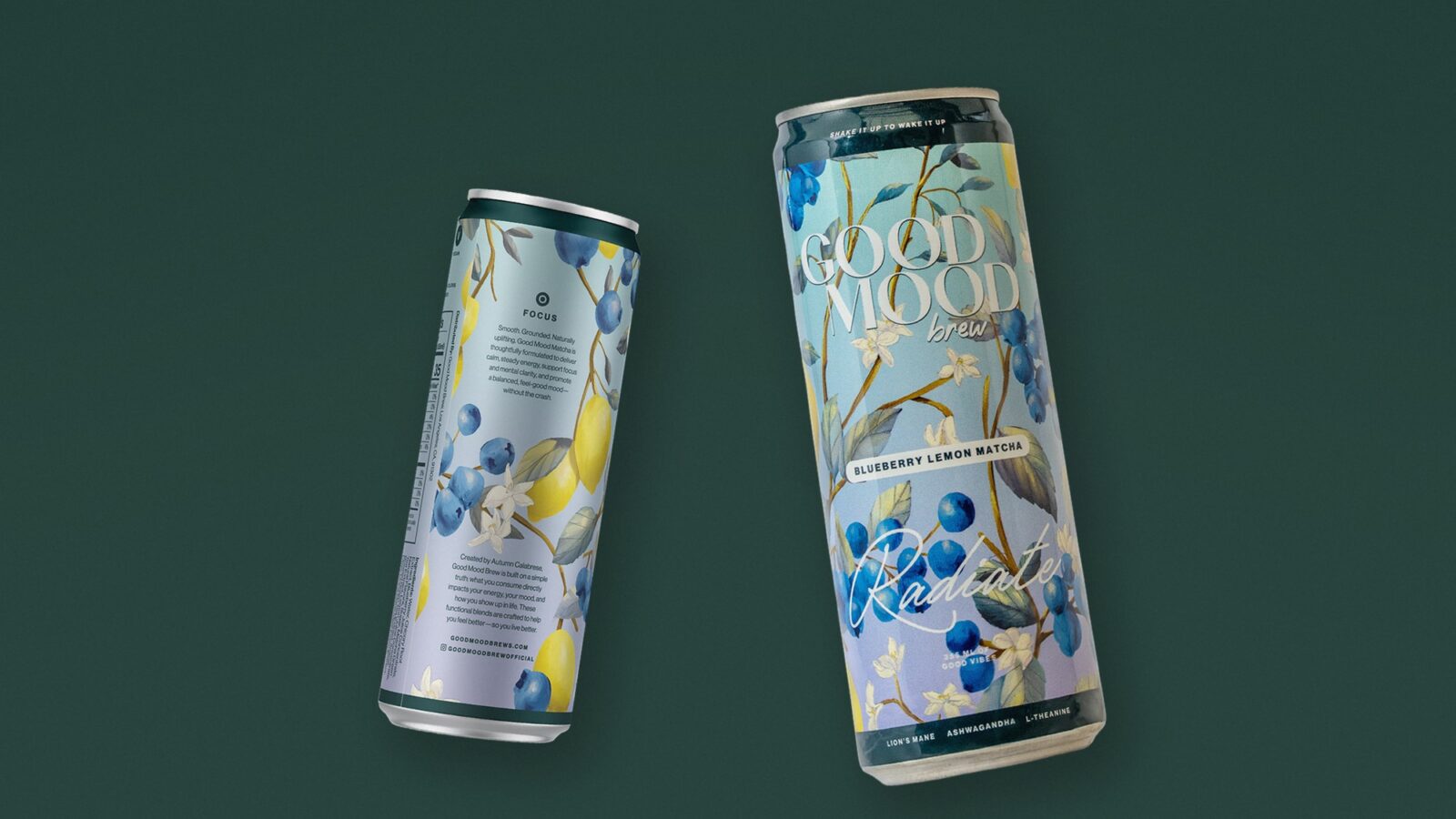
Good Mood Brew is a line of six canned drinks from Autumn Calabrese, the creator of Beachbody’s 21 Day Fix: three sparkling matchas (Blueberry Lemon, Strawberry Vanilla, Tropical Coconut Lime) and three sparkling functionals (Bright Eyed, Beauty Brew, Un-Wine). Per the Nutrition Facts panels on the brand’s product pages, read October 25, 2026, each 12-ounce matcha lists 35 to 40 calories, 6 g dietary fiber, 2 g total sugars all of them added, and 15 to 16 mg caffeine; the three functionals list 40 to 50 calories, 5 g fiber and 2 g added sugar. The fiber is chicory root extract, second to fourth on every ingredient list, plus acacia fiber in two of the matchas. By our arithmetic 6 g is 21 percent of the FDA’s 28 g Daily Value, which clears the 20 percent line the FDA sets for a “high” fiber claim; 5 g is 18 percent, a “good source.” A six-pack is $24.99 on the brand’s site. Educational, not medical advice.

On the front, a can of Good Mood Brew’s Blueberry Lemon Matcha is a watercolor of blueberries, lemons and white blossom, with “Radiate” written across it in script and three words running along the bottom rim: lion’s mane, ashwagandha, L-theanine. Nothing on the front mentions fiber. The back does. The Nutrition Facts panel lists 6 grams of dietary fiber in the 12-ounce can, and the ingredient statement puts chicory root extract second, right after carbonated water. That is the fiber the prebiotic soda shelf runs on, at a dose that sits level with Olipop’s shelf-stable cans and double a Poppi.
Good Mood Brew is the first drink from Autumn Calabrese, the trainer who created Beachbody’s 21 Day Fix, and it is sold on calm, focus and energy rather than on the gut. Yet every one of its six cans, three matchas and three sparkling functionals, carries 5 or 6 grams of fiber and 2 grams of added sugar, and every product page closes its pitch with the same seven words: “to help support gut health.” This page reads all six labels, works out what 6 grams of chicory root fiber means next to the sodas that made the ingredient famous, and follows the brand from a Calabasas start-up to the bar at the Ritz-Carlton in Laguna Niguel.
The drink: six 12-ounce sparkling cans from Autumn Calabrese’s Good Mood Brew of Calabasas, California: Blueberry Lemon, Strawberry Vanilla and Tropical Coconut Lime matchas, plus Bright Eyed, Beauty Brew and Un-Wine; $24.99 a six-pack on the brand’s site on October 25, 2026.
The label (Blueberry Lemon Matcha, per can): 35 calories, 11 g carbohydrate, 6 g dietary fiber, 2 g total sugars of which 2 g added, 15 mg caffeine, 100 mg L-theanine, per the brand’s own Nutrition Facts panel read October 25, 2026.
The fiber: chicory root extract is the second ingredient in both 6-gram matchas and never lower than fourth in the other four cans; the two 6-gram matchas add acacia fiber. The FDA counts both toward the fiber line on a label.
The math: 6 g is 21 percent of the FDA’s 28 g Daily Value, past the 20 percent line for a “high” fiber claim by our reading; 5 g is 18 percent, a “good source.” Poppi lists 3 g a can and Olipop 6 or 9, per our August label read.
The founder: Autumn Calabrese created Beachbody’s 21 Day Fix and, in March 2022, its 4 Week Gut Protocol; her Instagram bio (1.4 million followers) now leads with “Founder @goodmoodbrewofficial.” The brand says it is self-funded and pouring at The Ritz-Carlton, Laguna Niguel and the JW Marriott San Antonio.
Sources: the six product pages on goodmoodbrews.com; the FDA Daily Value table and 21 CFR 101.54; the brand’s October 15, 2026 post with CPG Latest; Simon & Schuster; Business Wire. Educational, not medical advice.
The label: Chicory root second, and six cans that read almost alike
The ingredient statement on the Blueberry Lemon Matcha page runs: carbonated water, chicory root extract, blueberry juice concentrate, natural flavors, sugar, matcha green tea extract, lemon juice concentrate, brewed green tea extract, acacia fiber, lion’s mane mushroom extract, ashwagandha extract, L-theanine, citric acid, stevia extract. The panel beside it: 35 calories, 11 grams of carbohydrate, 6 grams of dietary fiber, 2 grams of total sugars, all of them added, 5 milligrams of sodium, 15 milligrams of caffeine and 100 milligrams of L-theanine, with juice at 7.96 percent. The sweetness, in other words, comes from a little sugar and a little stevia, and most of the carbohydrate on the panel is the fiber.
| Good Mood Brew, per 12 fl oz can | Calories | Fiber | Added sugar | Caffeine | Where the chicory root sits |
|---|---|---|---|---|---|
| Blueberry Lemon Matcha | 35 | 6 g | 2 g | 15 mg | 2nd, plus acacia fiber |
| Strawberry Vanilla Matcha | 40 | 6 g | 2 g | 15 mg | 2nd, plus acacia fiber |
| Tropical Coconut Lime Matcha | 40 | 5 g | 2 g | 16 mg | 3rd, after coconut water |
| Bright Eyed (white peach, yuzu) | 50 | 5 g | 2 g | 100 mg | 4th |
| Beauty Brew (dragonfruit, lychee, rose) | 45 | 5 g | 2 g | none listed | 3rd |
| Un-Wine (pear, shiso, vanilla) | 40 | 5 g | 2 g | none listed | 4th |
Strawberry Vanilla is built the same way, chicory root second and acacia fiber further down, and lands at 6 grams too. Tropical Coconut Lime puts coconut water concentrate ahead of the chicory, drops the acacia, and reads 5 grams. The three sparkling functionals each list 5 grams from chicory root alone: Bright Eyed adds ginseng, magnesium citrate, vitamin B12 and 100 milligrams of natural caffeine, the one genuinely caffeinated can in the line; Beauty Brew adds marine collagen, tremella mushroom, biotin and zinc; Un-Wine adds tulsi, lemon balm, California poppy and magnesium glycinate. The brand’s claims for those botanicals are its own. The fiber line is the same on all six cans, and it is the line this page is about.
The find: Six grams clears the FDA’s “high in fiber” line, by our reading
Chicory root extract is inulin, a chain of fructose units the small intestine cannot break down, and the FDA has counted it as dietary fiber on labels since its June 2018 guidance named inulin and inulin-type fructans among eight carbohydrates it intends to add to the legal definition; acacia fiber joined that list in December 2021. Until the rulemaking is finished the agency lets manufacturers declare both as fiber, which is why the 6 grams on this can is a label number rather than a marketing one. It is also a large one for a 35-calorie drink. The Daily Value for fiber on the FDA’s own table is 28 grams, so 6 grams is 21 percent of a day, and under the federal labeling rule a food that supplies 20 percent or more of a nutrient’s Daily Value may call itself “high” in it. By our reading, both 6-gram matchas clear that bar, and the 5-gram cans, at 18 percent, sit inside the 10-to-19 percent band for a “good source.” Good Mood Brew makes neither claim on the front of the can.
The comparison the fiber invites is with the prebiotic sodas, because they use the same roots. By our August label read, a 12-ounce Poppi lists 3 grams of fiber from cassava root fiber and agave inulin, and an Olipop lists 9 grams in its refrigerated line, which leans on chicory root inulin, or 6 grams in its shelf-stable cans, which use cassava, acacia and guar. A Good Mood Brew matcha, then, sits level with a shelf-stable Olipop and double a Poppi, in a can that is sold as a matcha. It is the same root, incidentally, behind the chicory coffee New Orleans has poured for a century and a half.
“The competition stage. The burnout. The bloating no doctor could explain. The food sensitivities.” Autumn Calabrese, on her own 20 years in fitness, Instagram, April 23, 2026.
The gut math: What 6 grams of chicory root does, and what it does not promise
Fiber is the nutrient Americans miss most reliably. The Dietary Guidelines for Americans put it plainly: more than 90 percent of women and 97 percent of men fall short of the recommended intake. Six grams in a 35-calorie can is about a fifth of a day’s target in a slot, the afternoon drink, where the default for a generation has been a can with none. That arithmetic is the reason the prebiotic soda category exists, and it applies to a matcha just as well.
What inulin does once it reaches the colon is the best-studied part of the prebiotic story. A 2022 systematic review in Advances in Nutrition went through the human trials of inulin-type fructans and found one effect that shows up again and again: more bifidobacteria, the genus most prebiotic claims are built on. The dose question is the one we laid out in our prebiotic soda explainer: a prebiotic effect registers at a few grams, and the trials that moved constipation used closer to 12 grams of inulin a day, so a single can sits in the lower half of that range. The fermentation that feeds the bacteria is also the reason inulin is a fiber most people ease into rather than start at a six-pack.
The matcha itself has a smaller, newer literature. In a 2023 randomized, double-blinded trial published in the Journal of Clinical Biochemistry and Nutrition, 33 adults drank a matcha or a placebo drink for two weeks; the overall composition of the matcha group’s gut bacteria shifted while the placebo group’s did not, with more Coprococcus and less Fusobacterium afterward. Two weeks and 33 people is a direction, not a dose. The caffeine, meanwhile, is modest: 15 milligrams a can, where brewed coffee runs about 95 milligrams a cup by the USDA’s figure of 40 milligrams per 100 grams, our arithmetic. The matchas are the gentle cans; Bright Eyed, at 100 milligrams, is the one that does the job of a coffee. Why a strong matcha latte can send some people to the bathroom is a different mechanism, and 15 milligrams is unlikely to trigger it.
View this post on Instagram
How it got here: From the 21 Day Fix to the Ritz-Carlton
Calabrese is, by her publisher’s account, a former dancer turned nutrition coach whose color-coded portion containers became the foundation of Beachbody’s 21 Day Fix and Ultimate Portion Fix; KTLA was introducing her as the program’s creator in September 2014. She has written cookbooks and a 2020 diet book, hosts a cooking show with her brother, and in March 2022 Beachbody launched her 4 Week Gut Protocol, a nutrition program paired with a four-week workout plan. So the gut was on her desk four years before it was in her can. Her Instagram, 1.4 million followers on October 25, now leads its bio with “Founder @goodmoodbrewofficial” and the words “Gut & Hormone health,” and in an April 23 post she listed, among the things her 20 years in fitness taught her, the competition stage, the burnout and “the bloating no doctor could explain.”
Good Mood Brew is registered to Calabasas, California, per its wholesale listing, and its Instagram account began posting on May 20, 2026, with #GutHealth among the first caption’s tags. The six cans sell for $24.99 a six-pack on the brand’s site, a little over $4 a can, with a one-of-each variety pack at the same price and wholesale through Faire. In the October 15 post it made with CPG Latest, the brand described itself as self-funded, female-founded and female-run, and put its first four months at nearly $200,000 in sales and more than 3,300 orders; those are the company’s figures and we have not checked them independently. The footer of its site lists where the cans are poured: The Ritz-Carlton, Laguna Niguel; the Balboa Bay Shore Club in Newport Beach; The Monarch and the JW Marriott in San Antonio.
View this post on Instagram
How we checked this: Sources and method
Every figure on this page is from the Nutrition Facts panels and ingredient statements on Good Mood Brew’s six product pages, read on October 25, 2026; the price, the hotel list and the founder line are from the same site the same day. The FDA’s treatment of inulin and acacia is from its dietary fiber questions-and-answers page and its June 2018 guidance; the Daily Value and the “high” and “good source” thresholds are the FDA’s; the fiber shortfall is the Dietary Guidelines for Americans 2020 to 2025; the inulin review is Hughes and colleagues, Advances in Nutrition, 2022; the matcha trial is Morishima and colleagues, Journal of Clinical Biochemistry and Nutrition, 2023; the coffee figure is USDA FoodData Central. The Poppi and Olipop figures are from our own August 2026 label read. Calabrese’s background is from her publisher’s biography, KTLA, a March 2022 Beachbody release and her own public posts. The sales, order and funding descriptions are the brand’s own, from its October 15 post with CPG Latest. The percentage and caffeine comparisons are our arithmetic and labeled as such. Gut Health Times has no relationship with Good Mood Brew or Autumn Calabrese and was not sent product. This article is educational, describes what the cited sources say, and is not medical advice.