12 Electrolyte Drinks, Ranked Against the WHO’s Rehydration Formula. Here’s How They Stack Up.
Liquid I.V., LMNT, Gatorade, Pedialyte, DripDrop, Nuun, Prime and five more, read against the only rehydration recipe with a global standard behind it: the WHO’s oral rehydration solution, 75 mmol of sodium and 13.5 g of glucose a litre. We worked every label out per litre as mixed. One stick pack beats the medicine on salt, five land in or beside the sports-drink band, and the two coconut-water drinks carry almost no sodium at all. Highest is not best; here is what each number is for.
Ranked by sodium per litre as mixed per the label, LMNT Citrus Salt in 16 oz (about 2,113 mg/L) is the only one of 12 electrolyte drinks above the WHO/UNICEF oral rehydration solution's 75 mmol/L, about 1,725 mg of sodium with 13.5 g of glucose per litre. DripDrop (1,395 mg/L), Liquid I.V. Hydration Multiplier (1,057) and Pedialyte Classic (1,030 to 1,080) follow; Gatorlyte (828) sits above the ACSM sports-drink guide of 460 to 690 mg/L, and Electrolit (688), Nuun Sport (634), Propel (460), Gatorade and Gatorade Zero (456) sit in it or within rounding of it; BodyArmor (63) and Prime (20) are coconut-water drinks with about 700 mg of potassium a bottle. Sugar per litre runs from 0 (LMNT, Gatorade Zero, Propel) to 57.5 g (Gatorade) against the WHO's 13.5. None of the 12 uses a sugar alcohol; the sweeteners are stevia, sucralose and acesulfame potassium. Highest is not best: the WHO dose was written for diarrhoea, the sports band for sweat, and the Institute of Medicine says most healthy people meet their needs by drinking to thirst. Educational, not medical advice.
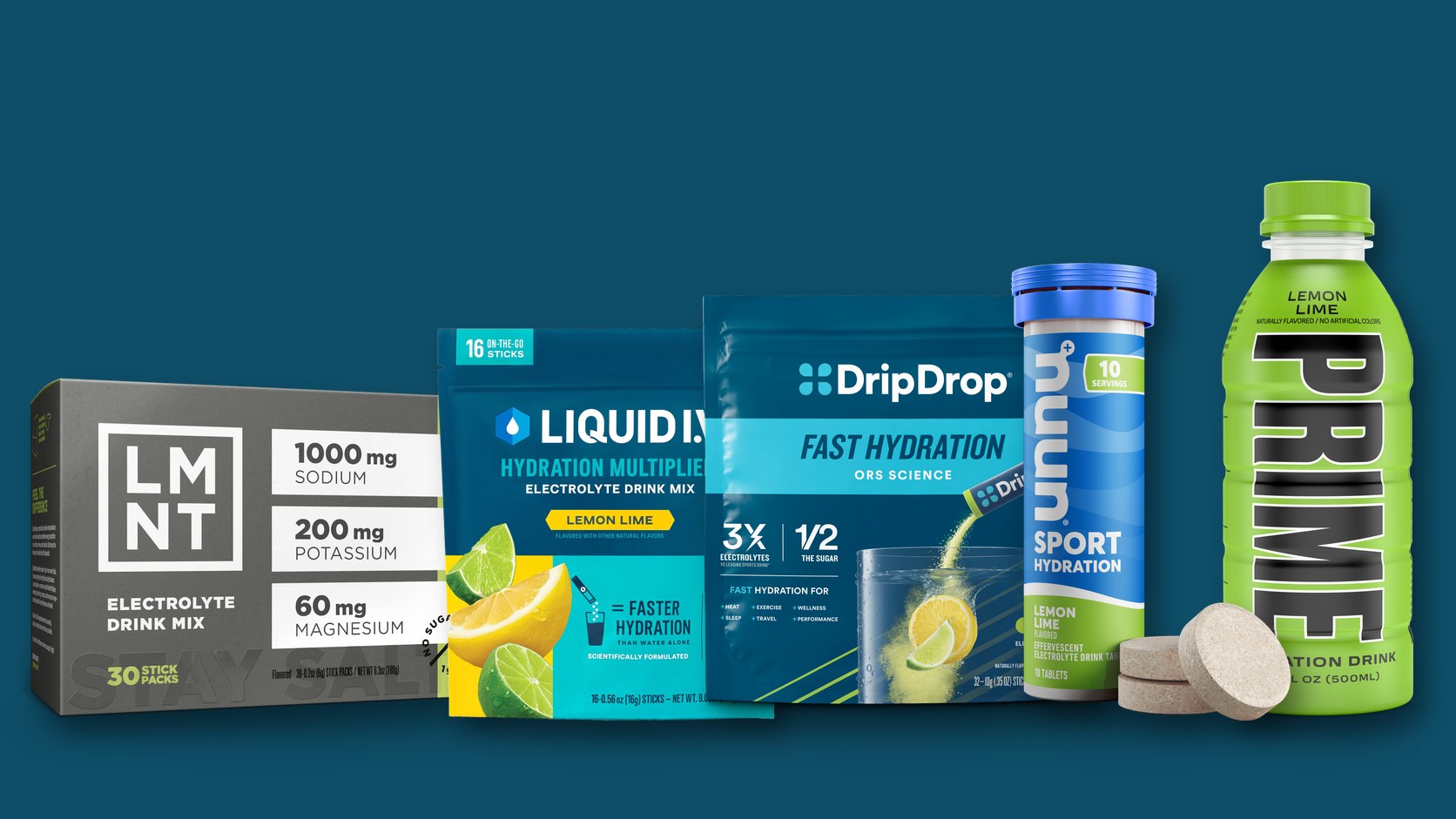
The hydration aisle at a drugstore now runs the length of a cold case: boxes of sticks with the word “multiplier” on them, a pouch built on ORS science, tubes of tablets, Gatorade in three strengths, a 21-ounce bottle promising six ions, two bottles built on coconut water and, at eye level, the litre of Pedialyte that was there before any of them. On November 9 the founders of Poppi add another one, Jetty. So we read the aisle. For 12 of the electrolyte drinks Americans actually buy, we took the Nutrition Facts panel from the brand’s own site (or a named retailer’s listing or the USDA label record, where the brand prints its panel only as a picture), worked each one out as sodium per litre, mixed the way the label says, and set the results against the one rehydration recipe with a global standard behind it.
The standard: the WHO/UNICEF oral rehydration solution holds 75 mmol of sodium (about 1,725 mg) and 13.5 g of glucose per litre, recommended since 2003.
The ranking: by sodium per litre as mixed, LMNT in 16 oz (2,113 mg) is the only drink above the WHO line; DripDrop (1,395), Liquid I.V. (1,057) and Pedialyte Classic (1,030) follow.
The sports band: the ACSM’s 2007 guide for sports drinks is 20 to 30 mEq of sodium per litre (460 to 690 mg); Electrolit, Nuun, Propel, Gatorade and Gatorade Zero sit in it or within rounding of it.
The coconut-water end: BodyArmor (63 mg/L) and Prime (20 mg/L) carry almost no sodium and about 700 mg of potassium a bottle.
The sugar: Gatorade has 57.5 g per litre, BodyArmor 52.8, Electrolit 49.6; the WHO formula 13.5; LMNT, Gatorade Zero and Propel none.
The sweeteners: no sugar alcohol in any of the 12; stevia in six, sucralose in five, acesulfame potassium in three.
Labels read at each brand’s site, a named retailer’s listing or the USDA label record on October 13, 2026; per-litre figures are our arithmetic. Educational, not medical advice.
The recipe: The WHO formula: salt, sugar, potassium, and why the sugar is there
The recipe is the World Health Organization and UNICEF’s oral rehydration solution, first used in 1969. In the WHO’s 2006 production document for the current version (WHO/FCH/CAH/06.1), a 20.5 g packet of 2.6 g sodium chloride, 13.5 g anhydrous glucose, 1.5 g potassium chloride and 2.9 g trisodium citrate, dissolved in one litre of drinking water, gives 75 mmol of sodium, 75 of glucose, 20 of potassium, 10 of citrate and 65 of chloride, at 245 mOsm/L. WHO and UNICEF have recommended this reduced-osmolarity version since 2003, after a July 2001 expert meeting in New York reviewed trials in which it cut stool output by about 20 percent, vomiting by about 30 percent and the need for unscheduled intravenous fluids in children by 33 percent, against the older formula of 90 mEq of sodium a litre. The document calls it a medicine, on the WHO Model List of Essential Medicines.
The sugar is not for taste. “Glucose facilitates the absorption of sodium (and hence water) on a 1:1 molar basis in the small intestine,” the WHO document says: the gut’s sodium-glucose transporter carries the two in together and water follows, which is why a rehydration solution has sugar at all. A 2014 review in Current Gastroenterology Reports by Henry Binder of Yale and colleagues says the same. To compare the recipe with a drink we converted it: 75 mmol of sodium at 23 mg per mmol is about 1,725 mg a litre, and 75 mmol of glucose is 13.5 g. Every product below gets the same formula: sodium per serving in milligrams, divided by the litres of water the label says to add, with one US fluid ounce taken as 29.5735 mL. Every per-litre figure here is our arithmetic from a label’s rounded numbers.
The ranking: Twelve drinks by sodium per litre, as mixed
| Rank | Drink, as mixed | Sodium mg/L | Sugar g/L | Sweetener |
|---|---|---|---|---|
| 1 | LMNT Citrus Salt, 1 stick in 16 oz | 2,113 | 0 | stevia |
| — | WHO/UNICEF oral rehydration solution | 1,725 | 13.5 | none (glucose) |
| 2 | DripDrop ORS Lemon Lime, 1 stick in 8 oz | 1,395 | 29.6 | sucralose (plus sugar, fructose, dextrose) |
| 3 | Liquid I.V. Hydration Multiplier Lemon Lime, 1 stick in 16 oz | 1,057 | 23.2 | stevia (plus cane sugar, dextrose) |
| — | LMNT Citrus Salt, 1 stick in 32 oz | 1,057 | 0 | stevia |
| 4 | Pedialyte Classic Unflavored, 1 L bottle (flavoured: 1,080 and 13) | 1,030 | 25 | none (dextrose); flavoured bottles sucralose, acesulfame potassium |
| 5 | Gatorlyte, 20 oz bottle | 828 | 20.3 | stevia (plus sugar) |
| 6 | Electrolit Lemon Lime, 21 oz bottle | 688 | 49.6 | stevia, sucralose (plus dextrose) |
| 7 | Nuun Sport, 1 tablet in 16 oz | 634 | 2.1 | stevia (plus dextrose) |
| — | ACSM sports-drink guide (2007) | 460 to 690 | 50 to 100 | — |
| 8 | Propel Berry, 16.9 oz bottle | 460 | 0 | sucralose, acesulfame potassium |
| T-9 | Gatorade Thirst Quencher Lemon-Lime, 20 oz bottle | 456 | 57.5 | none (sugar, dextrose) |
| T-9 | Gatorade Zero Lemon-Lime, 20 oz bottle | 456 | 0 | sucralose, acesulfame potassium |
| 11 | BodyArmor Strawberry Banana, 16 oz bottle | 63 | 52.8 | stevia (plus cane sugar) |
| 12 | Prime Hydration Lemon Lime, 16.9 oz bottle | 20 | 4 | sucralose, acesulfame potassium |
| — | Plain water | 0 | 0 | — |
The top of the table: LMNT, DripDrop, Liquid I.V., Pedialyte: the four built like a rehydration solution
Only one drink lands above the WHO line, and only at one of its two strengths. An LMNT Citrus Salt stick pack carries 1,000 mg of sodium, 200 mg of potassium, 60 mg of magnesium and, as the brand’s page puts it, “NO SUGAR”; LMNT’s own science page says to “include 1 gram of sodium in 16–32 ounces of water.” In 16 ounces that is 2,113 mg a litre, 92 mEq by our arithmetic, saltier than the 90 mEq/L formula the WHO retired in 2003. In 32 ounces it is 1,057 mg a litre, exactly where Liquid I.V. sits. Sweetened with stevia, it is the only one of the 12 with no sugar of any kind, and so the only one that skips the glucose mechanism the WHO recipe is built on.
DripDrop says the quiet part on the pouch: its Lemon Lime sticks are “built on ORS science” and promise “rapid electrolyte and fluid absorption using your body’s sodium-glucose co-transport system.” One 10 g stick in 8 ounces gives 330 mg of sodium, 180 mg of potassium and 7 g of sugar, with sucralose: 1,395 mg and 29.6 g a litre, the nearest of the 12 to the WHO’s sodium from below, with about twice its sugar. Liquid I.V.’s Hydration Multiplier Lemon Lime, which the brand’s FAQ says is “classified as an Oral Rehydration Solution,” is a 16 g stick in 16 ounces: 500 mg of sodium, 370 mg of potassium and 11 g of sugar on its label record, so 1,057 mg and 23 g a litre, with potassium (782 mg a litre) almost exactly on the WHO’s 20 mmol. “The sugar in Hydration Multiplier is the key driver to achieve rapid absorption and fast hydration,” the FAQ says; the product page claims “3x the electrolytes of the leading sports drink,” and by our arithmetic its sodium plus potassium per 16 ounces is about 3.1 times a Gatorade’s. Liquid I.V. belongs to Unilever (deal announced September 2020); its formula is now branded LIV Hydrascience, and the “Cellular Transport Technology” of that announcement no longer appears on the pages we read.
Pedialyte Classic, from Abbott, is the only one sold already mixed by the litre. Abbott’s page prints 1,030 mg of sodium, 780 mg of potassium and 25 g of sugar per litre for Unflavored, and 1,080 mg, 780 mg and 13 g for the seven flavoured bottles, which add sucralose and acesulfame potassium. That is about 45 mEq of sodium a litre, the figure Pedialyte’s own site gives for the original, with potassium on the WHO line; Abbott’s page says it “has glucose to promote sodium and water absorption.”
The sports-drink band: Gatorlyte, Electrolit, Nuun, Propel and Gatorade: made for sweat
The second standard is older and gentler. The American College of Sports Medicine’s 2007 position stand on exercise and fluid replacement (read in the college’s own Spanish and Chinese editions) repeats the Institute of Medicine’s guide for “sports drinks” for prolonged activity in the heat: about 20 to 30 mEq of sodium a litre, 2 to 5 mEq of potassium and 5 to 10 percent carbohydrate, or 460 to 690 mg of sodium and 50 to 100 g of carbohydrate a litre in our units. The logic is sweat, which the stand puts at about 35 mEq of sodium a litre on average (a range of 10 to 70), roughly 805 mg.
Five of the 12 are built to that spec. Electrolit’s 21-ounce bottle, “made with pharmaceutical-grade ingredients” and “made with 6 vital ions” in the brand’s words, carries 430 mg of sodium and 31 g of sugar: 688 mg and 49.6 g a litre, the top of the sodium band and a hair under its carbohydrate floor. A Nuun Sport tablet (5 g) in 16 ounces is 300 mg of sodium and 1 g of sugar, 634 mg and 2 g a litre: a sports-drink salt dose without the sports-drink sugar. Propel Berry, 230 mg in a 16.9-ounce bottle on Hannaford’s listing, is 460 mg a litre, the bottom edge of the band with zero sugar. Gatorade Thirst Quencher and Gatorade Zero in the 20-ounce bottle are both 270 mg, 456 mg a litre, within rounding of Propel: one with 34 g of sugar (57.5 g a litre, inside the carbohydrate band), the other with none; Gatorade’s page for Zero is headed “Hydrates Better than Water.” Gatorlyte, the 20-ounce bottle Gatorade sells for “rapid rehydration” with “a specialized blend of 5 electrolytes,” sits above the band at 490 mg, 828 mg a litre, the closest of the 12 to the sodium of average sweat, with 12 g of sugar and stevia. Gatorade, Gatorlyte and Propel are PepsiCo products: Gatorade is on PepsiCo’s brands page, and PepsiCo’s Propel site says Propel “was created by The Gatorade Company in 2002.”
The coconut-water end: BodyArmor and Prime: potassium drinks with a pinch of salt
The bottom two are not failed rehydration solutions. They are a different drink. BodyArmor Strawberry Banana (16 ounces) lists 30 mg of sodium and 680 mg of potassium with 25 g of sugar and stevia on the Nutrition Facts in Food Lion’s listing; the brand’s own site loads its panels as scripts we could not read. Prime Hydration Lemon Lime (16.9 ounces) is 10 mg of sodium and 700 mg of potassium with 2 g of sugar on its USDA label record, under the brand’s claims of “Zero Added Sugar,” “20 Calories” and “10% Coconut Water.” Both are built on coconut water, which is where the potassium comes from: at 1,437 and 1,400 mg a litre they carry nearly twice the potassium of the WHO formula and 1 to 4 percent of its sodium. BodyArmor’s Flash I.V. sticks are another product: 510 mg of sodium a packet in 16 to 32 ounces, 1,078 to 539 mg a litre, per Hannaford’s listing.
The sugar, and the day: What sweetens each bottle, and which number was written for which day
The WHO recipe’s 13.5 g a litre is a working dose of glucose: enough to run the transporter, not enough to taste like much. Only Pedialyte’s flavoured litre lands on it (13 g); Gatorlyte, Liquid I.V., Pedialyte Unflavored and DripDrop run one and a half to two times it (20 to 30 g); Gatorade (57.5), BodyArmor (52.8) and Electrolit (49.6) are at sports-drink levels, which the ACSM band defines as 50 to 100 g. We also read every ingredient list for the sugar alcohols that upset stomachs, sorbitol, xylitol, erythritol and mannitol, which a 2016 review in the International Journal of Dentistry by Kauko Mäkinen says “may cause gastrointestinal disturbances at least in unaccustomed subjects,” the osmotic effect behind our sugar-free candy piece. None of the 12 uses one. The sweeteners are stevia leaf extract in six (LMNT, Liquid I.V., Gatorlyte, Electrolit, Nuun, BodyArmor), sucralose in five (DripDrop, Electrolit, Propel, Gatorade Zero, Prime) and acesulfame potassium in three (Propel, Gatorade Zero, Prime), plus Pedialyte’s flavoured bottles; Gatorade Thirst Quencher and Pedialyte Unflavored use sugar alone.
Highest sodium is not best. The WHO dose replaces what diarrhoea takes; the sports band replaces sweat; on an ordinary day, thirst does the job.
A ranking by sodium invites the wrong conclusion, so here is the right one: each line on the table was written for a different day. The WHO’s 1,725 mg is a treatment dose, built to replace what diarrhoea takes out; the trials behind it were run in children with acute diarrhoea and adults with cholera. The 460 to 690 mg band was written for people sweating for an hour or more in the heat; the ACSM abstract says such drinks can help “over water alone under certain circumstances.” For the rest of the week, the 2004 Institute of Medicine report that set the US intake levels for water put total water at 3.7 litres a day for men and 2.7 for women, about 80 percent of it from drinks, and added that “the vast majority of healthy people adequately meet their daily hydration needs by letting thirst be their guide.” Water is a fine electrolyte drink for a day with no diarrhoea and no sweat in it, which is most days. Where a rehydration solution fits is in our guide to stopping diarrhoea; this table covers what is in the bottle.
How we did it: Labels, arithmetic and what we could not read
Same method as our Halloween candy fiber ranking: one public number, one reference line. We read each Nutrition Facts panel on the brand’s own site on October 13, 2026. Where a brand prints its panel only as an image or behind a script (Liquid I.V., Gatorade and Gatorade Zero, BodyArmor, Propel, Prime), we used a named retailer’s listing or the product’s label record in USDA FoodData Central, which is built from labels; the table below says which. Serving sizes and mix volumes are the label’s. Electrolit’s page prints its sodium as 430 mg in the Nutrition Facts table and 330 mg in a marketing panel; its per-100-mL label records (69 mg) agree with 430. Labels change, and the bottle on a shelf today may differ from the page we read.
| Drink | Serving and water | Sodium mg | Potassium mg | Sugars g |
|---|---|---|---|---|
| LMNT Citrus Salt | 1 stick pack in 16 to 32 oz (brand) | 1,000 | 200 | 0 |
| DripDrop ORS Lemon Lime | 1 stick (10 g) in 8 oz (brand) | 330 | 180 | 7 (7 added) |
| Liquid I.V. Hydration Multiplier Lemon Lime | 1 stick (16 g) in 16 oz (brand directions; panel from USDA label record) | 500 | 370 | 11 (11 added) |
| Pedialyte Classic Unflavored | 1 L bottle, no mixing (Abbott); label serving 12 oz = 370 / 280 / 9 | 1,030 | 780 | 25 (25 added) |
| Pedialyte Classic Strawberry | 1 L bottle (Abbott) | 1,080 | 780 | 13 (13 added) |
| Gatorlyte | 20 oz bottle (brand; calories and ingredients from USDA label record) | 490 | 350 | 12 |
| Electrolit Lemon Lime | 21 oz (625 mL) bottle (brand) | 430 | 490 | 31 (31 added) |
| Nuun Sport | 1 tablet (5 g) in 16 oz (brand) | 300 | 150 | 1 (1 added) |
| Propel Berry | 16.9 oz (500 mL) bottle (Hannaford listing) | 230 | 60 | 0 |
| Gatorade Thirst Quencher Lemon-Lime | 20 oz bottle (Hannaford listing) | 270 | 80 | 34 (34 added) |
| Gatorade Zero Lemon-Lime | 20 oz bottle (Hannaford listing) | 270 | 80 | 0 |
| BodyArmor Strawberry Banana | 16 oz bottle (Food Lion listing) | 30 | 680 | 25 (23 added) |
| Prime Hydration Lemon Lime | 16.9 oz (500 mL) bottle (USDA label record) | 10 | 700 | 2 (0 added) |
Facts to carry: the WHO/UNICEF oral rehydration solution is 75 mmol of sodium (about 1,725 mg) and 13.5 g of glucose a litre, recommended since 2003, with the sugar there to pull salt and water across the gut wall; by sodium per litre as mixed, LMNT in 16 ounces (2,113 mg) is the only drink above that line, DripDrop (1,395), Liquid I.V. (1,057) and Pedialyte Classic (1,030 to 1,080) follow, Gatorlyte (828) sits above the sports-drink band, Electrolit, Nuun, Propel and both Gatorades sit in or beside it, and BodyArmor (63) and Prime (20) are potassium drinks; none of the 12 contains a sugar alcohol; the WHO dose is for diarrhoea, the sports band for sweat, and thirst is the guide on an ordinary day. None of the companies named had any involvement in this article. It is educational, describes what the cited labels, documents and studies say, and is not medical or nutrition advice.