The Chicago Marathon’s Official Gel Says It Eases the Stomach. We Read the Four Trials
The Bank of America Chicago Marathon’s course page says the Maurten gels handed out at Mile 12.4 and Mile 18.1 move carbohydrate through the stomach with less discomfort. We read the sentence against Maurten’s own pages and the four papers that looked at it. A review and two trials found the stomach ratings no different; one trial of eleven runners found the hydrogel helped, and the course supplies two of the six to seven gels Maurten’s own plan calls for.
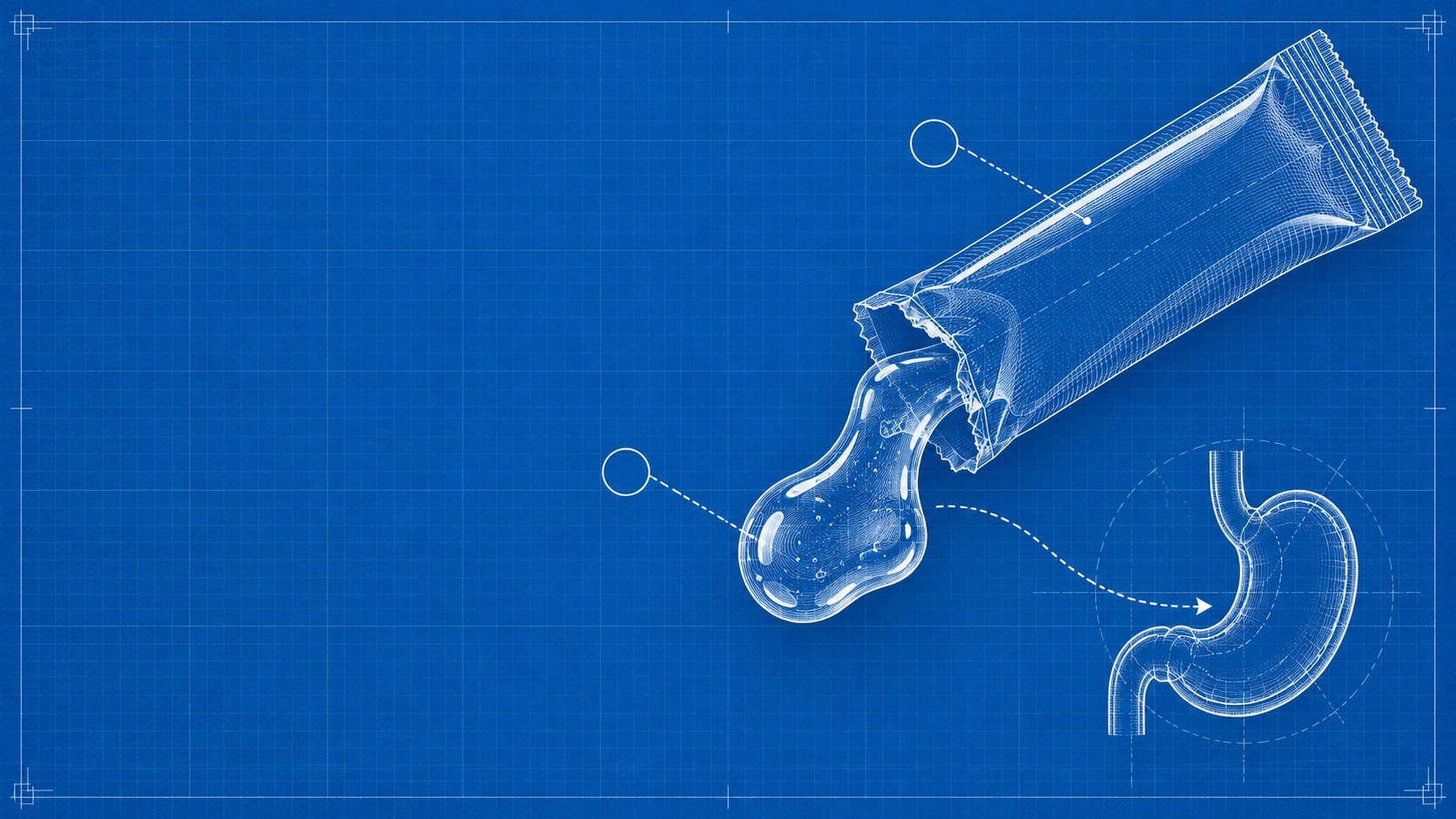
The evidence is split, and most of it finds no difference. The Chicago Marathon course page says the Maurten gels handed out at Mile 12.4 and Mile 18.1 move carbohydrate through the stomach with less discomfort. A 2020 review of the randomized trials found ratings of gut distress not different from ordinary carbohydrate drinks, and trials of nine runners and nine cyclists found no difference either. One 2022 trial of eleven runners, funded by Leeds Beckett University, found fewer gut symptoms and a 2.1 percent faster time trial with the hydrogel. A Gel 100 is 40 g of gel, 25 g of glucose and fructose, six listed ingredients and no pectin. Two course gels supply 50 g of carbohydrate; Maurten's own marathon plan is 175 to 200 g.

On Sunday morning, a little past Mile 12 of the Bank of America Chicago Marathon, a volunteer will hold out a small sachet to a runner who, at an even four-hour pace, is close to two hours in. The sachet is a Maurten Gel 100, and the race’s own course page says what it is for. Maurten gels, the page reads, “use patented Hydrogel Technology that enables smooth transportation of carbohydrates through the stomach during high-intensity exercise, reducing discomfort.” It is one sentence on a page mostly about toilets and water, and the second depot is nearly six miles on, at Mile 18.1. So we read it against Maurten’s own pages and the four papers, a review and three trials, that looked at stomach symptoms with and without the gelling agents.
Google already finishes the sentence: maurten gel stomach issues, maurten gel upset stomach, maurten gel sensitive stomach, chicago marathon gels on course. The race-week guides repeat the hydrogel line; none we read sets it beside the trials. Our marathon piece covered why running moves the bowels. This is a different find: the official gel’s stomach claim, and what it rests on.
The course page: Two depots and one sentence
The course page lists 20 aid stations “approximately one to two miles apart,” each with a medical tent, toilets, Gatorade Endurance Formula in lemon-lime and water. Maurten is “the Official Hydrogel Sports Fuel” of the race, and runners “can grab a caffeinated or non-caffeinated Gel 100, both containing 25 grams of carbohydrates, from the Hydrogel Fuel Depots at Mile 12.4 (near Aid Station 9) and at Mile 18.1 (near Aid Station 14).” Then the race’s one instruction: “Please only take one gel per station to ensure participants behind you have access to gels.” Chiquita bananas appear at Aid Stations 16 to 18, Miles 20.2 to 23. The header gives the date: October 11, 2026.
Maurten’s own event page opens with “Running Chicago takes guts,” repeats the two depots and offers registered runners 20 percent off. It makes no stomach claim. The claim lives in two places: the race’s course page, and Maurten’s Gel 100 page, which says the hydrogel “protects the carbohydrates as they are transported through the stomach to the intestine,” “making it easier to fuel by limiting stomach distress.”
The gel: What a Gel 100 is, in Maurten’s words
“An actual gel, not a syrup,” the product page says. A sachet weighs 40 grams, holds 25 grams of carbohydrate at about 100 calories, and lists six ingredients: water, glucose, fructose, sodium alginate, gluconic acid, calcium carbonate. The sugars come in a “1:0.8 glucose to fructose ratio,” roughly 14 grams of glucose and 11 of fructose (our arithmetic). A box of 12 is $45, or $3.75 a sachet (our arithmetic); the Caf 100 adds 100 milligrams of caffeine as a seventh ingredient and costs $52.
The hydrogel itself is explained on Maurten’s innovation page: built from alginate, “extracted from seaweed,” and pectin, “found in fruit fibres.” At the low pH of the stomach the structure holds, the page says, so the carbohydrate moves to the small intestine in a more controlled way, where the gel dissolves and the sugars are absorbed. “Ideally, you want to feel nothing,” it adds. One detail worth printing exactly: the Gel 100 ingredient list carries no pectin. Its gelling agents, on the page’s own Swedish-language label line, are sodium alginate, gluconic acid and calcium carbonate. We print what the page lists.
The table: What the course supplies, by the course page
| Where | What is handed out | Carbohydrate, as stated |
|---|---|---|
| All 20 aid stations, about one to two miles apart | Water; Gatorade Endurance Formula (lemon-lime); toilets; medical tent | Not stated on the page |
| Mile 12.4, near Aid Station 9 | Maurten Gel 100 or Gel 100 Caf 100, one per runner | 25 g |
| Mile 18.1, near Aid Station 14 | Maurten Gel 100 or Gel 100 Caf 100, one per runner | 25 g |
| Miles 20.2 to 23, Aid Stations 16 to 18 | Chiquita bananas | Not stated on the page |
| Before Miles 5.7, 10.1, 15.7 and 20.3 | Culligan refill stations for approved self-carried bottles and flasks | 0 g (water) |
Two depots at 25 grams is 50 grams of carbohydrate from the course (our arithmetic). Maurten’s marathon fuel guide, on the same event page, is built on “five (GEL160) to seven (GEL100) GELs in total – or 175-200g of carbohydrate”: one gel in the warm-up, then “Six Gels, one every 6k.” For a four-hour finisher the guide says a gel every 35 minutes; at that even pace the depots come at about 1:54 and 2:46 (our arithmetic). The course covers a quarter to a bit under a third of the brand’s own plan (our arithmetic). The rest a runner brings, in the front-pocket vests, fuel belts, handhelds and soft flasks the page allows; hydration bladders are not permitted.
The trials: Four papers, line by line
In 2020, three researchers reviewed the randomized trials of carbohydrate hydrogels in the International Journal of Sport Nutrition and Exercise Metabolism. Against the marketing claims of faster emptying and less distress, the finding, in the review’s words: “subjective ratings of gastrointestinal distress do not appear to be different.” The review concludes that the literature does not endorse the marketing claims; its authors declare no conflicts of interest. On emptying, the review found one at-rest study: half the hydrogel drink gone in 21 minutes against 37 without the gelling agents, a gap that narrowed after 30 minutes. No available study, the reviewers wrote, had measured gastric emptying during exercise, and emptying is not, in the wider literature, the step that limits fuel to the muscle.
The three trials are small and built the same way: a glucose or maltodextrin plus fructose mix in both arms, the gelling agents the only difference. At Monash University, nine trained male runners ran three hours at 60 percent of their maximum on 90 grams of carbohydrate an hour, once with sodium alginate and pectin in the drink and once without. Gut symptoms turned up in every runner on both days, and the severity scores, 29.1 against 34.8, were not statistically different (p = .262). In a second trial, nine trained cyclists rode 98 minutes plus ten sprints on 78 grams an hour of a hydrogel, the same sugars un-gelled, or maltodextrin alone: few went past moderate discomfort on any drink, with no systematic differences between them. The funding statements for those two papers were not available to us.
The fourth paper is the one in Maurten’s favor. In a 2022 paper in Medicine & Science in Sports & Exercise, eleven trained male runners ran two hours at 68 percent of maximum and then a 5-kilometer time trial, three times, double-blind: 90 grams an hour of 2:1 glucose-fructose as a hydrogel, the same sugars as a plain solution, or a carbohydrate-free placebo. The time trial was 2.1 percent faster after the hydrogel than after the plain solution (P = 0.033). On the stomach, the abstract reports total gut symptoms no different between the hydrogel and the sugar-free placebo, and higher on the plain sugar solution than on either (P < 0.001). The accepted manuscript, deposited in the University of Glasgow’s repository, thanks Leeds Beckett University for funding the study and declares no conflict of interest. Two of its authors also wrote the 2020 review, and the paper says plainly that its performance result conflicts with the earlier trials and that the authors cannot say why.
A review and two trials found the stomach ratings no different. One trial of eleven runners found the hydrogel helped.
The ratio: The part of the gel that is not the gel
The glucose-and-fructose pairing has evidence older than hydrogels, and it belongs to every gel that uses it. The two sugars cross the gut wall by different transporters, and a 2010 review by Asker Jeukendrup put the burn rate of ingested carbohydrate at up to 1.75 grams a minute with the mix, against a ceiling once thought to be 1, and said the mix may make gut distress less likely. In eight cyclists, a 2:1 glucose-fructose drink left the stomach faster than glucose alone. The trials above held that constant; both arms had it. Why 25 grams of sugar can hurt on the run at all is the subject of our marathon piece: a 2014 review puts gut complaints at 30 to 50 percent of athletes and names reduced blood flow to the gut as one of the main contributors, and a 2017 systematic review sets two hours at 60 percent of maximum as the point where the disturbance shows up regardless of fitness. (Sugar at rest, in a very different cup, is in our dirty soda read; the bowel end of hard training is in our Hyrox piece.)
The practical lines: What the race and Maurten say to do
We are not going to tell anyone what to eat on Sunday; the race and the brand have their own lines. The course page: one gel per station. Maurten’s event page: “your start line is now,” in training, where runners can “practice the art of fueling” with the Gel 100 and Caf 100, “the same that you’ll have available on-course during race day.” Its how-to-fuel page goes further: “Science has shown that training our guts with certain amounts of sports nutrition decreases the likelihood of gastrointestinal distress on race day.” That science is the two-week gut-training trial of 18 runners in our marathon piece: daily runs on 90 grams an hour reduced gut symptoms and cut breath hydrogen, a marker of unabsorbed carbohydrate, from 13 to 6 parts per million.
Facts to carry to the corral: two Maurten depots, Mile 12.4 and Mile 18.1, one gel each, 25 grams of carbohydrate apiece; Maurten’s own plan is six to seven gels and 175 to 200 grams; a Gel 100 is 40 grams of gel, six listed ingredients, no pectin; and of the four papers that looked at stomach symptoms, three found no difference and one, a trial of eleven runners, found the hydrogel helped. Maurten, the Bank of America Chicago Marathon and its organizer Chicago Event Management, Bank of America, Gatorade and PepsiCo, Chiquita and Culligan had no involvement in this article. It is educational, describes what the cited course page, product pages and studies say, and is not medical advice.