Bryan Johnson Told Axios People Want Him to Die. His Stomach Disease Is in 1 in 26 of Us
Bryan Johnson told The Axios Show on Monday that people want him to die, and that the autoimmune disease in his stomach has probably been there for 30 years. We read his posts and the studies: autoimmune gastritis is in 3.85 percent of people by the biggest count, usually silent, and the clue that tends to show first is low ferritin on an otherwise normal blood panel.
Bryan Johnson has autoimmune gastritis, a condition in which the immune system destroys the stomach's acid-making parietal cells, so the body slowly loses the ability to absorb iron and, later, vitamin B12. He announced it on X on June 30, 2026, said he was diagnosed in May by stomach biopsy, and told The Axios Show on October 5 that he has probably had it for about 30 years, linked to a hypothyroidism diagnosis at 21. A 2025 meta-analysis of 15,817 people puts the condition in 3.85 percent of people worldwide, about one in 26, and most cases cause no symptoms. The usual early clue is low ferritin with a normal blood count. There is no approved cure; care means replacing iron and B12 and periodic endoscopy.

On Monday, in Los Angeles, Bryan Johnson sat down with Axios’s Madison Mills for The Axios Show and said the quiet part. “I think people really want me to die,” he told her. “Now I get it. It’s funny. It’s ironic.” This is the founder of the Don’t Die movement and of Blueprint, the supplement business, a man who, by Axios’s count, spends more than $2 million a year on not dying, and in June he announced that his own immune system had been attacking his stomach, likely, he now says, for about 30 years, without him feeling a thing. So we read his posts, the interview and the studies: what autoimmune gastritis is, how many people carry it unknowingly, and the one blood-test line that tends to flag it first.
Google already finishes the sentence: bryan johnson autoimmune disease, bryan johnson disease cause, autoimmune gastritis symptoms, autoimmune gastritis treatment.
The interview: Monday with Axios, Thursday in full
Axios published the interview on Tuesday and put the 44-minute extended cut on YouTube on Thursday; the stomach comes up at 23:28. Asked whether anything in his routine could have caused the disease, Johnson said no. “I got diagnosed with hypothyroidism when I was 21 years old,” he said. “The thyroid and the stomach are very closely linked in immunology.” Then: “I probably have had this thing for about 30 years.” He described the reaction to his announcement as “joy all around the world,” and the diagnosis as a test he was glad to take: “I like the challenge. I’m up for it. I think it’s good timing.” The Telegraph ran the same lines; the disease got a paragraph.
The posts: A normal blood count, and the line underneath it
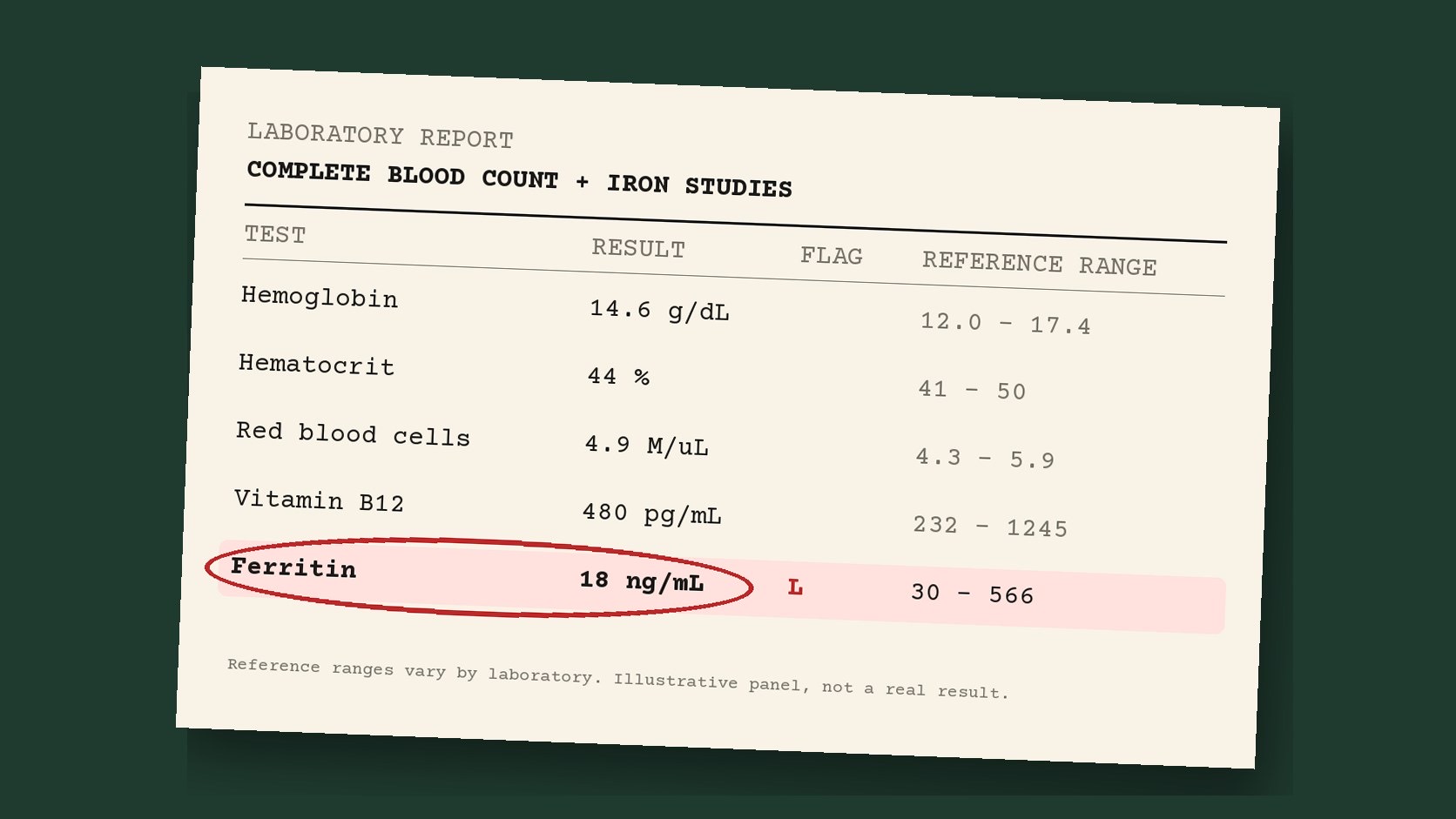
The announcement came on June 30, on X: “Bad news #1: I have an autoimmune disease. My stomach is eating itself. Bad news #2: 2–5% of people have this, too. Likely more, because it hides. Good news: I’m going to try and solve it.” The long post under that is a case history written by the patient. For 11 years, he wrote, his ferritin, the protein that stores iron, had been low while his hemoglobin and hematocrit, the numbers that define anemia, were normal, so the low iron kept getting explained away. This year a rebuilt medical team went looking. A colonoscopy, overdue at 48 by his own admission, came back clean, and an upper endoscopy in the same session looked normal. What found it was a blood test for antibodies against the stomach’s acid-making cells, and five biopsies from three regions of the stomach showing “early atrophy confined to the acid-producing lining.” On July 8 he put it plainly: “In May, I got diagnosed with autoimmune gastritis (AIG). We found it by taking a tissue biopsy of my stomach.”
View this post on X
The condition: What autoimmune gastritis is
Autoimmune gastritis is an organ-specific autoimmune disease in which the immune system destroys the stomach’s parietal cells, the 2020 Nature Reviews Disease Primers summary explains, “leading to the loss of intrinsic factor and reduced acid output.” Stomach acid frees iron from food so the gut can take it up; intrinsic factor escorts vitamin B12 into the body. Lose the cells and you slowly lose both, which is why the primer lists “malabsorption of iron, vitamin B12 (pernicious anaemia)” as the consequences and “a substantial diagnostic delay” as the norm. A 2021 review in Therapeutic Advances in Gastroenterology adds the order of events: iron stores run down faster than B12 stores, so iron deficiency “is often an early manifestation.” It is a different stomach problem from gastroparesis, which is about emptying, not lining.
And it is quiet. “The overwhelming majority of these cases are asymptomatic,” Ashkan Farhadi, a gastroenterologist at MemorialCare Orange Coast Medical Center, told Healthline in July. When symptoms arrive, Felice Schnoll-Sussman of Weill Cornell Medicine told the same outlet, they are things like “fatigue, poor concentration, reduced stamina, indigestion, or just not feeling quite right.” That is the stake: a common condition can run for decades in a body that feels fine.
The numbers: Nearly 4 percent of people, by the biggest count
| Measure | Figure | Source |
|---|---|---|
| People with autoimmune gastritis, worldwide | 3.85% (95% CI 2.94 to 5.04) | Li 2025, 47 studies, 15,817 people |
| The Americas | 2.82% | Same meta-analysis |
| Europe | 4.94% | Same meta-analysis |
| Found by antibody blood test vs by biopsy | 5.4% vs 2.71% | Same meta-analysis |
| AIG patients who also have autoimmune thyroiditis | 36% to 44% | Rustgi 2021 review, two cohorts |
| Gastric cancer in people with AIG | 0.12 per 100 person-years | He 2025, 23 follow-up studies |
| Gastric neuroendocrine tumors in people with AIG | 1.09 per 100 person-years | Same meta-analysis |
The largest estimate is a 2025 meta-analysis in Helicobacter: 47 studies, 15,817 people, a pooled global prevalence of 3.85 percent. That is one person in 26, our arithmetic. Johnson’s “2–5%” sits inside that range; STAT used “an estimated 4% of people worldwide”; a 2025 review in Cells gives 0.5 to 2 percent of the general population, rising to 5 to 10 percent among people with other autoimmune conditions.
The clue: One line on a blood panel
The number that would have flagged it years earlier is ferritin. Hemoglobin and hematocrit count the red cells in circulation; ferritin measures the iron in storage, and the body drains storage first to keep the circulating numbers normal, exactly the pattern Johnson described. Cleveland Clinic’s reference page gives 15 to 205 nanograms per milliliter for females and 30 to 566 for males, adding that exact cutoffs depend on the lab. Autoimmune gastritis “is notoriously insidious and frequently remains silent for decades,” Mimi Chang Tan of Baylor College of Medicine told STAT, and “anyone with low ferritin levels or iron deficiency anemia warrants an upper endoscopy” and a colonoscopy, to screen for this and for the commoner causes: bleeding in the bowel, polyps, an H. pylori infection.
“Notoriously insidious and frequently remains silent for decades.” Mimi Chang Tan, Baylor College of Medicine, to STAT
The thyroid link: Why he counts back 30 years
The pairing is old enough to have a name. “Thyrogastric syndrome” was coined in the 1960s, a 2020 review notes, for thyroid autoimmunity turning up in people with pernicious anemia. The 2021 review puts figures on it: in two cohorts of autoimmune gastritis patients, 36 to 44 percent had autoimmune thyroiditis, and among people with autoimmune thyroid disease roughly 40 percent had atrophic gastritis of the stomach body. None of this says one causes the other; Tan told STAT that people with autoimmune thyroid disease are more likely to be diagnosed with this, “though one doesn’t cause the other.” A thyroid diagnosis at 21 and a stomach diagnosis at 48 can plausibly be two chapters of one immune story; that is the arithmetic behind his 30 years. The cause is not known; nothing in the studies ties it to a routine, his or anyone’s.
The cancer question: A monitored risk, with a number on it
Cancer deserves its figure. A second 2025 meta-analysis in Helicobacter, 23 follow-up studies covering 4,309 hospital patients and 36,015 people in registries, put gastric cancer in autoimmune gastritis at 0.12 per 100 person-years: about one case a year for every 800 people with the condition, our arithmetic. Gastric neuroendocrine tumors were commoner, at 1.09 per 100 person-years; Toby Cornish, a gastrointestinal pathologist at the Medical College of Wisconsin, described the mechanism to STAT as a feedback loop: no acid, so the stomach keeps making gastrin, the hormone that calls for it. Both rates were higher in people 60 and over. That is why the standard of care is surveillance. Farhadi told Healthline that “interval endoscopy is sometimes recommended every 2 to 5 years,” and called the clinic’s job “damage control”: keep iron and B12 replaced, watch the lining.
The plan: What he says he will do, and what the pathologist said
In his July 3 and July 8 posts he laid it out: sequence one million of his own immune cells to find the “rogue platoon” attacking the lining; take a second biopsy for live tissue; draw blood every two weeks and pair it with wearable data; then build one of four therapies, from restoring the immune system’s off switches to engineered cells that hunt the attackers. He is candid about the footing, calling the later tiers “investigational preclinical evidence at best, and in several cases therapies that still have to be built.” Cornish told STAT that engineered cell therapy “has not been well studied for this particular condition” and “it’s still very early.” The one idea he called “highly speculative” was different: Johnson’s musing that a childhood of sugar cereal and a later weight gain might have set it off, for which there is no specific research. Schnoll-Sussman told Healthline that treating the disease before the lining is lost is an area of growing interest, but “that research is still preclinical.”
He says he will publish the bloodwork as it comes; we will read it. Facts to carry: autoimmune gastritis is an immune attack on the stomach’s acid-making cells; the biggest count puts it in 3.85 percent of people, about one in 26; most people who have it feel nothing; the clue that tends to show first is low ferritin, even with a normal blood count; it is diagnosed by biopsy and managed with iron, B12 and scheduled endoscopy. If your own ferritin has been low without an explanation, that is a conversation for your own clinician. Bryan Johnson, Blueprint, Axios, The Telegraph, STAT and Healthline had no involvement in this article. It is educational, describes what the cited posts, interview and studies say, and is not medical advice.