Two Sprout Outbreaks at Once. Here’s Why Sprouts Are the One Salad Topping the Food-Safety Rules Single Out
A 15-state E. coli and Salmonella outbreak tied to alfalfa sprouts, whose seed lot surfaced in an FDA enforcement report on Thursday, and a four-state Salmonella outbreak tied to broccoli sprouts, recalled last week, are open at the same time. Different growers, different germs, same food — and the reason is inside the seed.
Two unrelated sprout outbreaks are open in the United States. The alfalfa-sprout outbreak, per CDC pages updated September 1, has 55 ill in 15 states (46 Shiga toxin-producing E. coli across three serotypes, 7 Salmonella Agona, 2 with both), 4 hospitalised and no deaths, with illnesses from May 31 to August 8, most in Minnesota and Wisconsin; Everything Sprouts of Minneapolis recalled its alfalfa sprouts and mixes on August 22 and 28. FDA's August 31 update said a second grower used the same seed lot from a common supplier that "has not responded to FDA's recall recommendation"; on September 10 eFoodAlert reported an FDA enforcement-report entry for International Sprout Holdings covering 43,799 pounds of alfalfa seed shipped to 16 states plus Puerto Rico, Canada and Mexico. The broccoli-sprout outbreak, per FDA and CDC as of September 9, has 22 ill in Washington, Montana, Idaho and Utah, 2 hospitalised, illnesses from July 7 to August 26; Evergreen Fresh Sprouts of Idaho recalled 4-ounce broccoli sprouts on September 4 after Montana officials found Salmonella in a sample, and leftover sprouts from a patient tested positive. Sprouts are uniquely risky because, in FDA's words, bacteria "can get into sprout seeds through cracks in the shell before the sprouts are grown" and are then "nearly impossible to wash out," and sprouting happens "under warm and humid conditions" ideal for bacterial growth, "even if you are growing your own sprouts under sanitary conditions at home"; FDA counts 52 sprout outbreaks and more than 2,700 illnesses from 1996 to 2020. STEC symptoms start 3 to 4 days after exposure with cramps, often-bloody diarrhea and vomiting, and CDC says antibiotics and anti-diarrheal medicines can increase the chance of hemolytic-uremic syndrome; Salmonella starts 6 hours to 6 days after exposure and lasts 4 to 7 days. CDC advises calling a clinician for fever over 102°F, diarrhea beyond two days, bloody diarrhea, uncontrolled vomiting or dehydration signs. Educational, not medical advice.
There are two sprout outbreaks open in the United States right now, and they have nothing to do with each other except the vegetable. One is a 15-state outbreak of Shiga toxin-producing E. coli and Salmonella tied to alfalfa sprouts from a Minneapolis grower, 55 people sick, whose contaminated seed lot showed up in an FDA enforcement-report entry that surfaced Thursday. The other is a four-state Salmonella outbreak in the Pacific Northwest tied to broccoli sprouts from an Idaho grower, 22 people sick, recalled last week after Montana officials found the bacteria in a bag. Different growers, different states, different germs. Same food.
That is not a coincidence, and it is the useful part of the story. Sprouts are the one item on a salad bar that federal food-safety pages tell vulnerable people to skip entirely, and they say it in plain language: the problem is inside the seed, and washing does not fix it. Here are both outbreaks as the agencies have them, the mechanism behind the standing advice, and what the two infections actually feel like if you were in the wrong state at the wrong time.
The two outbreaksSide by side
| Alfalfa sprouts | Broccoli sprouts | |
|---|---|---|
| Germs | STEC (three serotypes: O26, O103, O168) and Salmonella Agona | Salmonella Bovismorbificans |
| Sick | 55 (46 E. coli, 7 Salmonella, 2 with both) | 22 |
| Hospitalised | 4 of 48 with information | 2 |
| Deaths | 0 | 0 |
| States | 15, led by Minnesota and Wisconsin | 4: Washington, Montana, Idaho, Utah |
| Illness onsets | May 31 – Aug 8 | Jul 7 – Aug 26 |
| Grower | Everything Sprouts, Minneapolis (recalls Aug 22 and 28) | Evergreen Fresh Sprouts, Moyie Springs, Idaho (recall Sep 4) |
| Status | Seed lot traced to a common supplier; a second grower used it | Leftover sprouts from a patient tested positive for the outbreak strain |
The alfalfa outbreak is the larger and the stranger one. CDC’s investigation page lists 46 people with E. coli infections across three STEC serotypes, seven with Salmonella Agona and two infected with both, ages 12 to 94; of the 34 people interviewed, 26 reported eating alfalfa sprouts. Minnesota and Wisconsin carry most of the cases. Everything Sprouts recalled its alfalfa sprouts and two sprout mixes on August 22 and added a radish mix on August 28; the products went to Minnesota and Wisconsin between late May and late August. CDC announced the outbreak on August 21.
Then FDA followed the seed. Its August 31 update said traceback had “identified at least one additional sprout grower who received and used the same lot of alfalfa sprout seeds” from a common supplier; that the supplier had told its customers “not to use, grow, sell, transfer, or redistribute the implicated seed lot”; that FDA had recommended a voluntary recall of the lot; and that “at this time, the common seed supplier has not responded to FDA’s recall recommendation.” FDA has not named the supplier or the second grower. On September 10, eFoodAlert reported an FDA enforcement-report entry for International Sprout Holdings of Cookeville, Tennessee: 43,799 pounds of alfalfa seed in one lot, in 50-pound bags, shipped to 16 states plus Puerto Rico, Canada, Mexico and beyond, with a recall the entry says began on August 23 by email to customers. Sprouts grown from that seed by the second grower have not been recalled under any name. That is the open end of this story.
The broccoli outbreak is smaller and tidier. FDA’s page, current to September 9, counts 22 people in Idaho, Montana, Utah and Washington, two hospitalised, illnesses starting between July 7 and August 26. Evergreen Fresh Sprouts recalled its 4-ounce broccoli sprouts on September 4 after “a positive Salmonella result from a broccoli sprouts sample collected and analyzed by Montana state officials”; the bags went to three distributors between August 24 and September 2 and FDA warns they “may have been distributed further.” Washington’s health department adds the detail that clinches it: leftover sprouts collected from one patient’s fridge tested positive for the outbreak strain. Expiration dates on the recalled bags run through September 16, which is to say some are still in refrigerators.
Why sproutsThe problem is the seed, and the seed is the point
Every other salad vegetable has a surface you can wash. Sprouts do not, for a reason FDA states without hedging. Its produce-safety page: “Unlike other fresh produce, sprouts are grown from seeds and beans under warm and humid conditions. These conditions are also ideal for the growth of bacteria, including Salmonella, Listeria, and E. coli. If just a few harmful bacteria are present in or on the seed, the bacteria can grow to high levels during sprouting, even if you are growing your own sprouts under sanitary conditions at home.” Its page for pregnant readers explains where the few bacteria come from: they “can get into sprout seeds through cracks in the shell before the sprouts are grown. Once this occurs, these bacteria are nearly impossible to wash out.” CDC says the same about the finished sprout: “Germs can grow on the inside and outside of sprouts, so washing them does not remove all germs.”
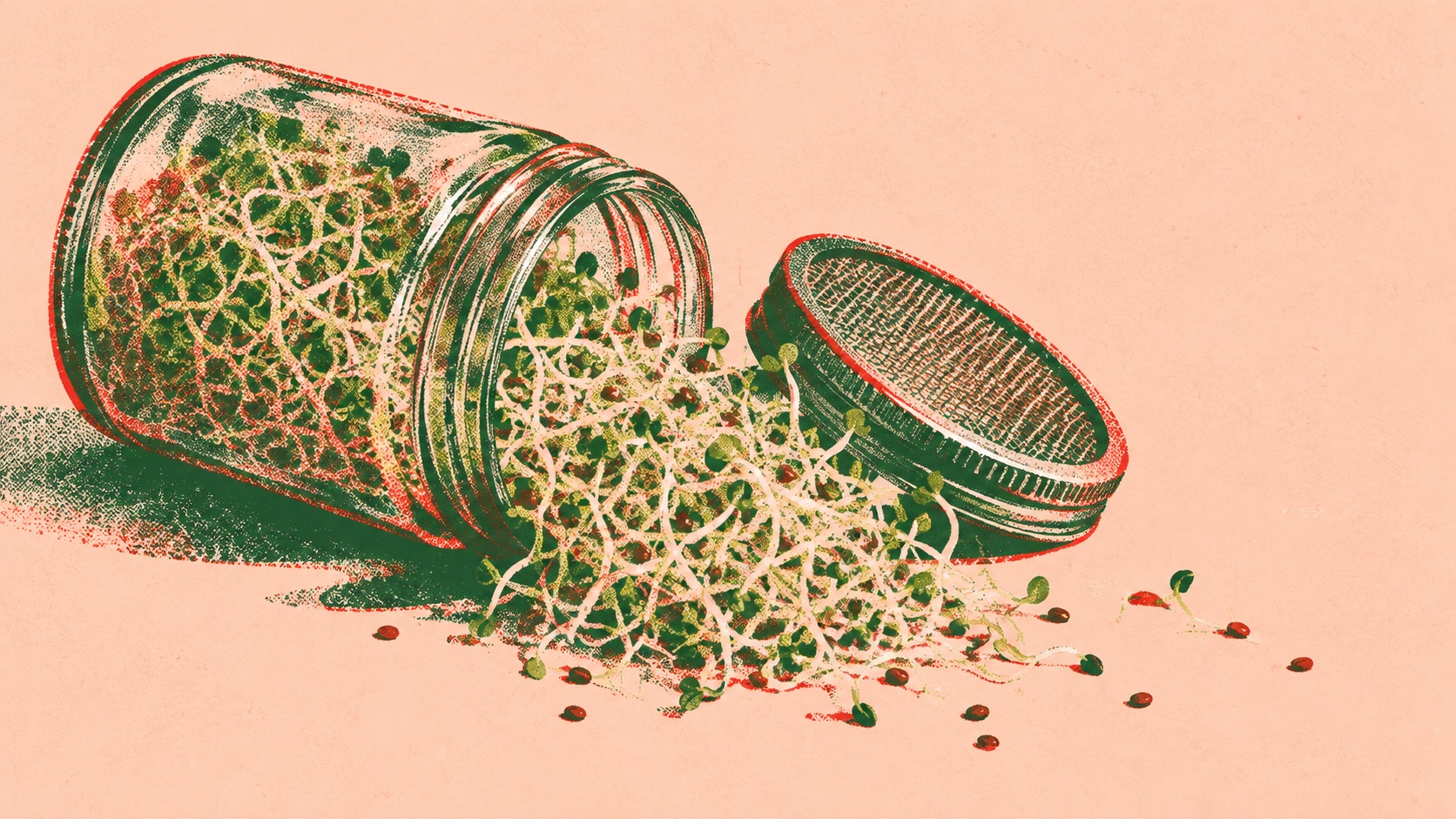
So a sprouting jar is an incubator: a seed with a hairline crack, three to five days at room temperature in standing water, and a handful of cells becomes a colony inside the plant tissue. The same conditions that make sprouts fast and cheap to grow make them the only produce category where the contamination is built in before harvest. That is why both of this month’s outbreaks trace to the seed and the grow room rather than to a field or a truck, and why FDA’s guidance to seed suppliers counts 52 sprout outbreaks and more than 2,700 illnesses between 1996 and 2020, noting that “contaminated seed has historically been identified as the likely source of most sprout-related outbreaks.” The worst on record was not in the US: in 2011, an outbreak in Germany that investigators traced to sprouted fenugreek seed produced 3,816 cases, 845 of them with hemolytic-uremic syndrome, and 54 deaths.
“If just a few harmful bacteria are present in or on the seed, the bacteria can grow to high levels during sprouting, even if you are growing your own sprouts under sanitary conditions at home.” — FDA
The standing advice follows from the mechanism, and it is more specific than “be careful.” FDA’s wording: people more vulnerable to foodborne illness “should avoid eating raw or lightly cooked sprouts of any kind (including onion, alfalfa, clover, radish, and mung bean sprouts),” and for everyone, “Cook sprouts thoroughly. This significantly reduces the risk of illness.” CDC names the vulnerable groups as children under 5, adults 65 and older, pregnant people and anyone with a weakened immune system. For the two products actually recalled, the instruction is simpler: “Do not eat any recalled sprouts. Throw them away or return them,” and wash whatever they touched “using hot soapy water or a dishwasher.” This is the same logic as the leafy-greens problem, one step further along: lettuce can at least be rinsed; a sprout is contaminated from the inside out.
Know the signsTwo germs, two timelines
The two outbreaks carry different bacteria, and they announce themselves differently. Shiga toxin-producing E. coli, the alfalfa outbreak’s main germ, starts three to four days after eating it: “severe stomach cramps, diarrhea (often bloody), and vomiting,” with most people recovering in five to seven days. Its particular hazard is a kidney complication, hemolytic-uremic syndrome, that CDC calls a medical emergency and says is most common in children under five; the warning signs it lists are urinating less or not at all, losing the pink in the cheeks and lower eyelids, unexplained bruising or tiny red spots, blood in the urine, unusual tiredness or irritability, and decreased awareness. No HUS cases have been reported in either outbreak. Salmonella, the broccoli outbreak’s germ and the alfalfa outbreak’s second one, is faster and usually milder: symptoms “start 6 hours to 6 days after infection and usually last 4 to 7 days,” mostly “watery diarrhea that might have blood or mucus,” fever and cramps.
One instruction is specific to the E. coli half and worth knowing before you reach for the medicine cabinet. CDC’s treatment page: “Most people get better without using antibiotics,” and “Using antibiotics with STEC infection can increase the chance of HUS.” The same page says anti-diarrheal medication “might make your illness last longer” and “can increase the chance of hemolytic uremic syndrome.” In other words, the usual stop-the-diarrhea reflex is the wrong one for a suspected STEC infection, and bloody diarrhea after a suspect food is a reason to be seen, not medicated at home. CDC’s call-a-clinician list, identical on both outbreak pages: diarrhea with a fever over 102°F; diarrhea for more than two days that is not improving; bloody diarrhea; vomiting so much you cannot keep liquids down; and signs of dehydration — not peeing much, dry mouth and throat, dizziness on standing.
There is also a long tail. In a 2017 meta-analysis of people who had a bacterial, viral or parasitic gut infection, the pooled prevalence of irritable bowel syndrome twelve months later was 10.1 percent, rising to 14.5 percent beyond a year — the post-infectious IBS that readers of this summer’s cyclospora coverage will recognise. Most people who get sick from sprouts this month will be fine in a week. Roughly one in ten will still be thinking about it next September.
The bottom lineWhat to do with the sprouts in your fridge
If you have Everything Sprouts or Calco alfalfa sprouts, or Evergreen Fresh Sprouts broccoli sprouts, the agencies say throw them out, whatever the date on the bag. If you have sprouts from any other grower, nothing in either investigation implicates them; the standing advice about cooking and about who should skip raw sprouts is the same as it was in August. And if you grow your own, FDA’s sentence about sanitary home conditions is the one to remember: the jar is not the problem, the seed is. Keep an eye on the alfalfa investigation — a second grower used the same seed lot and has not yet been named. This article is educational, describes what the cited agencies report as of September 10, and is not medical advice.