Whole Foods Ashwagandha Recalled Over Salmonella. Dry Powder Doesn’t Kill It
One lot of the 365 Whole Foods Market ashwagandha capsules, sold for 11 months on Amazon and in stores in 30 states and D.C., is being recalled for possible Salmonella. No one has been reported sick, and the code to check is on the bottom of the bottle.
Yes. On October 30, 2026, Vitality Works Inc. recalled one lot of 365 Whole Foods Market Standardized + Full Spectrum Blend Ashwagandha Capsules, 120 count, lot 2025-26227, expiration 10/13/2028, UPC 9948252099, for possible Salmonella, according to the company notice posted by the FDA. It was sold from November 24, 2025, to October 20, 2026, on Amazon.com and at Whole Foods Market stores in 30 states and D.C. No illnesses have been reported. Throw it away; Whole Foods gives refunds in store.
It is a plain white plastic bottle of 120 capsules, the kind that sits next to the vitamin D and the magnesium on a bathroom shelf. Turn it over and two lines are printed on the bottom: a lot number and an expiration date. If they read 2025-26227 and 10/13/2028, that bottle is part of a recall announced on Friday. We read the company’s notice line by line, counted the states and the days it covers, and went to the food-safety research on a question most people never think to ask about a supplement: can a bone-dry powder carry a stomach bug at all?
It can. Below: exactly which bottle is covered and where to look, why a dry capsule does not kill Salmonella the way people assume it might, and what the illness looks like in the gut if someone has already taken some.
The product: 365 Whole Foods Market Standardized + Full Spectrum Blend Ashwagandha Capsules, 120 count, white plastic bottle, UPC 9948252099, per the Vitality Works Inc. notice posted by the FDA on October 30, 2026.
The code: lot 2025-26227 and expiration date 10/13/2028, both printed on the bottom of the bottle. Both must match.
Where and when: Amazon.com and Whole Foods Market stores in 30 states and D.C., sold November 24, 2025 to October 20, 2026, which is 330 days by our arithmetic.
Illnesses: none reported, according to Vitality Works. A routine test of one retail bottle found the problem.
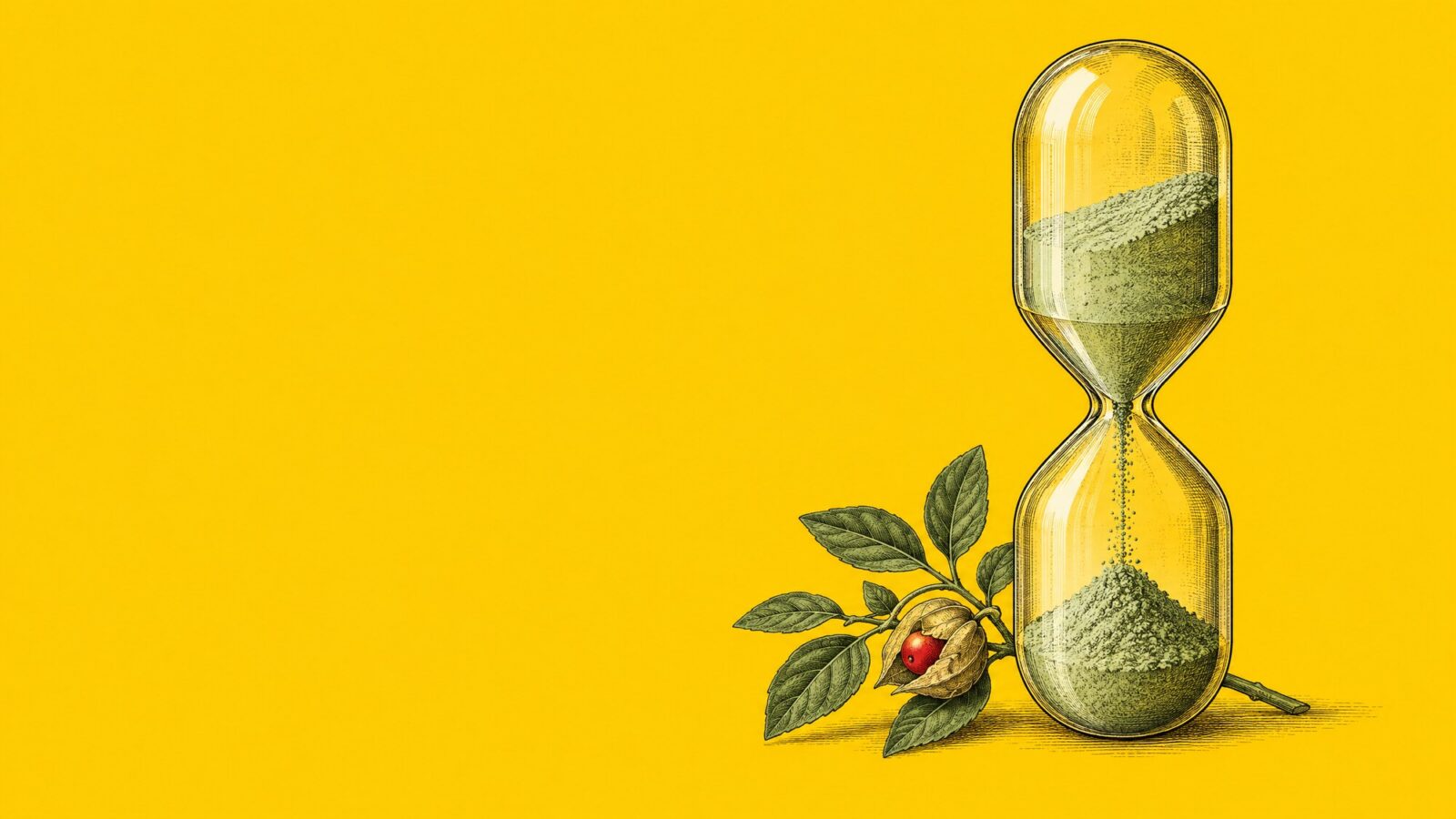
The dry-food fact: on dried garlic stored at room temperature, Salmonella never grew but “could persist over months,” a 2017 study found (PMID 29024904).
Sources: Vitality Works Inc. via FDA, October 30, 2026; CDC; NCCIH; PubMed. Educational, not medical advice.
The recall: One lot, 120 capsules, sold for 11 months in 30 states and D.C.
On October 30, 2026, Vitality Works Inc. of Albuquerque, New Mexico, announced it is recalling one lot of 365 Whole Foods Market Standardized + Full Spectrum Blend Ashwagandha Capsules, the 120-count bottle, “because it has the potential to be contaminated with Salmonella.” The FDA posted the notice the same day. The bottle carries the 365 Whole Foods Market name; Vitality Works is the company named in the notice as recalling this lot.
According to the notice, the capsules were sold from November 24, 2025, through October 20, 2026, online through Amazon.com and in Whole Foods Market stores in Arkansas, Arizona, California, Colorado, Connecticut, Florida, Georgia, Hawaii, Iowa, Illinois, Kansas, Massachusetts, Maryland, Maine, Michigan, Minnesota, Missouri, North Carolina, New Jersey, New York, Ohio, Oklahoma, Oregon, Pennsylvania, Tennessee, Texas, Utah, Virginia, Washington and Wyoming, plus the District of Columbia. Our arithmetic: that is 30 states and D.C., over a window of 330 days, roughly 11 months.
Vitality Works says no illnesses have been reported to date, and that “the potential contamination was identified through routine sampling of a single retail unit.” In plain words: someone tested one bottle off a shelf, not a sick customer, and that test is what started this. Only lot 2025-26227 is named. Other 365 ashwagandha products, such as gummies, drops or powders, and other lots of these capsules are not part of this recall by the notice’s own wording.
Check your shelf: The code is on the bottom of the bottle, not the label
The FDA notice describes white plastic bottles labeled 365 Whole Foods Market Standardized + Full Spectrum Blend Ashwagandha, 120 count, UPC 9948252099. The lot number, 2025-26227, and the expiration date, 10/13/2028, are both printed on the bottom of the bottle. Both have to match. A bottle with a different lot or a different date is not covered.
If yours matches, the company says not to take it, to throw it away, and not to return it to the store. Refunds are available at any Whole Foods Market store. Vitality Works lists a recall line at (505) 268-9950, Monday to Friday, 8 a.m. to 5 p.m. Mountain Time. Amazon buyers got the same lot, so the code on the bottom matters more than where the bottle came from.
Our arithmetic on the date: the printed expiration of October 13, 2028 is 714 days, about 23 months, after the recall. A bottle like this is built to sit for years, which is exactly why the next question matters.
The dry question: A powder stops Salmonella growing. It does not make it go away
Ashwagandha is an evergreen shrub from parts of India, Africa and the Middle East, and supplements “typically contain ashwagandha root, leaf, or root/leaf extracts,” according to the National Center for Complementary and Integrative Health, which notes it is “often promoted for stress and anxiety, sleep” and athletic performance. In a capsule, that plant material is a dry powder, swallowed as it is, with no cooking step between the bottle and the stomach.
Dry feels safe. Bacteria need water to multiply, and a dried plant powder has very little of it available. But not multiplying and dying are two different things. A 2010 review in the Journal of Food Protection (PMID 21067682) put it flatly: “It is well recognized that Salmonella can survive for long periods in low-moisture food products,” from peanut butter to dried milk. The same review notes that Salmonella’s heat resistance “generally increases with reducing moisture,” which is part of why dry foods are hard to clean up once they are contaminated.
The closest test to a dried root powder comes from a 2017 University of Georgia study in the International Journal of Food Microbiology (PMID 29024904) on dehydrated garlic. The researchers found Salmonella could not grow on the dried garlic at any temperature or moisture level they tried. Yet stored at room temperature, it “could persist over months with the population gradually declining,” falling by 4.3 log over 88 days. Our arithmetic: a 4.3 log drop means the count fell by a factor of about 20,000 in three months. That is a real decline, and it is still not zero.
A 2026 review from the University of Campinas in Brazil (PMID 41906447) explains how. Under drying stress, Salmonella slows down, packs its cells with protective molecules such as trehalose, a sugar that steadies the cell when water leaves, and can clump into protective films. Some cells go dormant and become hard to detect until conditions improve. The authors note that this stress can make the bacterium tougher against heat as well. For a capsule, the conditions improve the moment it dissolves in a warm, wet stomach.
In the gut: What Salmonella does, and how long it usually lasts
The CDC lists the most common symptoms of a Salmonella infection as “watery diarrhea that might have blood or mucus” and “stomach cramps that can be severe,” sometimes with nausea, vomiting or a headache; the Vitality Works notice also lists fever. Symptoms “usually start 6 hours to 6 days after infection and usually last 4 to 7 days.” The Vitality Works notice adds that young children, frail or elderly people and people with weakened immune systems are more likely to get seriously ill.
The CDC suggests calling a doctor for diarrhea or vomiting that lasts more than two days, bloody poop or pee, a fever higher than 102°F, or signs of dehydration such as peeing very little or feeling dizzy. For scale, the CDC estimates about 1.35 million Salmonella infections in the United States every year, most of them from food. None have been tied to this lot.
How we checked this: Sources and method
We read the Vitality Works Inc. company announcement as posted by the FDA on October 30, 2026, for the product name, lot, UPC, expiration date, sale dates, states, illness count and refund instructions; the state count and the day counts are our arithmetic. Symptom timing and the national estimate come from the CDC’s Salmonella pages; the description of ashwagandha comes from NCCIH. The research on dry foods comes from three papers read on PubMed, each matched to its title: Podolak and colleagues, 2010 (PMID 21067682); Zhang and colleagues, 2017 (PMID 29024904); and Oliveira, Amorim-Neto and Sant’Ana, 2026 (PMID 41906447). The garlic study is a close cousin of a root powder, not a test of this product; we say so because it matters. This article is educational, describes what the cited sources say, and is not medical advice.