The Frozen Berry E. coli Recall Just Reached Trader Joe’s. Here’s Every Lot Code to Check
On October 2, the supplier behind this summer’s frozen blueberry outbreak added six more lots to its recall: five sold as Walmart’s Great Value and one as Trader Joe’s Organic Mixed Berry Blend. The outbreak itself ended on September 21. Here is every code in one table, and what the digits appear to say.
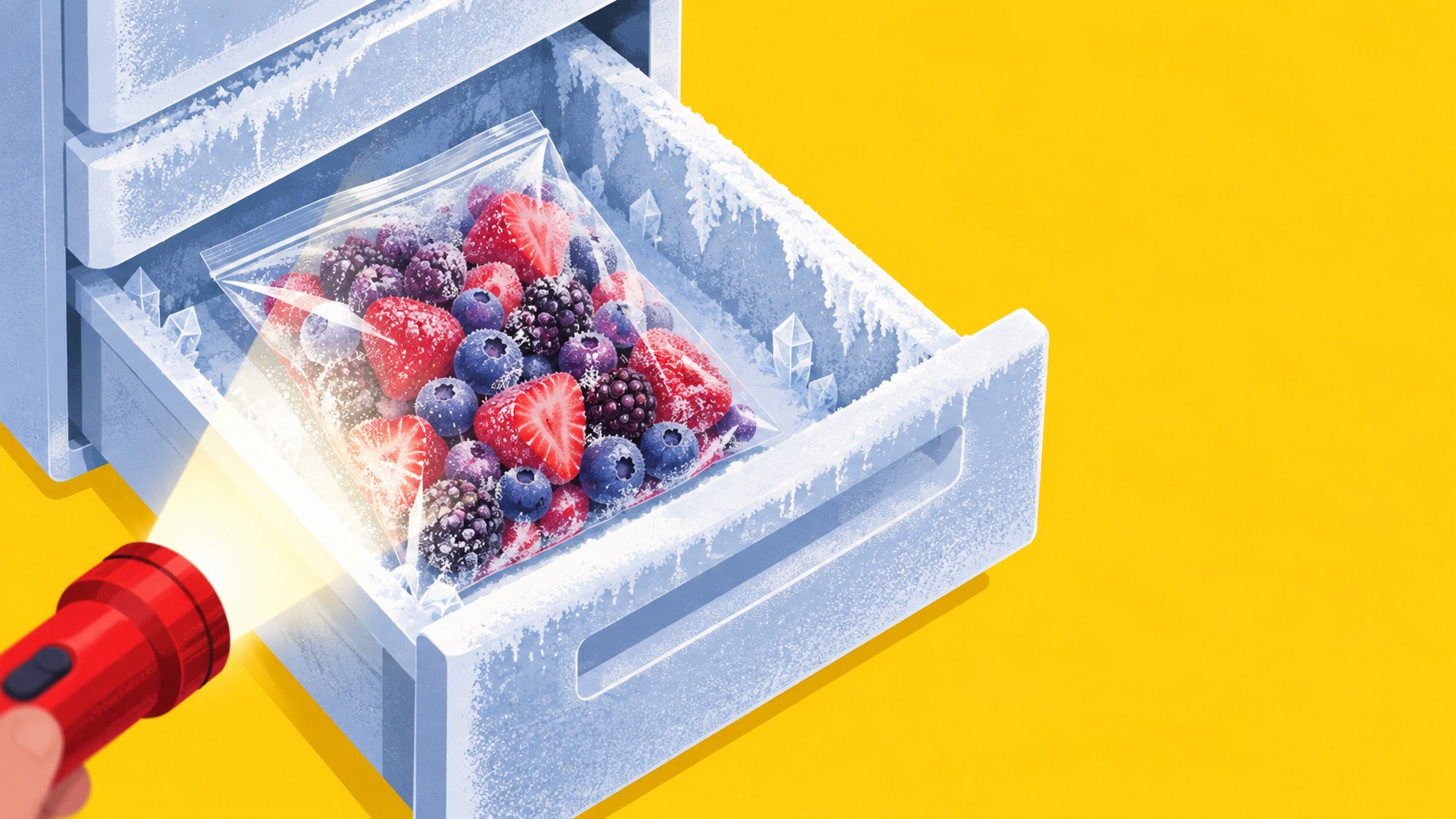
On October 2, 2026, Frutas y Hortalizas del Sur S.A. expanded its frozen berry recall by six lots over possible E. coli O145:H28: Trader Joe's Organic Mixed Berry Blend, 12 oz, lot 6 051 01 (best before February 20, 2028); Great Value Organic Blueberries, 10 oz, lots 6 019 01, 6 040 01 and 6 163 01; and Great Value Organic Triple Berry Blend, 10 oz, lots 6 031 01 and 6 041 01. They were sold at Trader Joe's in 26 states and Washington, D.C., and at Walmart in 30 states and Puerto Rico. The outbreak itself ended on September 21 at 17 illnesses, and Trader Joe's says no illnesses have been reported from its product. Recalled bags can be discarded or returned for a full refund.

The code is easy to miss. On a bag of Trader Joe’s Organic Mixed Berry Blend it is printed on the back, with a best-before date of 02/20/2028: CF 6 051 01-5. On Walmart’s Great Value frozen berries it is on the front. Since Friday, October 2, those few digits are what separate an ordinary bag of smoothie fruit from one covered by a recall that has now grown three times since July. We read all four recall notices, Trader Joe’s own announcement and both federal outbreak pages, and put every code in one table.
The short version: on October 2 the Chilean supplier behind this summer’s frozen blueberry E. coli outbreak, Frutas y Hortalizas del Sur S.A., added six lots to its recall. Five were sold as Walmart’s Great Value and one as Trader Joe’s. The outbreak itself has not grown. The CDC closed it on September 21 at 17 people sick, six hospitalized and no deaths, and that count has not changed. What changed, eleven days after the investigation closed, is the list of bags.
What changed: Six more lots, one new retailer, one new product
The supplier’s notice, posted by the FDA on October 2, widens its July and September recalls to take in two more lots of Great Value Organic Triple Berry Blend, three lots of Great Value Organic Blueberries, a product that had not been part of the recall before, and one lot of Trader Joe’s Organic Mixed Berry Blend, the first Trader Joe’s product to be named. The reason given is one sentence long: the action is “a precautionary measure following traceback information linked to frozen blueberries which were the subject of the first recall on July 3, 2026.”
Trader Joe’s own announcement, dated the same day, is more direct. The company says it is recalling a single lot “in an abundance of caution,” and adds: “No illnesses related to this product have been reported, the regulatory investigations are closed, and no further expansion is anticipated for Trader Joe’s products.” The supplier’s October notice does not address illnesses for the new Walmart lots either way. Its September notice, for the first Great Value lot, said none had been associated with that product to date.
Check your freezer: Every code now under recall
| Product (frozen) | Lot code | Best by | Sold at |
|---|---|---|---|
| Trader Joe’s Organic Mixed Berry Blend, 12 oz | 6 051 01 | Feb. 20, 2028 | Trader Joe’s |
| Great Value Organic Blueberries, 10 oz | 6 019 01 | Jan. 19, 2028 | Walmart |
| Great Value Organic Blueberries, 10 oz | 6 040 01 | Feb. 9, 2028 | Walmart |
| Great Value Organic Blueberries, 10 oz | 6 163 01 | June 12, 2028 | Walmart |
| Great Value Organic Triple Berry Blend, 10 oz | 6 031 01 | Jan. 31, 2028 | Walmart |
| Great Value Organic Triple Berry Blend, 10 oz | 6 041 01 | Feb. 10, 2028 | Walmart |
| Great Value Organic Triple Berry Blend, 10 oz | 6040 01-6 | Feb. 9, 2028 | Walmart |
| GreenWise Organic Whole Blueberries and Whole Mixed Berries, 10 oz and 48 oz | All lots | Any | Publix |
The October notice lists Walmart stores in 30 states and Puerto Rico: Alabama, Arkansas, Connecticut, Florida, Georgia, Iowa, Illinois, Indiana, Kansas, Kentucky, Louisiana, Michigan, Minnesota, Missouri, Mississippi, North Carolina, North Dakota, Nebraska, New Jersey, New York, Ohio, Oklahoma, Pennsylvania, South Carolina, South Dakota, Tennessee, Texas, Virginia, Wisconsin and West Virginia. Connecticut, New Jersey, New York and Pennsylvania are new since September. Trader Joe’s lists 26 states and the District of Columbia: Alabama, Arkansas, Colorado, Delaware, Florida, Georgia, Illinois, Indiana, Iowa, Kansas, Kentucky, Louisiana, Maryland, Michigan, Minnesota, Missouri, Nebraska, North Carolina, Ohio, Oklahoma, Pennsylvania (in Trader Joe’s wording, “Pittsburgh only”), South Carolina, Tennessee, Texas, Virginia and Wisconsin.
Put the two lists together and the recall touches 33 states by our count. No West Coast state is on either one, including California, where Trader Joe’s is based; Colorado is as far west as it goes.
Two details matter at the freezer door. For the Walmart and Trader Joe’s products only specific lots are recalled, so the brand alone settles nothing; the lot code does. And the best-by dates run as late as June 2028, which is why the FDA says recalled products “should no longer be available for sale” and still asks people to check their homes. If a bag matches, the notice says it should not be eaten and can be discarded or returned to Walmart or Trader Joe’s for a full refund. Trader Joe’s customer line is (626) 599-3817, weekdays from 6 a.m. to 5 p.m. Pacific; the supplier’s is 336-899-5612, weekdays from 8 a.m. to 6 p.m. Eastern.
Reading the code: What the digits appear to say
None of the notices explains the lot codes. But they follow a pattern, and it holds for every bag. Each code starts with a 6, followed by three digits. Count that many days into 2026, add two years, and you land exactly on the bag’s best-by date: 019 is January 19, 031 is January 31, 040 is February 9, 041 is February 10, 051 is February 20 and 163 is June 12. A day-of-the-year number is a familiar way to stamp a pack date; the USDA describes the same three-digit system on egg cartons, “starting with January 1 as 001.”
Read that way, and this is our reading, not the supplier’s, the recalled Walmart and Trader Joe’s bags were packed on six days: five between January 19 and February 20, and one on June 12. The lot at the center of the first recall in July, GreenWise lot 60401, carries the same 040, and so does one of the newly recalled Great Value blueberry lots, 6 040 01. Five of the six new lots sit within three weeks of that date. That fits the notice’s only explanation, that the expansion follows traceback from the July 3 blueberries. It does not tell us whether any of these bags is contaminated, and no notice says that.
The outbreak ended on September 21. The list of recalled bags grew on October 2. Both are true.
Why now: An outbreak can close while a recall keeps growing
An outbreak and a recall are different instruments. An outbreak is closed when illnesses stop being linked to a food. The CDC’s page says simply, “This outbreak is over,” and its final count stands: 17 people in Florida and Georgia, six hospitalized, no deaths, with illnesses that began between May 11 and August 2. A recall is a company pulling product, and it can keep widening as production and shipping records are traced. The FDA, which calls its own investigation complete, has placed the supplier on Import Alert 99-35, under which its frozen blueberries “may be detained without physical examination” at the border.
One practical wrinkle: as of Sunday, October 4, neither federal outbreak page had caught up. The CDC’s page and the FDA’s outbreak advisory both still carry their September 21 updates, which list a single Great Value lot and no Trader Joe’s product. For now the six new lots appear only in the October 2 recall notice and on Trader Joe’s site, so a bag checked against the outbreak pages alone would not show up as recalled.
Why the freezer matters: Freezing is a pause button
Frozen berries are usually eaten uncooked, and the freezer does not sanitize them. The USDA’s food-safety service puts it this way: freezing to 0 °F “inactivates any microbes,” but “once thawed, however, these microbes can again become active.” That is why a recall still matters for bags dated into 2028. We went deeper on the freezer question, and on what the name O145:H28 means, in our close-out of the outbreak.
Know the signs: What this kind of E. coli infection looks like
The strain in this outbreak, E. coli O145:H28, is a Shiga toxin-producing E. coli. Per the CDC, most people infected “experience severe stomach cramps, diarrhea (often bloody), and vomiting”; symptoms usually start three to four days after swallowing the bacteria, and most people recover without treatment in five to seven days. Some develop a kidney complication called hemolytic uremic syndrome and need hospital care, which the recall notice says is a particular risk for young children, older adults and people with weakened immune systems. The FDA’s guidance for anyone who ate a recalled product and has symptoms that resemble an E. coli infection is to contact a health care provider. We cover diarrhea and blood in the stool in their own guides.
For scale: the outbreak count is 17 confirmed illnesses in two states, and Trader Joe’s reports none tied to its product. This is a freezer check, not an emergency. A different strain, O26:H11, is behind the raw-milk cheese outbreak we covered on September 29, and we log recalls like this one on our gut health recall tracker. Trader Joe’s, Walmart, Publix and Frutas y Hortalizas del Sur had no involvement in this article. It is educational, describes what the cited recall notices and agency pages say, and is not medical advice.