Why Beer Gives You Diarrhea and Liquor Doesn’t
Oktoberfest pours 6.5 million litres a year in one-litre mugs, and the morning-after question has a folk answer that is wrong at the first organ: in the one experiment that timed beer, wine and whisky through a human stomach, beer left slowest. The real answer is downstream, and it is mostly arithmetic.
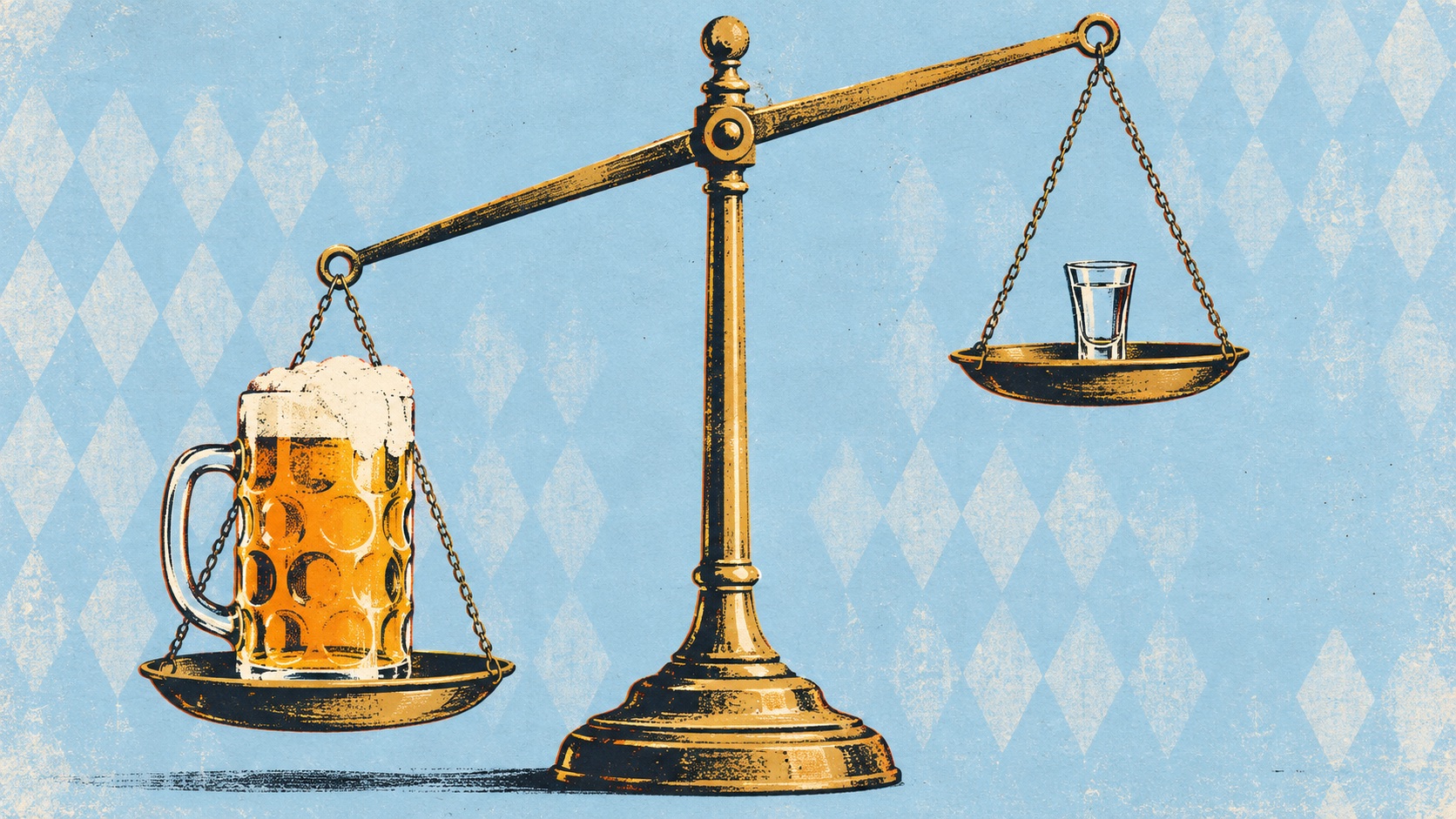
Beer is not rushing through you; it is delivering more. In the only controlled study that timed beverages through a fasted human stomach, beer half-emptied in 39.3 minutes against 26.4 for whisky and 14.6 for water, and the authors concluded that beer's non-alcohol components inhibit emptying more than its alcohol predicts. The difference people feel is what arrives further down. A one-litre Oktoberfest mug at about 6 percent alcohol carries roughly 60 millilitres of pure alcohol, a litre of fluid and the fermentable malt carbohydrate that distilled spirits contain essentially none of, and a beer occasion delivers several of those where a spirits occasion delivers a few 40-millilitre shots. In experimental reviews, acute alcohol depresses the colon's holding motility and enhances its propulsive motility, while heavy use reduces water and sodium absorption in the small intestine; unabsorbed carbohydrate then ferments in the colon, which is why Cleveland Clinic flags high-carbohydrate drinks such as beer as more likely to cause diarrhea. Next-day looseness is not mainly dehydration: a litre of 4 percent beer produced about 160 millilitres more urine than alcohol-free beer in 12 men, and that effect vanished when they started out dehydrated. Monash University lists rum, red wine over 250 millilitres and sticky wines as the high-FODMAP drinks, not beer. Educational, not medical advice.
The 191st Oktoberfest opens in Munich on September 19, and for sixteen days the city will pour roughly what it poured last year — 6.5 million litres for 6.5 million visitors, in one-litre glass mugs that will cost between €14.80 and €15.90 this season. Cincinnati runs its own version two days earlier, 808,300 people strong last year. And in the days after all of it, a very specific question spikes in search, one you can watch autocomplete finish for you: why does beer give me diarrhea but not liquor?
It is a good question with a bad folk answer. The folk answer is that beer is fizzy and voluminous, so it “rushes through” while a shot of something strong sits politely in the stomach. The stomach data, which exists and is oddly beautiful, says almost the reverse. So here is the actual physiology in three stops — the stomach, the small intestine, the colon — and why beer still wins the bathroom contest even though it loses the first leg.
The stomach: Beer leaves slower than whisky
In 2004, a group in Germany did the experiment everyone assumes has been done and nobody has read. They gave ten fasted volunteers water, ethanol at three strengths, beer, red wine and whisky on separate days, with a tube in the stomach and an ultrasound on the outside, and timed how long each took to half-empty. Water was gone in about 15 minutes. Whisky took 26. Beer took 39. Red wine took 73. Alcohol at 4% and 10% in plain water emptied in 23 minutes — faster than the beer that shares their strength — which told the researchers something in beer other than its alcohol was holding it back. Their conclusion was blunt: beer and red wine inhibit emptying more than their alcohol content predicts, and whisky does not.
| Drink (fasted, 500 ml unless noted) | Gastric half-emptying time |
|---|---|
| Water | 14.6 min |
| 4% ethanol in water | 22.6 min |
| 10% ethanol in water | 22.7 min |
| Whisky (125 ml + 125 ml water) | 26.4 min |
| 40% ethanol in water | 27.8 min |
| Beer | 39.3 min |
| Red wine | 72.6 min |
A follow-up with a meal in the stomach found the same order at gentler margins: 16 men, 300 millilitres of drink with solid food, half-emptying 131 minutes with water, 163 with beer, 186 with red wine. And in a third study the same group tested the ritual behind every schnapps at a Bavarian table — the 40-millilitre digestif “to help the meal go down.” It did nothing to emptying time. A walk after the meal did, significantly. The stomach, in other words, is not where beer earns its reputation. If anything, beer parks there.
Ten fasted adults, seven drinks, one ultrasound: beer half-emptied in 39 minutes, whisky in 26. The rushing-through theory fails at the first organ.
The dose: A litre at six percent
So where is the difference? Start with arithmetic that nobody does at a beer hall. Paulaner brews its Oktoberfest beer at 6.0% alcohol, and the other tent beers sit close to that. One Maß is a litre. That is about 60 millilitres of pure alcohol in a single glass, delivered alongside a litre of liquid and the carbohydrate that malt leaves behind — the maltose and dextrins that make beer taste like beer and that distilled spirits, by definition, contain essentially none of. A person who says “liquor doesn’t do this to me” is usually comparing a night of two or three litres against a night of three or four 40-millilitre shots. The alcohol dose differs by a multiple, and the fluid and carbohydrate dose differs by an order of magnitude.
Alcohol’s effect on the gut is dose-shaped. The standard review puts it in one sentence: “Low alcohol doses accelerate gastric emptying, whereas high doses delay emptying and slow bowel motility.” That sounds like it should favour beer’s reputation, but read it with the Franke tables in hand: beer’s slowness in the stomach is the beverage’s doing, and what happens next depends on how much alcohol and fluid finally arrive downstream. At a litre a glass, a lot arrives.
The colon: Where the water goes
The intestine is where alcohol’s laxative reputation is actually earned, and the mechanism has two halves that the literature is careful to keep apart. The acute half: in experimental work summarised by Bode and Bode, alcohol given acutely “depressed the colon’s impeding motility but enhanced its propulsive motility” — less of the churning that holds stool in place, more of the pushing that moves it along. The chronic half: in people who drink heavily over time, the same review describes “markedly reduced water and sodium absorption in the jejunum and ileum,” which is the part of the small bowel whose entire job is reclaiming fluid. Less reclaiming plus more pushing is a recipe, and the review says so, noting these effects “may contribute to” the diarrhea frequently seen in heavy drinkers.
Cleveland Clinic’s explainer compresses this to “alcohol draws water into your intestinal tract, acting like a laxative,” and adds the line that is most relevant to Oktoberfest: “high-carb options, such as beer and sugary alcoholic beverages, may be more likely to cause diarrhea.” Unabsorbed carbohydrate arriving in the colon is food for bacteria, and fermentation means gas and water. It is the same reason a fiber soda or a bag of sugar-free candy can send you to the bathroom, running on a different molecule. A shot of vodka brings alcohol to the colon. A litre of Festbier brings alcohol, a litre of water and a fermentable snack.
One more measured piece, because it explains the morning after. In a study of twelve men drinking a litre of beer at 0% or 4% alcohol, the alcoholic version produced 1,279 millilitres of urine over the following hours against 1,121 for the alcohol-free one — a real diuretic effect, about a glass and a half. But when the same men started the experiment already dehydrated, the difference vanished. The body defends its water. Which means the next-day looseness after a long session is not mainly “dehydration diarrhea”; it is the colon finishing the work described above, on a night’s worth of alcohol and fermentable leftovers.
The other suspects: Wine, FODMAPs, and a study of four
Two things people blame that the evidence does not support, and one it half does. Histamine in wine is often accused of digestive mischief, but in double-blind challenges of wine-intolerant adults, histamine-rich and histamine-poor wine produced no difference in reactions; beer, for the record, carries roughly a milligram of histamine per litre in published assays, a fraction of what those wines contained. FODMAPs are the half-supported one: Monash University’s own alcohol guidance names rum, red wine over 250 millilitres and sticky dessert wines as the drinks that tested high, and beer is not on that list — though Monash also calls alcohol itself “an irritant to the gut” regardless of FODMAP content, which for anyone with IBS is the operative sentence.
And then there is the finding that went around social media last year as “pooping cures hangovers.” The study is real; it is also four men, drinking vodka, in an uncontrolled pilot, in which blood alcohol happened to hit zero right after the first bowel movement. It is an interesting observation about the gut still absorbing alcohol hours later. It is not a treatment, and nobody should be planning a Sunday around it.
The honest bottom line: It is the dose, worn as a costume
Cleveland Clinic ends its piece by saying that unless you have a digestive condition, the type of alcohol “probably matters less than how much you drink.” The stomach-emptying data is the reason that hedge is correct and the reason it feels wrong: beer really is different from liquor in the stomach — slower, not faster — and the difference people feel the next morning is what beer carries in with the alcohol and how much of it a beer occasion delivers. A litre of six-percent lager is a large dose of alcohol, a litre of fluid and a fermentable carbohydrate load arriving together; a shot is none of those things but the first. That is the whole answer, and it is not really about beer.
For the record, the gut also keeps score over time: in one classic measurement, heavy drinkers within four days of their last drink almost always showed higher intestinal permeability than controls, an effect that persisted for up to two weeks — a good argument for the alcohol-free tent beer that Munich says was up 6 to 10 percent in demand last year. If a beer night reliably produces more than a loose morning — blood, pain, days of symptoms, or a pattern that tracks every drink — that is worth a conversation with a clinician rather than a search bar. This article is educational, describes what the cited studies measured, and is not medical advice.