How to Make Yourself Poop: What Actually Works
On a stuck morning, the reliable fixes are unglamorous: water, fiber, the morning reflex, a walk, a footstool, and prunes. Here they are, in the order the specialists reach for them.
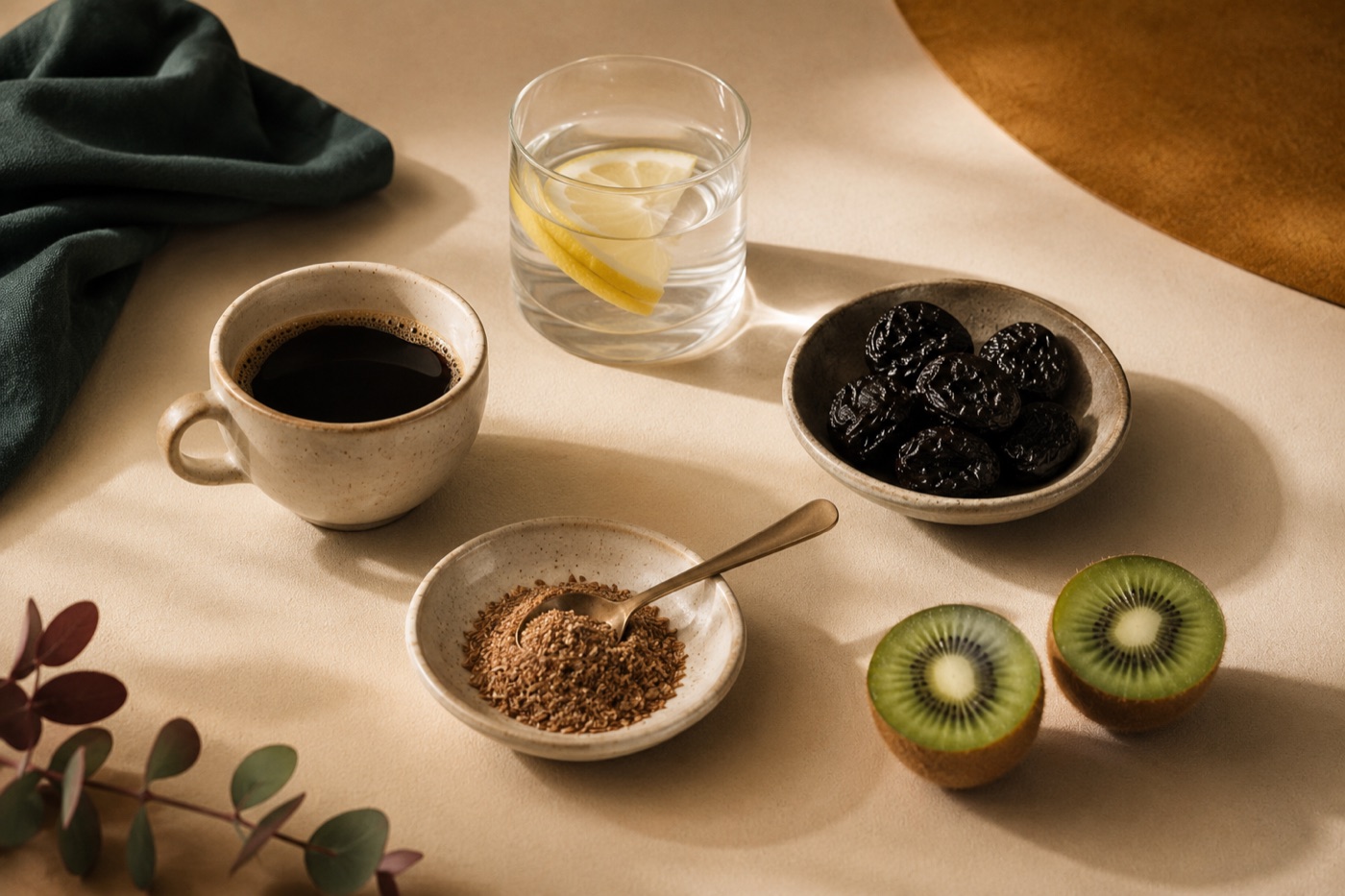
To relieve a slow day: drink water, add soluble fiber gradually, use the gastrocolic reflex (a warm drink with a meal), take a short walk, use a footstool to straighten the path, and try prunes. See a doctor if you go about a week or have severe pain, vomiting, or blood.

Almost everyone has had the morning: you know you need to go, and nothing happens. The good news, and it is genuinely good news, is that occasional constipation is one of the most common and most fixable complaints in all of medicine. Most of the time it answers to a short list of unglamorous levers, none of which involve the pharmacy.
What follows is the same advice the large medical centers give — a way to coax a stuck gut, in rough order of how gently and reliably each step works. It is not a treatment plan for chronic constipation, which is a conversation to have with a clinician. It is what to reach for on an ordinary slow day.
Start here: Water and fiber, the two that do the heavy lifting
The most boring answer is also the most effective one. Dehydration hardens stool, and fiber is what gives it the soft, bulky form that a colon can actually move. The two work together: fiber draws in water, and without enough water, fiber can make things worse rather than better. Harvard’s clinicians put hydration and fiber at the top of the list for exactly this reason.
For a stuck day, soluble fiber is the friendlier choice — oats, psyllium, the flesh of fruit — because it softens without the gas that a sudden pile of raw bran can bring. The one rule that trips people up: add fiber slowly, and always with water. A large dose overnight tends to produce bloating, not relief.
Fiber without water is a mistake. The two only work as a pair.
Prunes beat psyllium in a head-to-head trial. Forty constipated adults ate 50 g of prunes twice a day for three weeks, then 11 g of psyllium twice a day (the same 6 g of fibre either way); complete spontaneous bowel movements and stool consistency both improved significantly more on prunes (P < 0.05) (Attaluri et al., Aliment Pharmacol Ther 2011).
Two green kiwifruit a day added about 1.5 bowel movements a week. In a multicentre trial of 184 people (121 of them with constipation), four weeks of two kiwifruit daily added 1.53 complete bowel movements a week in functional constipation and 1.73 in IBS-C, outperforming psyllium in the combined group (P = 0.038) (Gearry et al., Am J Gastroenterol 2023; funded by Zespri, the kiwifruit marketer, which the paper discloses).
Coffee moves the colon like a meal does. Colonic manometry in 12 healthy adults: caffeinated coffee stimulated the colon 60% more than hot water and 23% more than decaf, an effect the authors called similar to eating a 1,000-calorie meal (Rao et al., Eur J Gastroenterol Hepatol 1998).
A footstool changed 1,119 recorded bowel movements. Fifty-two healthy adults logged every trip for a month with and without a footstool: 71% had faster bowel movements, 90% strained less, and the average trip dropped from 5.6 to 4.2 minutes (Modi et al., J Clin Gastroenterol 2019). Our fibre calculator covers the other half of the equation.
Use the reflex you already have: Why morning, coffee, and breakfast help
Your gut has a built-in trigger called the gastrocolic reflex: eating sets off a wave of colonic activity, and it is strongest after the overnight fast. That is the physiology behind the after-breakfast bathroom trip, and it is a tool you can use on purpose. A meal — even a small one — is a signal to the colon that it is time to make room.
Coffee adds its own push, stimulating colonic contractions within minutes in many people, decaf included, so a warm drink with breakfast stacks two nudges at once. And when the urge does arrive, honor it. Routinely ignoring the signal — too busy, wrong bathroom — teaches the colon to go quiet, which is one unglamorous route into constipation in the first place.
Move, and change the angle: A walk, and a footstool
Physical movement helps the gut’s own muscles do their work; even a short walk counts, which is part of why a stroll after a meal is such durable folk wisdom. Then there is a factor almost nobody thinks about: the angle you sit at.
The rectum takes a kink at the anorectal angle, held partly closed by a muscle sling — useful continence engineering the rest of the day, less useful when you are trying to go. Bringing your knees above your hips, as a small footstool does, relaxes that sling and straightens the path. Small studies have found the squatting-style posture reduces both the straining and the time spent, which is the entire appeal of the footstools that became a bathroom fixture. No gadget is required; a sturdy step or a stack of books does the same job.
The kitchen remedies: Prunes earn their reputation
Some foods pull double duty as gentle laxatives. Prunes are the classic, and they deserve the fame: they combine fiber with sorbitol, a sugar alcohol that draws water into the bowel. A handful of dried prunes, or a small glass of prune juice, is a time-tested nudge. Kiwifruit has a growing evidence base for the same purpose, and warm liquids of almost any kind seem to help get things moving.
About laxatives: Fine occasionally, not a habit
When the gentle levers are not enough, over-the-counter options exist, and they are not all the same. Osmotic laxatives draw water into the colon to soften stool; stimulant laxatives prod the bowel to contract. For a one-off, either can be reasonable, but the general guidance from clinicians is to lean on the osmotic and fiber-based options and to treat stimulants as short-term help — because leaning on them to hit a daily quota can, over time, leave the bowel less responsive on its own. A pharmacist is the right person to ask which is sensible for you, and the labels are worth reading.
If you find yourself needing any laxative regularly, that is the signal to stop self-managing and talk to a doctor. Persistent constipation is common and very treatable, but it is a conversation, not a supermarket decision.
When it is more than a slow day: The signs that change the plan
Most constipation is a nuisance, not an emergency. A smaller set of signs changes that. Going longer than about a week without a bowel movement, or constipation that comes with severe abdominal pain, vomiting, bloating with no passing of gas, unexplained weight loss, or blood in the stool, warrants a prompt call to a clinician rather than another glass of prune juice. A sudden, lasting change in your usual pattern deserves the same attention. For more on where that line sits, see how long you can safely go without pooping.
For everyone else, the levers on this page are the same ones the specialists reach for first. They are slow, they are dull, and they work far more often than the internet’s more dramatic suggestions — which is exactly why the doctors keep recommending them. Sources for this piece include Harvard Health, the Cleveland Clinic, and Healthline.