The Lunchbox PB&J Grows Up. Jams Baked Whole Grain Into the White Bread.
Jams built the lunchbox PB&J for the protein era and got it into Walmart, Target and a deal with the NFL players’ licensing arm inside 15 months. The quieter number is on the back of the box, so we read the Banana label line by line.
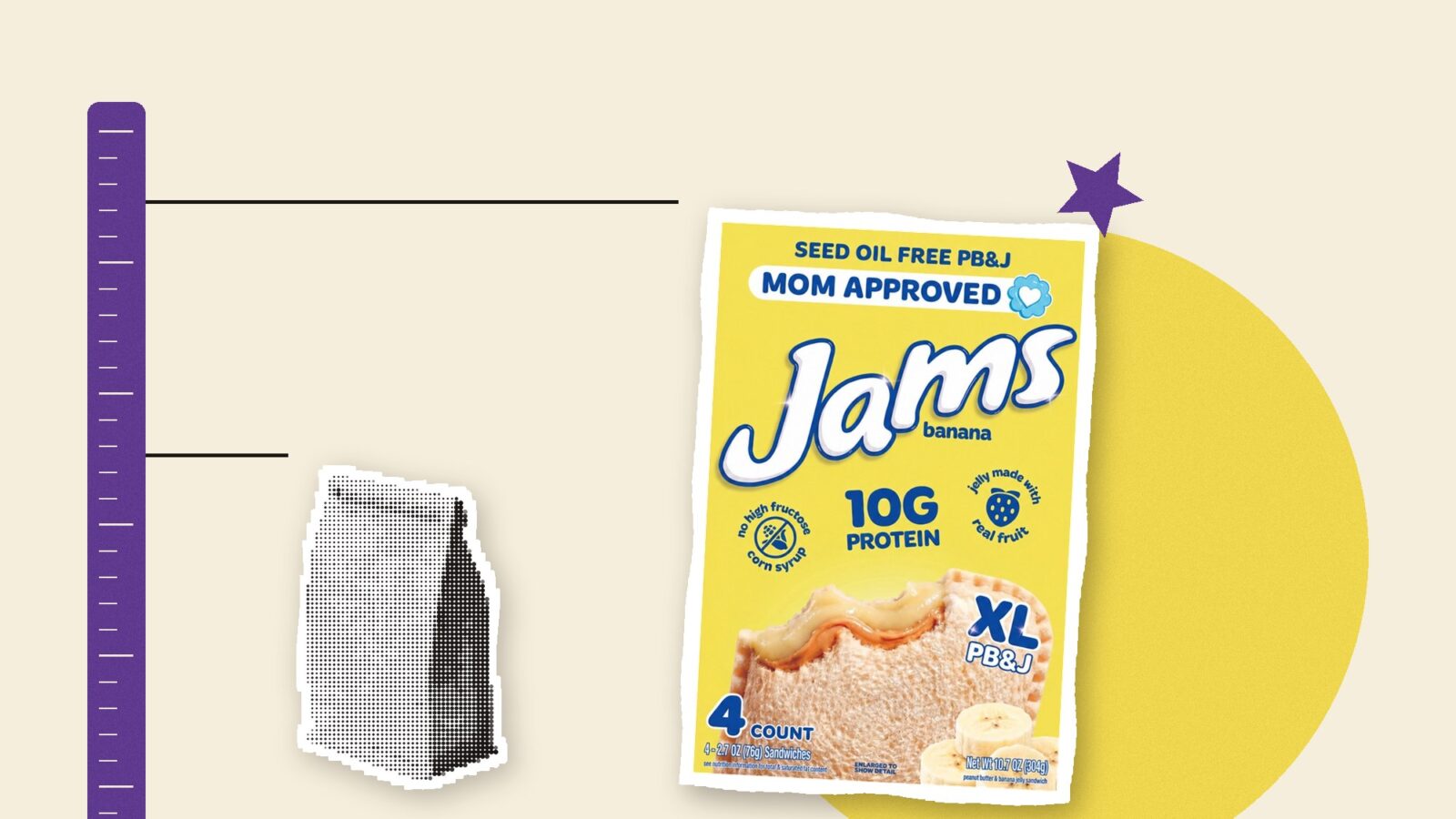
Jams is a frozen, crustless peanut butter and jelly sandwich from Nashville’s Dropout Companies, sold at Walmart, Target and H-E-B in Strawberry, Mixed Berry, Banana and Grape. The Banana XL label lists white wheat bread whose first flour is whole white wheat, peanut butter made of peanuts and palm oil, and a banana jelly of banana purée, sugar, pectin and citric acid. Per 76-gram sandwich it shows 270 calories, 10 g protein, 4 g dietary fiber (14 percent of the Daily Value), 8 g total sugars of which 6 g are added, and no high-fructose corn syrup, artificial colors or seed oils. White whole wheat is a whole grain milled from a paler wheat variety, and 4 g of fiber clears the 10-percent-of-Daily-Value line the FDA sets for a “good source” claim, by our reading of the rule. Educational, not medical advice.

Thirty minutes out of the freezer, a Jams sandwich looks like the one that came out of a lunchbox in 1998: soft white bread, the crust cut away, a crimped edge holding the peanut butter in, jelly just starting to show through the top slice. The box it came in is louder than that: “10G PROTEIN” sits in type nearly as big as the name. We turned the box over and read the small type instead, because the number a gut cares about is rarely the one on the front.
The first flour in the bread is whole white wheat. The jelly starts with fruit purée. The peanut butter is peanuts and palm oil, with no sugar of its own. And each 76-gram sandwich carries 4 grams of dietary fiber, 14 percent of a day’s worth, alongside the 10 grams of protein the box leads with. This page reads the Banana XL label line by line, works out where those 4 grams come from, and follows the sandwich from a Walmart freezer in July 2025 to a deal with the NFL players’ licensing arm and a co-owner named Pat McAfee by the summer of 2026.
The sandwich: a frozen, crustless peanut butter and jelly sandwich from Nashville’s Dropout Companies, launched at Walmart on July 14, 2025, in Strawberry and Mixed Berry; Banana arrived in August 2026 and Grape in September, and the line is now sold as “XL PB&J”.
The label (Banana XL, per 76 g sandwich): 270 calories, 10 g protein, 4 g dietary fiber (14 percent of the Daily Value), 8 g total sugars of which 6 g added, 14 g fat, 190 mg sodium, 240 mg potassium, per the product listing read on October 24, 2026.
The flour: “whole white wheat flour” is the first flour in the bread, ahead of enriched flour. White whole wheat is a whole grain milled from a paler variety of wheat, per the Academy of Nutrition and Dietetics.
The reach: more than 3,000 Walmart stores from July 2025, more than 950 Target stores from November 2025, H-E-B listings in 2026; $5.87 for a box of four at Walmart on October 24, 2026.
The league: a May 22, 2026 licensing deal with NFL Players Inc. for a PB&J developed with active players; the company says about 80,000 PB&Js are eaten across the league each year.
Sources: the Banana XL label as listed by Nosh and Walmart; Jams releases of July 2025, November 2025, May 2026 and June 2026; CNBC; Stack3d; the FDA Daily Value table. Educational, not medical advice.
The label: Whole white wheat first, then a PB&J with nothing unusual in it
The ingredient statement on the Banana XL label runs in three parts. The bread is water, whole white wheat flour, unbleached enriched flour, sugar and wheat gluten, then two percent or less of palm oil, yeast, salt, cultured wheat flour as a natural preservative, vinegar, wheat starch, enzymes and ascorbic acid. The peanut butter is two words long: peanuts, palm oil. The jelly is banana purée, sugar, pectin and citric acid. The allergen line says peanuts and wheat.
| Banana XL PB&J, one sandwich (76 g) | On the label |
|---|---|
| Calories | 270 |
| Protein | 10 g |
| Dietary fiber | 4 g (14% of the Daily Value) |
| Total sugars / added sugars | 8 g / 6 g (12% DV) |
| Total fat / saturated fat | 14 g / 3 g |
| Sodium | 190 mg |
| Potassium | 240 mg |
| First flour in the bread | Whole white wheat flour |
| Peanut butter | Peanuts, palm oil |
| Jelly | Banana purée, sugar, pectin, citric acid |
The claims on the front of the box check out against that list. There is no high-fructose corn syrup; the sweeteners are sugar and the fruit itself. There are no artificial colors; nothing in the list is a dye. The “seed oil free” line is accurate as labeled, because the only added fat is palm oil, which is pressed from the fruit of the oil palm rather than from a seed. Walmart’s listing prints the same four facts the pouch does, 10 grams of protein and 4 grams of fiber, and prices a box of four at $5.87.
The find: The bread is white, and it is whole grain
Most people read “soft white wheat bread,” which is how Jams describes its own loaf, as the opposite of whole grain. On this label it is not. Whole white wheat flour is milled from a naturally paler variety of wheat, with the bran and germ left in, and the Academy of Nutrition and Dietetics counts it as a whole grain in the same breath as the brown kind; Michigan State University Extension puts it the same way. The difference is a paler bran and a milder taste, which is why a bakery would choose it for a sandwich meant to look like the one you grew up on. Jams’ bread is a blend, with enriched flour second, so this is not a 100 percent whole-grain loaf. But the first flour on the list is the whole one, and that is where most of the fiber lives.
Four grams per sandwich is 14 percent of the 28-gram Daily Value on the FDA’s own table. Under the federal labeling rule, a food that supplies 10 to 19 percent of a nutrient’s Daily Value may call itself a “good source” of it, so by our reading a Jams sandwich clears that bar with room to spare. Our reading of where the grams come from: the whole-wheat portion of the bread first, the peanuts second, and a little from the pectin that sets the jelly. The banana purée shows up elsewhere on the panel, in 240 milligrams of potassium, a little over half of what a medium banana carries by the USDA’s figures.
“Me and every other kid in America grew up eating peanut butter and jelly sandwiches.” Connor Blakley, the founder of Jams, in the company’s June 22, 2026 announcement.
The gut math: Why 4 grams in a lunchbox is worth more than it sounds
Fiber is the nutrient Americans miss most reliably. The Dietary Guidelines for Americans put it plainly: more than 90 percent of women and 97 percent of men fall short of the recommended intake, and the guidelines list fiber among the dietary components of public health concern, for children as well as adults. The gap is usually lost in the ordinary places, the sandwich at noon and the snack after practice, where white bread and a sweet filling have been the default for generations. A sandwich that lands 4 grams in that slot, from a food a nine-year-old already asks for, does more for a week’s total than its label suggests.
The peanuts carry their own small case. In a 2022 crossover trial at Penn State, 50 adults ate 28 grams of dry-roasted peanuts a day for six weeks, then a calorie-matched higher-carbohydrate snack for six weeks, and the peanut period left them with more of the Ruminococcaceae, a family of gut bacteria that make butyrate, the short-chain fatty acid the cells lining the colon run on. Overall diversity did not change, and a sandwich is not a trial, but it is the direction a gut-health reader would want the peanut butter layer to point.
Two more things the label settles. The 10 grams of protein are not from a protein powder; nothing on the list is whey, soy isolate or pea protein. They come from the wheat, which the bakery reinforces with wheat gluten, and from the peanuts. That makes this a wheat product through and through: good news for anyone who dislikes the texture of fortified snacks, and no news for anyone avoiding gluten. And the sugar is modest for the category: 8 grams in total, 6 of them added, which the label itself puts at 12 percent of the Daily Value.
View this post on Instagram
How it got here: From a Walmart freezer to the NFL in 15 months
Jams went on sale in more than 3,000 Walmart stores on July 14, 2025, in Strawberry and Mixed Berry, a 74-gram sandwich at $5.97 a box, with a backer list that CNBC reported as Alex Morgan, CJ Stroud, Micah Parsons, the LaBrant family and the founders of poppi. Target followed in November, with more than 950 stores. H-E-B lists the line in Texas this year, which is the “& more” in the brand’s Instagram bio.
On May 22, 2026, the company announced a licensing deal with NFL Players Inc., the players’ union’s commercial arm, to develop what it called the first PB&J made hand in hand with active players, with the Chicago Bears quarterback Caleb Williams as the first name attached. Ben Ruiz, the group’s vice president of consumer products, said in the release that PB&J “products have become a staple in locker rooms,” and the co-founder Josh Franko supplied the figure the brand has used since: about 80,000 of them eaten across the league in a year, a company estimate we have not been able to check independently. A month later Pat McAfee came in as a co-owner, his first food brand, with a line about growing up in a PB&J house in Western Pennsylvania.
View this post on Instagram
The flavors kept coming. Banana reached Walmart in late August, Grape reached supermarkets in September, and the whole line now wears “XL PB&J” on the box. Nosh’s reviewers liked the banana one, calling the peanut butter and banana pairing a flavorful, differentiated middle ground between a PB&J and the classic peanut butter and banana sandwich, with one fair note for shoppers: the slices on the front of the box are a flavor cue, and the filling inside is a smooth purée, which is what the label says.
How we checked this: Sources and method
Every figure on this page is from the Banana XL Nutrition Facts panel and ingredient statement as listed in Nosh’s product database and matched against the Walmart listing on October 24, 2026. Store counts, dates and quotations are from Jams’ releases of July 14, 2025, November 10, 2025, May 22, 2026 and June 22, 2026, and from CNBC’s launch report. The whole-grain status of white whole wheat is per the Academy of Nutrition and Dietetics and MSU Extension; the Daily Value and the “good source” threshold are the FDA’s; the fiber shortfall is the Dietary Guidelines for Americans 2020 to 2025; the peanut trial is Sapp and colleagues, Clinical Nutrition, 2022. The potassium comparison and the reading of where the fiber comes from are ours and labeled as such. Gut Health Times has no relationship with Jams or Dropout Companies and was not sent product. This article is educational, describes what the cited sources say, and is not medical advice.