Coeliac Disease Took Morgan Moore’s Childhood Bakes. In London, She Remade Them.
Diagnosed with coeliac disease weeks before she left New Zealand for London, Morgan Moore set out to remake the bakes she grew up with gluten free. As How To Coeliac, she now reaches 83,500 TikTok followers with recipes, guides and jokes.
Morgan McKenzie Moore is the New Zealand-born, London-based creator of How To Coeliac. She says she was diagnosed with coeliac disease in 2018 and moved to the UK a few weeks later, then began remaking New Zealand bakes such as lamingtons, Toffee Pops and tan slice gluten free. Her TikTok had 83,500 followers on October 18, 2026, and she says a New Zealand recipe book of 70 childhood recipes is in progress.
At her school tuck shop in New Zealand, the chocolate chip cookies sat on top of the food warmer, which, as Morgan Moore remembers it, was “just enough heat to melt the chocolate inside.” She called herself the “chocolate chip cookie goddess of the gluten world,” and when she was diagnosed with coeliac disease, she wrote in a January 2021 recipe post, one of her first thoughts was: “how the heck am I going to continue my reign now?” The answer took a lot of butter, some xanthan gum and, by her own count on one recipe, five attempts. It is now a cookie recipe, a back catalogue of gluten-free Kiwi biscuits and slices, and a following that tunes in as much for the jokes as the food.
Moore, who posts as @howtocoeliac, describes herself on her site as “a gluten free content creator based in London UK, from New Zealand,” diagnosed in 2018. This autumn she has added a new run of recipes to her site, from potato-topped beef pies to Party Rings, and her New Zealand recipe page says she is working on a book of 70 recipes “all from my childhood.” Gut Health Times read her posts, pages and profiles at source to tell her story in her own words.
Who she is: Morgan McKenzie Moore is the New Zealand-born, London-based creator behind How To Coeliac, who says she was diagnosed with coeliac disease in 2018.
The audience: 83,500 TikTok followers, 4.7 million likes and 900 videos, plus about 9,050 YouTube subscribers (shown as 9.05K), read logged out on October 18, 2026.
The work: gluten-free versions of the New Zealand bakes she grew up with, London and travel guides, and food reviews told for laughs; she says a New Zealand recipe book of 70 childhood recipes is in the works.
The condition: about 1 in 100 people in the UK have coeliac disease and only 36% are diagnosed, according to Coeliac UK.
Sources: her site, TikTok and YouTube; Coeliac UK; PubMed 29551598; all read October 18, 2026. Educational, not medical advice.
The move: A diagnosis, then a flight to the other side of the world
The timing was tight. “I moved to the UK a few weeks after I got diagnosed with coeliac disease,” she wrote in a June 2021 post, “and I didn’t even realise oats were a no go back home.” The post is a good example of how she works: a confusing rule, explained through her own life. New Zealand, she writes, “totally vetoed oats for a gluten free diet,” while the UK “says pure oats, are fine for a gluten free diet.” So she eats oats, and every time one appears in her feed, she says, someone asks why she would disrespect her home country’s standing on them. “Honestly, who thought oat’s could be so political.”
Home, for Moore, is Christchurch, which she calls “my home city” on her New Zealand page. When she wrote it, she counted one gluten-free bakery there and no dedicated gluten-free restaurants. Favourite spots from home no longer worked for her. Of a favourite Japanese bakery in the city, she wrote in April 2020: “After my Coeliac diagnosis, I realised that this bakery sadly offered very little gluten free alternatives so I’m trying to recreate all my favourites.”
The turn: She decided to “gluten free” the food she grew up with
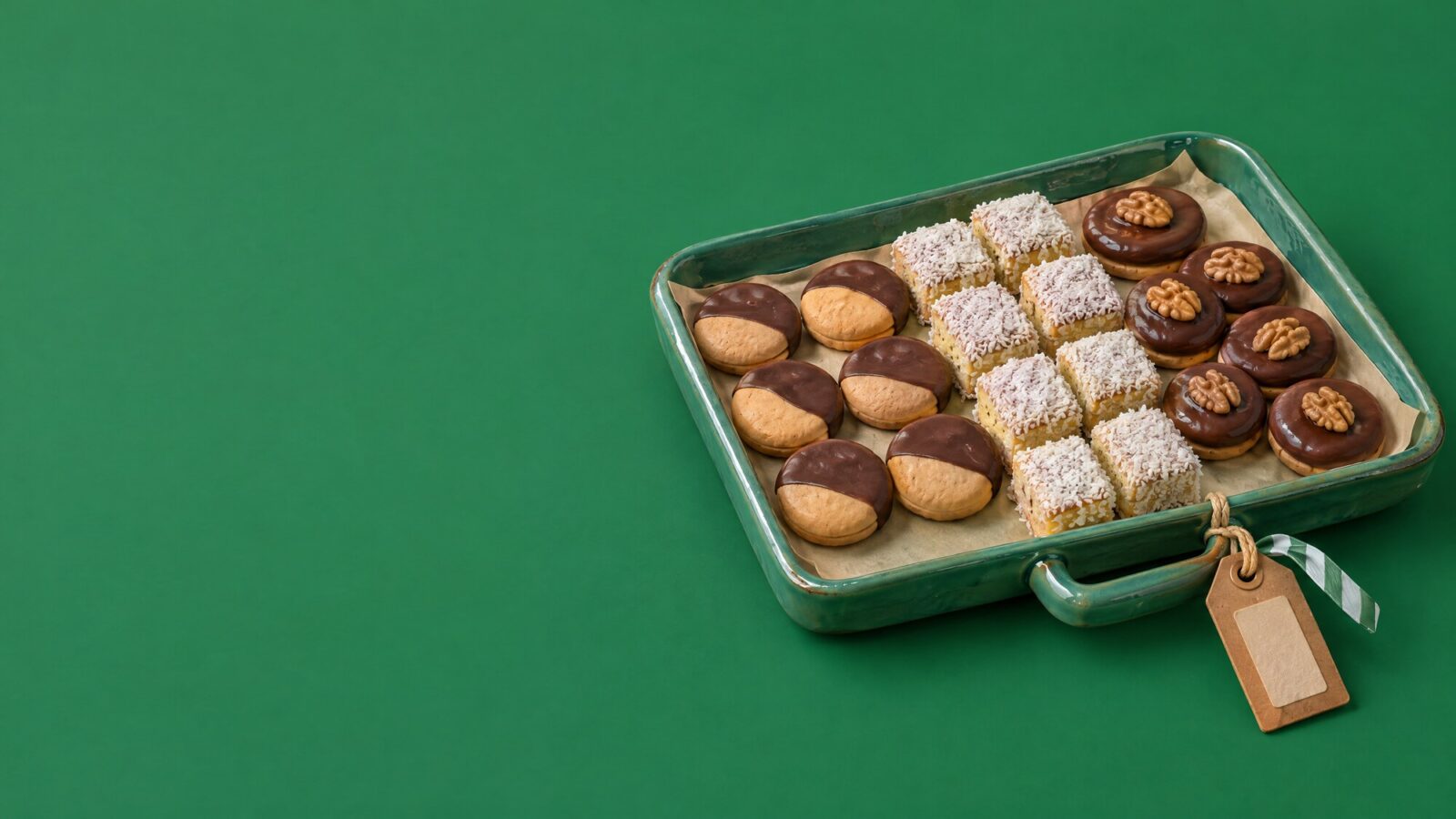
Seven weeks later she named the project. Introducing a recipe for lamingtons, the coconut-dusted sponge squares sold in packs at every New Zealand supermarket, she wrote on June 11, 2020: “This is the start of my journey into ‘gluten freeing’ the New Zealand bakery food that I grew up with.” Lolly cake came next. Then Afghan biscuits, Belgian slice, custard squares, ginger crunch, Mallowpuffs, Shrewsbury biscuits and more, now gathered alphabetically on her New Zealand recipes page.
It was not a simple swap of flours, and she says so. Of a New Zealand tray bake, the tan slice, she wrote in February 2021: “After 5 tries (5 TRIES – do you know how much condensed milk that it?!) I finally have tan slice recipe I’m happy with.” The first versions, she explains, failed not because of the ingredients but because of the method. Toffee Pops, the caramel-topped chocolate biscuits, she introduced as “An OG New Zealand Bikkie! Probably the most requested biscuit for me to make gluten free, and here it is.”
“One of the first things I thought of after my coeliac diagnosis was, ‘how the heck am I going to continue my reign now?’” Morgan Moore, on her site, January 23, 2021
The cookie that started it all became her answer to Cookie Time, the chunky chocolate-chip cookie Kiwi children know from the tuck shop. In her recipe post she is blunt about the shop-bought gluten-free alternatives she had tried, and about the fix: browned butter for a nutty, caramel flavour, dark chocolate chunks, and a little xanthan gum, which, she explains, “acts as a binder, like the gluten protein.”
View this post on Instagram
The audience: Comedy, food reviews and a cat
On TikTok, where her bio reads “Comedy, food reviews & I have a great cat,” Moore had 83,500 followers, 4.7 million likes and 900 videos when we read the profile logged out on October 18, 2026. Her YouTube channel, described as “Gluten free food, recipes, reviews, and laughs,” showed 9.05K subscribers the same day, with a series called Making it GF that has covered Korean corn dogs, bao buns, soft pretzels, Pocky and French Fancies. She is also on Instagram as @howtocoeliac; that profile’s counts could not be read logged out, so we do not print them.
The humour is the point, not a garnish. On a supporter page she wrote that she created How To Coeliac “as a way to share gluten free tips & tricks, as well as adding a bit of comedy to living a life with dietary restrictions.” Her site’s welcome is the same idea in plainer words: food “so that we never feel like we have to miss out.”
The other half of the work is eating out. Her London gluten-free map comes with a promise: “Every spot on this map I have visited, some several times, a few I visit at least once a week.” There are guides to bakeries, afternoon teas, markets and Sunday roasts, and travel pages from Japan, where she shows readers the characters for wheat, barley and malt on convenience-store labels, to Cangas del Narcea in northern Spain, a mountain town she writes has a town-wide gluten-free accreditation system. Eating out there, she wrote, felt “easy. Safe. Normal.” Away from her own channels, she works as a freelance social media manager and content creator for food businesses, according to her site.
The science: Why a biscuit is harder than it looks
Coeliac disease is not an allergy or an intolerance. Coeliac UK describes it as an autoimmune condition in which the immune system reacts to gluten, the protein in wheat, barley and rye, and damages the lining of the gut, the villi where food and nutrients are absorbed. The charity says 1 in 100 people in the UK have it “but only 36% are diagnosed,” which by our arithmetic leaves roughly 64 in every 100 people with the condition undiagnosed. Worldwide, a 2018 review of 96 studies in Clinical Gastroenterology and Hepatology (Singh and colleagues) put biopsy-confirmed coeliac disease at 0.7% of people, and 0.8% in Europe and Oceania, the two regions Moore has called home.
“The only treatment,” Coeliac UK says, “is a strict gluten free diet for life.” That is where the baking problem starts. In ordinary dough, gluten is the stretchy network that holds a biscuit or a sponge together, so taking it out tends to leave things dry and crumbly, which is why Moore leans on binders such as xanthan gum. Oats show how the rules can differ by country. Oats contain avenin, a protein similar to gluten; Coeliac UK says research shows “most people with coeliac disease can tolerate gluten free oats with no problems,” while Coeliac New Zealand, as Moore explains in her oats post, advises people with coeliac disease not to eat them. Anyone unsure which advice applies to them should ask their own doctor or dietitian.
Where to find her: The site, the feeds and the book in progress
Moore’s recipes, London guides and travel pages are on how-to-coeliac.com. Her videos are on TikTok, Instagram and YouTube, all as @howtocoeliac. The New Zealand recipe book is, in her words on her recipes page, a work in progress: “70 recipes, all from my childhood,” with a mailing list for anyone who wants to hear first.
How we checked this: Sources and method
Every quotation from Morgan Moore comes from her own public writing: her site’s home, New Zealand, London map, Japan, Cangas del Narcea and services pages, and her recipe posts dated April 22, 2020, June 11, 2020, September 2, 2020, January 23, 2021, February 14, 2021, June 22, 2021 and September 22, 2026, plus the About text on her supporter page, all read on October 18, 2026. Audience figures were read logged out on her TikTok profile and YouTube channel on October 18, 2026; Instagram counts were not readable and are not printed. The embedded reel was matched to her account through the post page’s own metadata. Health figures come from Coeliac UK’s about-coeliac-disease and oats pages and from PubMed 29551598, with the paper’s title matched; the 64-in-100 figure is our arithmetic. Gut Health Times has no relationship with Morgan Moore: no payment, no affiliate link and no sponsorship. This article is educational, describes what the cited sources say, and is not medical advice.