The Most Common Thing in Dr Paul Tran’s Clinic Is Kids Who Can’t Poop. He Made It Funny.
On shift at Phoenix Children's, Paul Tran is the gut doctor for whom constipation is the most common thing in the clinic; online he plays a perpetually anxious medical student for hundreds of thousands of people who are training to become doctors. He is a board-certified pediatric gastroenterologist and an assistant professor; this is his story in his own words, with the research on childhood constipation and medical-student burnout beside it.
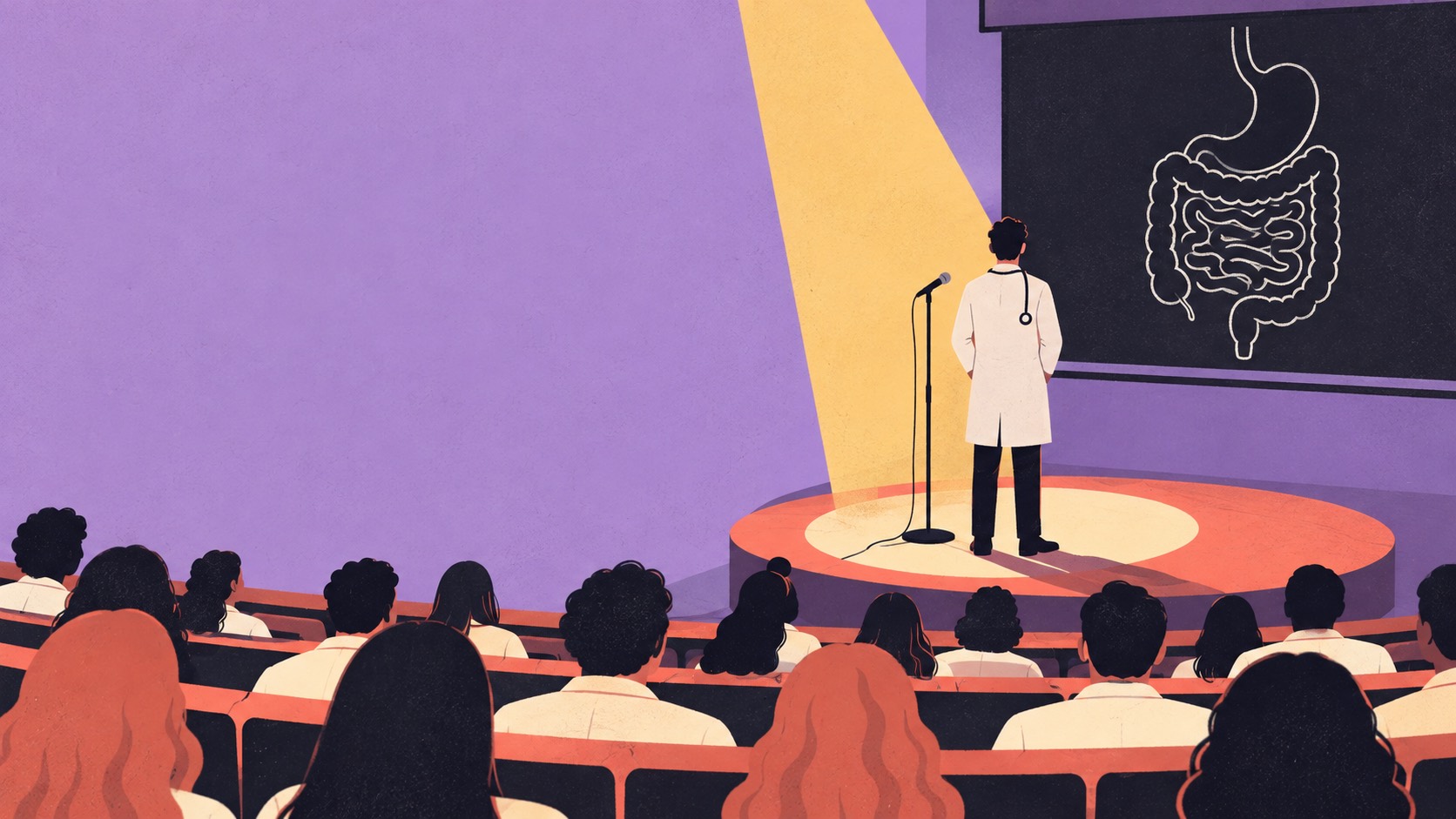
Dr Paul Tran is a pediatric gastroenterologist at Phoenix Children's in Arizona and the creator of Alimentary School, a comedy account about medical training with roughly 219,000 followers on Instagram and roughly 180,000 on TikTok under the handle @alimentaryschool. He finished medical school at the University of Colorado in 2016, a pediatrics residency in Dallas in 2019 and a pediatric gastroenterology fellowship at Children's Hospital Colorado in 2022, and the American Board of Pediatrics lists him as currently certified in general pediatrics and pediatric gastroenterology. His sketches cast him as an anxious medical student on rotations; his clinical posts explain why children hold in stool and how constipation is treated. He also teaches at the University of Arizona College of Medicine-Phoenix and gives keynote and commencement speeches. He is a doctor, not a patient-creator.

On Friday, October 16, a children’s gut doctor in Phoenix posted two new videos. In one he plays the actor a medical student must examine in a practical exam; in the other he asks what you heard through the stethoscope. A month earlier his “OSCE patient goes off script” had passed 377,000 views on YouTube alone. This is Alimentary School: roughly 219,000 followers on Instagram, roughly 180,000 more on TikTok, and four years of sketches in which Paul Tran plays, as the podcaster Dr Glaucomflecken put it, a perpetually anxious med student. In real life he is a board-certified pediatric gastroenterologist at Phoenix Children’s and an assistant professor at the University of Arizona College of Medicine-Phoenix; the American Board of Pediatrics lists him as currently certified in general pediatrics and pediatric gastroenterology.
There is no launch, book or awareness day attached to this profile. His site lists a year of “field trips” to medical schools, the autumn stops given by month only. What earns him a profile on a gut-health site is the thing underneath the jokes: the most common problem in his clinic is children who cannot, or will not, poop, and he has spent four years explaining why in the time a video takes to loop. He has also written the manual: with Temara Hajjat of Cincinnati Children’s he co-authored a 2024 review in Current Gastroenterology Reports on how pediatric gastroenterologists should use “medical media,” and it offers his own account as its example of short video “reaching a younger and more diverse audience.”
The doctor: A gut specialist for people under eighteen
The path is on his About page: Duke in 2011, a master’s in physiology at Cincinnati, medical school at the University of Colorado from 2012, a pediatrics residency at UT Southwestern in Dallas finished in 2019, and a pediatric gastroenterology fellowship at Children’s Hospital Colorado finished in 2022, the year he “began my practice as a pediatric gastroenterologist and started teaching at the University of Arizona College of Medicine Phoenix.” The American Board of Pediatrics certified him in general pediatrics in October 2019 and in pediatric gastroenterology in November 2023; both certificates read “Currently Certified” when we checked its public register on October 16. In 2023 he changed how he works: “I advocated for a new role as a GI hospitalist. I gave up clinic for shift work.”
Pediatric gastroenterology is the digestive system from birth to adulthood: reflux in babies, constipation, bleeding, inflammatory bowel disease, celiac disease, the liver, and the scopes that look at all of it. His hospital bio puts him on the endoscopy committee of NASPGHAN, the North American society for the specialty, and describes his role as “a coach to patients and families.” The scopes are his research: first author on a 2018 paper on over-the-scope clips for acute gut bleeding in children, lead author of a 2025 review of ultra-slim gastroscopes thin enough to pass through a nose. In a July 2024 video the scope goes through his own nose while he is awake, so that patients, his description says, can “walk into clinic, get prepped, get the procedure and walk out in under 45-60 minutes.”
The poop: The most common thing in his clinic
The clearest thing he has written about his day job is a caption from September 2022. “Constipation is the most common thing I see in my clinic!” Then the mechanism: “Lots of infants will have hard stools, naturally around the time of solid food introduction. A hard stool hurts coming out and babies and kids will start holding in poop to avoid pain.” The held stool “gets harder and harder,” he wrote, “a vicious cycle because kids just want to hold in more!” Eventually the stretched rectum stops signalling and “liquid stool leaks around solid stool.” His conclusion: “With a GI doctors help, a combination of 1) a cleanout of hard stool 2) maintenance laxatives to keep stools soft and 3) scheduled toilet sitting can help the large majority of children!” Our explainer on holding it in covers the adult version.
Watch this post on TikTok
The subject follows him onto other people’s shows. On Knock Knock, Hi!, the Glaucomfleckens’ podcast, on April 28, 2026, the hosts called him “one of the few people whose medical comedy I actually enjoy” and wrote that “Dr. Tran’s face literally lights up when he talks about constipation.” He explained the fear that makes a toddler hold stool “while standing behind a curtain,” which the hosts called “an impressive feat of physics that most adults can’t pull off,” and the red-stool scare they nicknamed “Flaming Hot Ketosis,” where “kids eat so many spicy snacks that their poop turns red, sending parents into a total tailspin thinking it’s a GI bleed.” Our guide to stool colour covers the food version.
“Constipation is the most common thing I see in my clinic! I don’t think it’s too crappy… until it is!”
The mission: Shaking up the culture of medical education
The TikTok account dates from March 2020, but the earliest video we found went up on Tuesday, March 1, 2022, with a caption that doubled as a mission statement: “Alimentary School marries pediatric gastroenterology and medical education!” Sixteen days later came an early poop joke: “With friends like this, who needs enemas?!” He told the student-run ND MD blog in 2023 what the gap had looked like: “There is so much advice on how to succeed in the first two years of medical school. And there were crickets for the advice on the years after… There was a gap for advice and positivity.” He wanted to “poke a little fun at toxic culture along the way.” His TikTok bio compresses it: “Peds GI Doc / I empower med learners / Spread positivity in medical education.”
The character is, as the Medicus podcast put it, “the ‘med student on rotations.’” On the preceptor list nobody updates: “Dr Williams retired so long ago that his daughter took over and SHE is about to retire.” On lectures: “YES it will run way over time… YES you’ll listen on 2.5x and retain nothing.” On a pediatrics-rotation sketch: “75% satire, maybe less.” The method is deliberate. “People don’t open TikTok to learn. They come to be entertained,” he told the How I Doctor podcast. “If I can sneak in a lesson while they laugh,” he added, “that’s a win.” His most-shared clip of 2026, a student who rehearsed a letter-of-recommendation ask for weeks until the attending offered first, had about 136,800 plays and 13,500 likes on October 16.
Watch this post on TikTok
Behind the sketches is a position. His Pri-Med faculty bio says he “champions his philosophy to view and treat learners as the colleagues they are.” His fellowship research was on feedback, “especially for people learning procedures,” and it became a talk, “Feedback is NOT a Dirty Word.” “I don’t want to just hand them fish,” he said of coaching students. “I want to teach them how to fish.” He co-directs the pediatric clerkship at the Phoenix medical school, per a 2025 bio. The Match is personal: in 2016, he writes, “I also matched my fourth choice for residency (bitter at first, but ultimately very sweet). A difficult match day became a life changing fork in the road.”
The field trips: A speaking year, between shifts
He calls 2026 “The Year of Field Trips!” and his site keeps the itinerary: a keynote at the AMA Medical Student Advocacy Conference in Washington in March, commencement speeches at UC Davis and the Medical College of Georgia in May, a keynote at the AMSA convention in Adelaide, Australia, in July, and an autumn listed as Dallas, Kansas City, Chicago, Miami, San Diego, Providence and Albany. The podcasts came first: Generations M.D. in October 2024, Medicus and CHOP’s Primary Care Perspectives in 2025, then the Glaucomfleckens in April.
The honest parts: Loans and a fourth-choice match
“It is too expensive,” he said of medical training on How I Doctor. “I’m still paying medical student loans.” His guardrail, from 2023: “if you’re doing it to build a following, to fill insecurities, I think it can become a vortex for unhealthy living.” And from his timeline: “Competitive figure skating taught me how to get up after I fall. Again and again and again.”
What the research actually measured: How common childhood constipation is, and why children hold it
The NIDDK, the US digestive-health institute, defines constipation in a child as fewer than two bowel movements a week, stools that are hard, dry or lumpy, or stools that are difficult or painful to pass, and says almost one in every twenty children’s doctor visits is for it. A 2018 meta-analysis in the Journal of Pediatrics pooled 37 population studies that applied the standard symptom-based definition and found functional constipation, the kind with no underlying disease, in 9.5% of children worldwide, with studies ranging from 0.5% to 32.2% and no difference between boys (8.6%) and girls (8.9%). The NIDDK’s causes page matches his caption: “Children most often get constipated from holding in their stool,” for reasons from potty-training stress to fear of pain.
The holding has been measured. In a 1997 study in Pediatrics, a suburban practice followed 482 healthy toddlers through toilet training: 106 (22%) refused to use the toilet for stool for at least a month, 61 developed stool withholding, and 80% of the withholders were refusers. One suburban practice is not a national rate; the striking detail is that of 27 children returned to diapers, 24 were using the toilet within three months. The treatment his caption describes, a clean-out, maintenance laxatives and scheduled sitting, is the shape of the 2014 joint guideline from NASPGHAN and its European counterpart, which graded the evidence and set out two algorithms, one for infants under six months and one for older children, while noting that large trials were still needed.
The red-stool scare is in the literature too. A 2022 case report describes a 22-year-old man seen in an emergency department with abdominal pain and red stools after eating “a whole large bag of Flamin’ Hot Cheetos the day prior,” a case of “food dye mimicking hematochezia,” the medical term for blood in stool. It is one case, and the NIDDK lists blood in a child’s stool among the symptoms that call for a doctor’s visit right away. On the teaching side, a 2019 meta-analysis of 24 studies and 17,431 medical students found 44.2% met criteria for burnout before residency. These are population findings; this profile is educational, not medical advice, and a parent with questions about a child’s bowel habits should talk to the child’s own clinician.
The disclosure map: Where his interests sit
Paul Tran is employed by Phoenix Children’s and holds a faculty appointment at the University of Arizona College of Medicine-Phoenix. Doc2Doc Lending, a personal-loan lender to clinicians, lists him as a strategic advisor. His site takes speaking bookings through a partnerships address and lists no fees. He describes himself as part of the Hippocratic Collective, a physician media group, and runs a private mentoring community on Discord; one 2024 caption carries TikTok’s creator-incentive hashtag. We found no book, course, merch, supplement, discount code or brand deal in anything we read. He is a board-certified pediatric gastroenterologist, not a patient-creator. Gut Health Times has no commercial relationship with him, Phoenix Children’s, Doc2Doc Lending or the Hippocratic Collective. This profile is educational, is not medical advice, and was prepared without input from him.