Why Leafy Greens Keep Showing Up in Outbreaks
Spinach. Romaine. Bagged salad. Now iceberg. The pattern in the headlines is not bad luck — it is arithmetic.
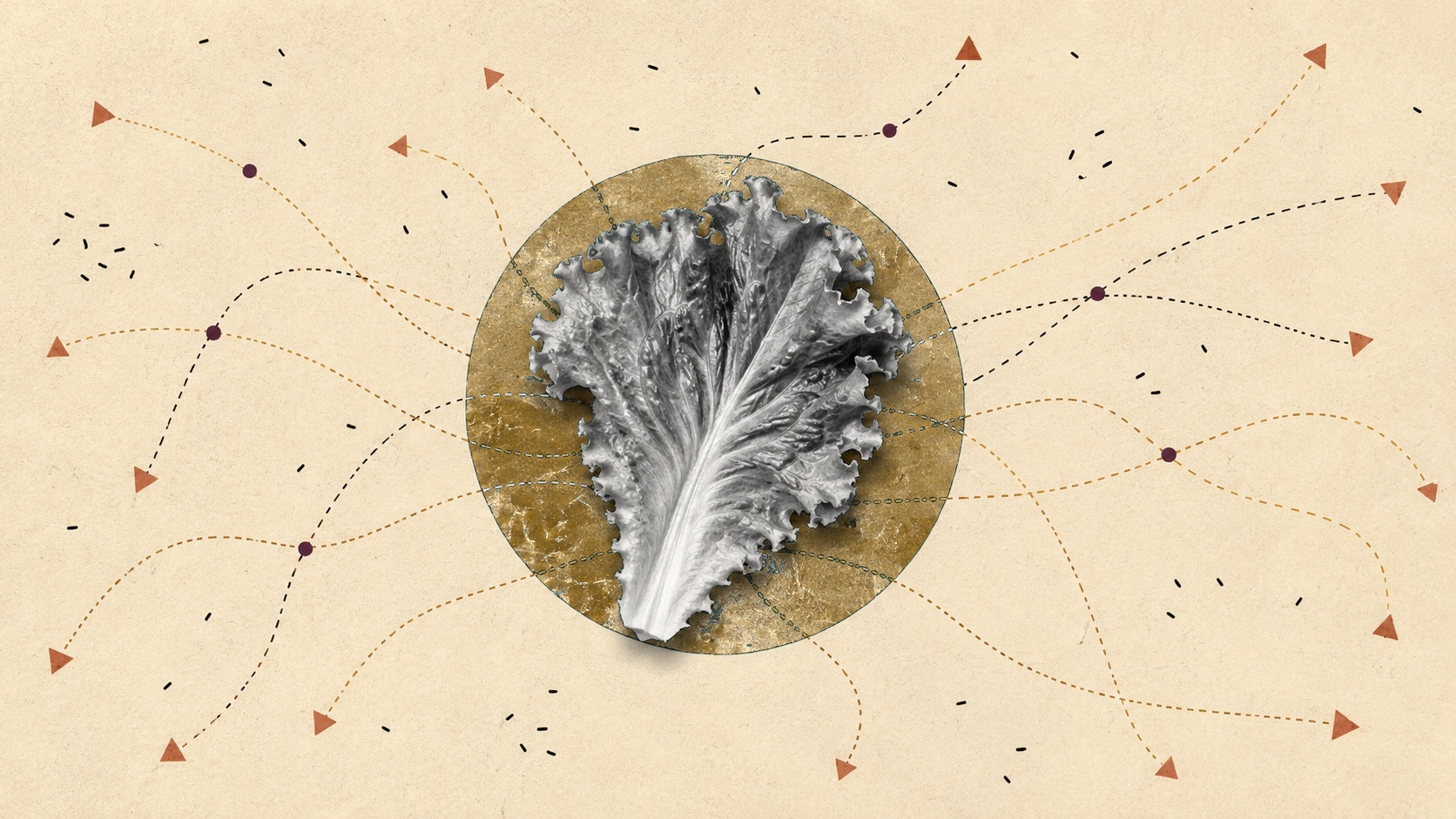
Leafy greens dominate produce outbreak headlines because several risk factors converge on one category: they grow at soil level in direct contact with irrigation water, they are eaten raw so there is no heat kill step, they are pooled from many farms into single bagged lots, they move fast through the supply chain with little slack for testing, and they are eaten in very high volume.
Spinach. Romaine. Bagged salad. Now iceberg lettuce. If you have the nagging sense that leafy greens appear in outbreak headlines more than their share, you are not imagining it — and the reason is not that greens are dirty. It is that almost every structural factor that makes food risky happens to converge on this one category.
One: it grows in the splash zoneClose to soil, and to water
Lettuce and spinach grow low, in open fields, with their edible parts inches from the soil. Rain and irrigation splash that soil upward onto the leaves. Which means the water used on the field is not incidental to the crop — it is in direct, repeated contact with the part you eat.
That is the pathway that matters. The CDC describes cyclospora as spreading when food or water comes into contact with human faeces, and in produce outbreaks contaminated irrigation or wash water is the usual suspected route. Adjacent land use — livestock operations, water sources shared downstream — is why regulators focus so heavily on agricultural water in leafy greens safety work.
Two: it is never cookedThe missing kill step
Every other high-risk food gets a moment of heat. Chicken is roasted, beef is seared, eggs are fried. Heat is the step that neutralises most foodborne pathogens, and in food-safety language it is called a kill step.
Salad is defined by the absence of the one step that reliably destroys pathogens.
Salad, by definition, skips it. Whatever arrives on the leaf arrives on the plate. And as covered in the piece on washing, rinsing is not a substitute — particularly for a parasite whose oocyst resists chlorine at the concentrations used in commercial washing.
Three: it is mixed at enormous scaleOne lot, a thousand bags
Modern salad is a pooled product. Greens from many fields, farms and sometimes countries are combined, chopped and bagged in centralised facilities. That aggregation is what makes cheap year-round salad possible, and it is also what turns a single contaminated lot into a multistate event rather than a local one.
It cuts the other way in tracing, too. Because one bag can contain leaves from several sources, working backwards from a sick person to a specific field is slow and often inconclusive — which is part of why produce investigations tend to move more slowly than the public expects.
Four: it is fragile and short-livedCold chain, and no margin
Leafy greens are delicate and perishable. They move fast through the supply chain and depend on unbroken refrigeration. Speed is good for freshness but leaves little slack for testing before product reaches shelves — and by the time an illness is confirmed weeks later, the implicated lot has usually been eaten or thrown out. It is common for investigators to have no sample of the actual food left to test.
Five: we eat a lot of itExposure is the multiplier
The least dramatic factor is also a genuine one. Salad is eaten constantly, by a very large number of people, often several times a week. Any contamination event therefore reaches an unusually wide population quickly. High consumption turns a supply-chain problem into a public-health one.
What has actually changedWater, traceability and the long game
The category has not been left alone. Two areas absorb most of the regulatory attention, and both map directly onto the risk factors above.
The first is agricultural water — unsurprisingly, given that it is the pathway connecting field conditions to the edible leaf. Standards governing the water used on produce close to harvest have been repeatedly revisited, and the FDA’s leafy greens safety work gives significant weight to water sources and to adjacent land use, including proximity to livestock operations.
The second is traceability. Leafy greens sit on the FDA’s list of foods subject to enhanced recordkeeping requirements, precisely because pooling makes traceback so slow. Better records shorten the gap between “people are sick” and “this lot, this farm” — which is the difference between a recall that catches product on shelves and one that arrives after everything has been eaten.
Neither is a solved problem, and neither eliminates the underlying structure: a crop grown at soil level and eaten raw carries risk that no paperwork removes. What they do is shrink the window and narrow the scope when something goes wrong.
What it adds up toA category, not a scandal
Put the five together — grown at soil level in contact with agricultural water, eaten raw with no kill step, pooled at scale, moved fast with little testing slack, and consumed in enormous volume — and the pattern in the headlines stops looking like a run of bad luck and starts looking like arithmetic.
It also explains why the response to a produce outbreak is nearly always a recall rather than guidance about preparation: when there is no kill step in the chain and washing does not close the gap, removing the product is the control that remains. Regulatory attention to agricultural water, adjacent land use and traceability follows the same logic. Anyone with questions about their own health should speak to a clinician. This article is educational and is not medical advice.