Is Dirty Soda Bad for Your Stomach? We Read the Cup, and the Cream Is the Small Number
Pepsi’s DRIPS trailer is pouring a Poppi dirty soda outside Austin City Limits this month. We built the classic cup from published labels: about 64 grams of sugar, and about one gram of lactose.
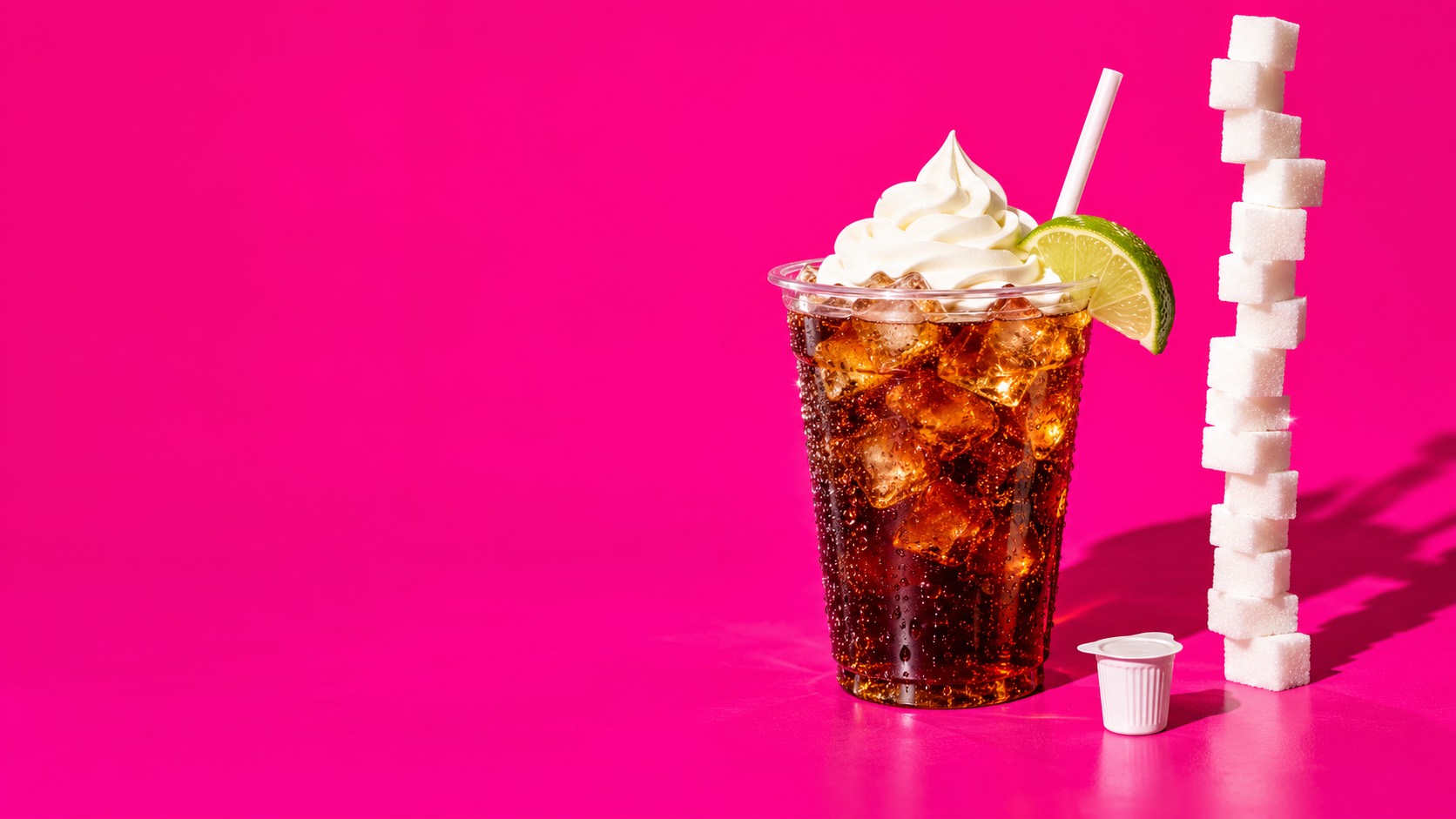
Going by published labels, a classic dirty soda is a large sugar drink with a little cream. A 12 fl oz Dr Pepper plus 2 tablespoons of coconut syrup and 2 tablespoons of half-and-half comes to about 64 g of sugar, 3.5 g of fat and about 1.2 g of lactose (our arithmetic). That lactose is a tenth of the 12 g single dose an NIH panel said people with lactose malabsorption could take with no or minor symptoms. McDonald's lists its medium Dirty Dr Pepper at 330 calories and 64 g of sugar. The bigger amounts are the sugar and the carbonation; curdled cream is ordinary acid-and-protein chemistry.
On both weekends of the Austin City Limits festival, October 2 to 4 and October 9 to 11, a silver Airstream is parked at The Picnic, a food-truck park on Barton Springs Road outside the festival grounds, selling soda with things in it. The trailer is DRIPS by Pepsi. It pours 17 drinks in 16- and 24-ounce cups, starting at $11.99, from noon to 10 p.m., no festival ticket required, Sporked and Bleeding Cool reported. One is the first DRIPS drink built on Poppi, the Austin prebiotic soda PepsiCo bought in 2025. It is called the Poppi Ruby Fizz, and its menu line reads: “Sweet cherry meets pomegranate swirl featuring poppi Shirley Temple.”
A dirty soda is a treat, and nobody needs a lecture with their treat. But people are asking Google whether it is bad for their stomach, whether it can make them sick and why the cream sometimes curdles, and the usual guess is the dairy. So we read the cup the way we read a can: ingredient by ingredient, from published labels. The dairy turns out to be the small number. The sugar is the big one.
The drink: What a dirty soda is
The recipe is soda, a flavored syrup, something creamy and often lime, over ice. Swig, the Utah chain that bills itself as the “Home of the Original Dirty Soda,” defines it as a soda mixed with “flavors, fresh fruits, purees, and creams.” Swig says it was founded in 2010 in St. George, Utah, and has more than 150 locations in 16 states. Its menu shows the template: the Texas Tab is Dr Pepper, vanilla and coconut cream; The Founder is Diet Coke, sugar-free coconut, coconut cream and fresh lime.
This year the drink went national. Taco Bell was adding a Dirty Sips lineup to its permanent menu nationwide, Nation’s Restaurant News reported in March. McDonald’s announced a Dirty Dr Pepper on April 28, one of six specialty drinks due nationwide from May 6. PepsiCo has run DRIPS pop-ups since 2024, and its DRIPS site now says the drinks are in more than 300 Regal cinemas.
The cup: What is actually in the cup
We found no nutrition page on Swig’s website and none on the DRIPS site, so we built a cup from labels. Torani’s own Classic Dirty Soda recipe calls for 2 tablespoons of its coconut syrup, 2 tablespoons of half-and-half, lime wedges and a 7.5-ounce soda. We kept the syrup and the cream and poured a full 12-ounce can of Dr Pepper. The can lists 39 grams of sugar. The syrup lists 23, all of it cane sugar. The half-and-half adds 3.5 grams of fat and 1.2 grams of sugar, every bit of it lactose, on USDA figures. Call it 64 grams of sugar in the cup.
| What goes in | Sugar | Fat | Lactose |
|---|---|---|---|
| Dr Pepper, 12 fl oz can | 39 g | 0 g | 0 g |
| Torani Coconut Syrup, 2 Tbsp | 23 g | 0 g | 0 g |
| Half-and-half, 2 Tbsp | 1.2 g | 3.5 g | 1.2 g |
| Lime wedges | under 1 g | 0 g | 0 g |
| The cup (our arithmetic) | about 64 g | 3.5 g | 1.2 g |
| McDonald’s medium Dirty Dr Pepper, as published | 64 g | 7 g | not listed |
McDonald’s publishes its numbers. A medium Dirty Dr Pepper lists 330 calories, 7 grams of fat and 64 grams of sugar, which its panel puts at 127 percent of the Daily Value for added sugars. The same size of plain Dr Pepper lists 250 calories, no fat and 67 grams of sugar. Going dirty there adds 80 calories and removes 3 grams of sugar.
The dairy: Is it the cream?
Lactose, the sugar in milk, is the part of dairy that some people digest poorly. The National Institutes of Health’s 2010 consensus panel concluded that adults and adolescents with diagnosed lactose malabsorption “could ingest at least 12 grams of lactose when administered in a single dose (equivalent to the lactose content found in 1 cup of milk) with no or minor symptoms.” A systematic review that year put the well-tolerated amount at 12 to 15 grams. In a 1995 double-blind trial, 30 people who called themselves severely lactose intolerant drank a cup of milk with breakfast for a week, and symptoms were minimal whether or not the lactose had been broken down in advance.
Two tablespoons of half-and-half hold 1.2 grams, a tenth of that line. Heavy cream holds about 0.9 grams, alongside about 11 grams of fat. By our arithmetic it would take about 19 tablespoons of half-and-half, more than a cup, to reach 12 grams. A grande pumpkin spice latte, by our earlier arithmetic, carries 15 or more. And McDonald’s uses no cream at all: it lists its cold foam as water, canola oil, cane sugar and corn syrup plus minor ingredients, one of them sodium caseinate, “a milk derivative,” and labels the drink as containing milk.
The cream in a dirty soda carries about a gram of lactose. The soda and the syrup carry more than 60 grams of sugar.
The mechanics: Sugar, gas, fat and caffeine
Start with the big number. In a 1983 experiment, salt water left the stomach quickly, while glucose solutions were released at a steady 2.13 calories a minute, whatever their strength. The soda and syrup in our cup supply 240 calories. By that rule, the more sugar in the cup, the longer the stomach holds on to it.
Fructose is the sugar with a measured ceiling. In a University of Iowa breath-test study of 20 healthy adults, nobody malabsorbed 15 grams, two did at 25 grams and 16 did at 50 grams, where 11 people had symptoms. Those doses were fructose alone. Dr Pepper is sweetened with high fructose corn syrup; the kind the FDA says is used primarily in soft drinks is 55 percent fructose, and cane sugar is half. If that is what is in the can, our cup holds roughly 33 grams of fructose. But it arrives with nearly as much glucose, and in a 1986 study of 10 healthy adults, most malabsorbed 50 grams of fructose alone and none did when it came as table sugar or with equal glucose.
Then the gas. A 2009 review from the University of Naples (one of its four authors was affiliated with a Coca-Cola Company institute) found that symptoms of mechanical distress in the stomach “appear only when drinking more than 300 ml of a carbonated fluid.” A 12-ounce can is 355. Fat slows the stomach, but a University of Nottingham study that showed it in eight healthy men used meals with 71 percent of their energy from fat; our cup gets about a tenth of its calories that way. Caffeine is modest too: Auburn University food scientists measured 42.6 milligrams in 12 ounces of Dr Pepper, and the coffee that stirred the colon in a 1998 study carried 150 (more in our coffee piece).
Zero-sugar orders trade the sugar for sweeteners. Torani’s sugar-free coconut syrup lists acesulfame potassium and sucralose, no sugar and no sugar alcohols.
The curdle: Why the cream sometimes breaks
The flecks are ordinary chemistry. About 80 percent of milk protein is casein, and as the pH falls toward 4.6, the University of Guelph’s dairy science text says, “the caseins aggregate.” Soda is well past that point. When University of Alabama at Birmingham researchers measured 379 drinks, Dr Pepper came in at 2.88, Pepsi at 2.39 and lemon juice at 2.25. A stomach does the same thing: caseins “form gastric coagula,” in the words of a review by two scientists at the dairy company FrieslandCampina. Cream that breaks in the cup is that step happening early.
The Poppi version: What a prebiotic soda changes
Back to the Airstream. A can of Poppi Shirley Temple, by the brand’s own panel, has 30 calories, 5 grams of sugar and 3 grams of dietary fiber, from cassava root fiber and agave inulin. Put that can in our home cup in place of the Dr Pepper and the sugar falls from about 64 grams to about 30, most of it syrup. That is our cup, not the Ruby Fizz: we found no published recipe or nutrition for it, and Bleeding Cool reported that the pop-up’s drinks use new syrups described as having no added sugar. Cream and syrup do not remove fiber; they add what they add. What 3 grams does is in our Poppi piece, the other cans are in our prebiotic soda tracker, and the energy drinks under the Celsius and Alani Nu builds are in our energy drink piece.
The facts to carry to the window: in a classic dirty soda the lactose is about a gram, the sugar is about 64, and a 12-ounce pour of fizz is just past the 300 milliliters at which one review says stomach symptoms can appear. PepsiCo, Poppi, Swig, McDonald’s, Taco Bell, Torani, Dr Pepper, Celsius and Alani Nu had no involvement in this article. It is educational, describes what the cited labels, nutrition pages and studies say, and is not medical advice.