Researchers Tested 39 Sweeteners Against 25 Gut Bacteria. Here Is What They Found
Three quarters of them changed how at least one species grew, and combining them with other compounds produced more than a hundred interactions nobody had catalogued. All of it happened in a dish, which the researchers were unusually insistent about.
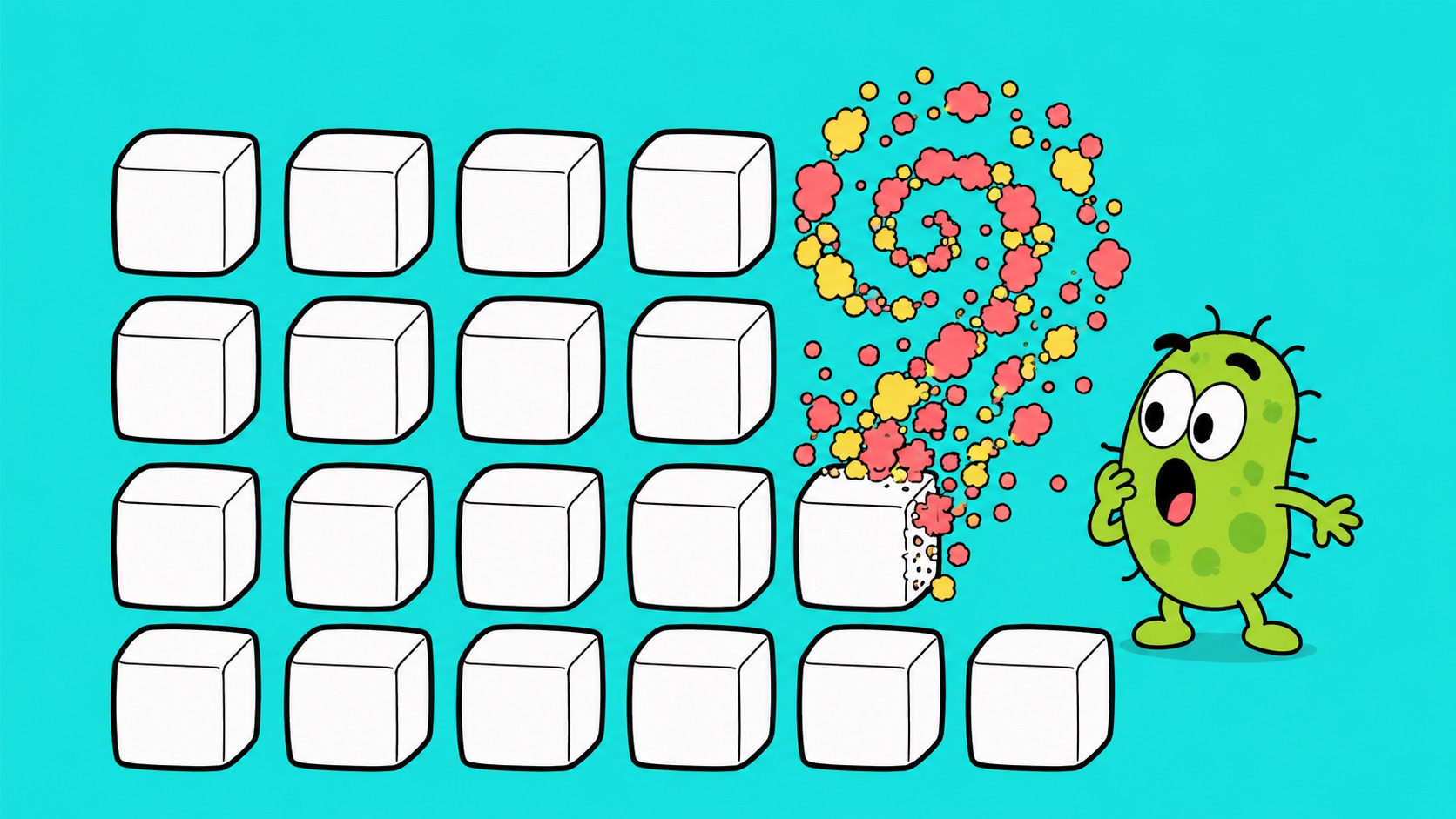
A University of Cambridge team published in Molecular Systems Biology in July 2026 tested 39 commercially used sweeteners against 25 species of gut bacteria grown in the laboratory. Roughly 75% of the sweeteners affected the growth of at least one species, and more than 100 interactions emerged when sweeteners were combined with other compounds. The clearest signal was isosteviol paired with the antidepressant duloxetine, which suppressed Roseburia intestinalis and Parabacteroides merdae in a community model. The researchers stated the work was done in controlled laboratory conditions, not in people, and that human studies remain necessary.
Screening studies rarely make good headlines, because their output is a table rather than a verdict. A team at Cambridge took 39 sweeteners, 25 species of gut bacteria, and a set of common medications, and worked through the combinations. What came back was less a finding about sweeteners than a finding about how little anyone had checked.
The designWhat did the sweetener study actually test?
Researchers grew 25 gut bacterial species separately in the laboratory, exposed each to 39 commercially used natural and artificial sweeteners, and tracked growth. They then tested sweeteners alongside caffeine, vanillin, advantame and eight common medications.
The work was published in Molecular Systems Biology in July 2026 by a University of Cambridge team. A final stage assembled all 25 species into a simplified microbial community and watched how its composition shifted — a step up from single-species dishes, though still a long way from a human gut.
The resultDid the sweeteners affect gut bacteria?
In this laboratory setting, roughly 75% of the sweeteners tested altered the growth of at least one bacterial species. When sweeteners were combined with other compounds, more than 100 distinct interactions emerged.
Both numbers deserve a moment of deflation. “Affected at least one species” is a deliberately low bar — it is the threshold a screening study uses to decide what merits a closer look, not a measure of consequence. A compound that nudges one bacterium out of 25 in a dish has cleared that bar and told you almost nothing about a person.
A screening study produces a list of things worth examining. It is not a list of things that have been shown to matter.
The specific pairingWhat was found with isosteviol and duloxetine?
The clearest signal came from isosteviol — a compound derived from stevia — paired with duloxetine, an antidepressant. In the laboratory community model, the combination strongly suppressed Roseburia intestinalis and Parabacteroides merdae, and reduced overall microbial diversity.
This was the study’s standout interaction, and it is worth being precise about what it was: an effect observed in cultured bacteria, in a simplified artificial community, at concentrations chosen by the researchers. It was not observed in people taking duloxetine. No clinical outcome was measured, because no humans were involved.
Anyone taking a prescribed medication should keep taking it as prescribed. Questions about a medication and diet belong with the prescribing clinician or a pharmacist, who can see the full picture. A laboratory interaction between two compounds in a dish is a reason for researchers to run a human study, not a reason for anyone to change anything.
The limitationDoes this tell us what sweeteners do inside the human body?
No, and the authors were direct about it. The experiments took place in controlled laboratory conditions. In a real digestive system, sweeteners may be absorbed, chemically altered, diluted or broken down before they ever reach the bacteria studied here.
Dr Blasche, one of the researchers, put the constraint plainly: “the simplified laboratory system cannot fully reproduce the complexity of the human body.” The team also noted that individual differences — diet, genetics, and whatever microbiome a person already has — could change outcomes substantially. Human studies, they said, remain necessary to establish any real-world effect.
It is unusual for a research group to spend this much of its own publicity on caveats, and the reason is probably experience. Sweetener studies have a history of arriving in the press stripped of their conditions, and a screen of 39 compounds offers a great deal of raw material for that.
The takeawayWhat is the honest summary of this research?
A large laboratory screen showed that many sweeteners can influence gut bacteria in a dish, and that combinations with other compounds produce effects neither produces alone. Whether any of this happens in people is unresolved.
The more durable contribution may be methodological. Most testing of food additives considers compounds one at a time, against a body rather than against a microbial community. This study looked at combinations and at a community, and immediately found over a hundred interactions nobody had catalogued. That gap — not any individual sweetener — is the result.