Gut Bacteria That Cannot Survive Open Air Are Passed Between Individuals
A bacterium that dies on contact with air cannot have drifted across a gap. Finding the same one in two animals is evidence of a route between them — which is how a study of birds on one Indian Ocean island became an argument about households.
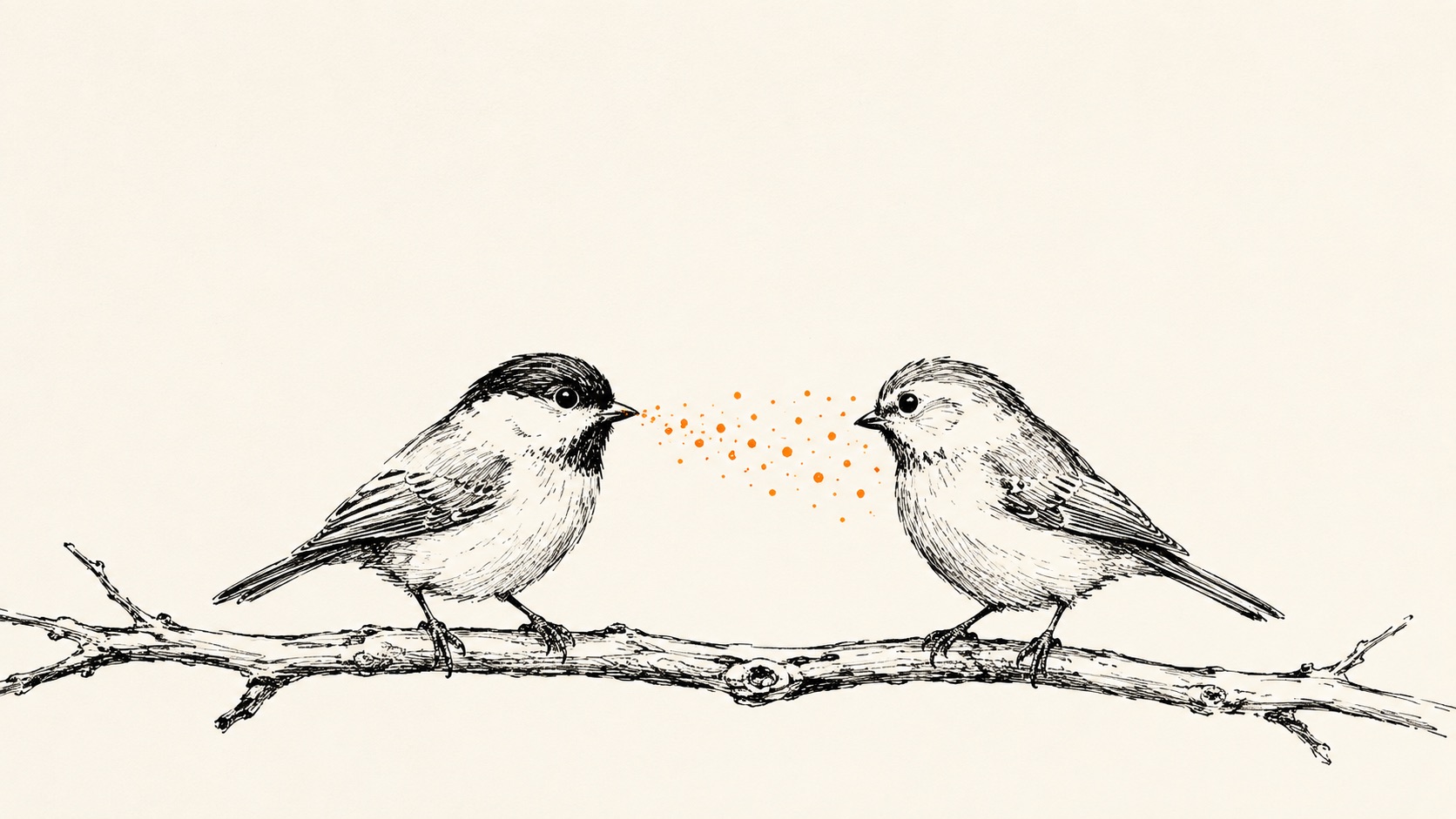
A study published in Molecular Ecology in 2026, led by Dr Chuen Zhang Lee at the University of East Anglia, analysed hundreds of faecal samples collected over several years from Seychelles warblers on Cousin Island. Birds that spent more time together had markedly more similar gut bacteria, with the effect concentrated in anaerobic microbes that cannot survive exposure to open air and therefore cannot spread through the environment. The researchers suggested the pattern may extend to human households through everyday contact, but the study was conducted entirely in birds and did not test humans.
The gut microbiome is usually discussed as a private possession, shaped by what one person eats and how they sleep. A study of a small brown bird on a single Indian Ocean island makes a different case: that a substantial part of it arrives from the individuals you spend time near, and cannot get to you any other way.
The studyWhat did the Seychelles warbler research examine?
Researchers collected hundreds of faecal samples over several years from Seychelles warblers on Cousin Island, a population where each bird’s social role is known — breeding pairs, helpers at the nest, and non-helpers — and compared gut bacteria against how much time birds spent together.
Published in Molecular Ecology in 2026, the work was led by Dr Chuen Zhang Lee of the University of East Anglia School of Biological Sciences as part of his PhD, with collaborators at Norwich Research Park, the University of Sheffield, the University of Groningen and Nature Seychelles. The Cousin Island population is unusually well suited to the question because it has been tracked for decades, so social relationships are documented rather than inferred.
The findingDo animals that spend time together share gut bacteria?
Yes. Birds that spent more time together had markedly more similar gut bacteria. The effect was concentrated in anaerobic microbes — species that cannot survive exposure to open air.
That last detail is what makes the result more than a correlation. As the researchers described it, these oxygen-sensitive bacteria “can’t survive in the open air, so they don’t drift around in the environment. Instead, they move between individuals through intimate interactions and shared nests.” A microbe that dies on contact with air cannot have crossed a gap. Its presence in two animals is evidence of a route between them.
A bacterium that cannot survive open air has only one way to reach you: something that was already carrying it.
The mechanismWhy does oxygen sensitivity make the case stronger?
Because it rules out the environment as a shared source. If two individuals harbour the same bacterium that dies in air, they did not both pick it up from the surroundings — it passed between them, or through close shared contact.
This is a neat piece of reasoning and it addresses the usual objection to studies of shared microbiomes, which is that animals living together also eat the same things and touch the same surfaces. Diet and habitat can explain shared aerobic bacteria easily. They cannot explain shared strict anaerobes, and the anaerobes are also the group the researchers identify as most relevant to digestion and immune function.
The caveatDoes this mean people share gut bacteria with their household?
The study did not test that. It was conducted entirely in birds. The researchers suggested the finding may extend to human households through daily interactions, but that is an extrapolation offered by the authors, not a result they measured.
The suggestion is specific — that everyday contact such as hugging, kissing and sharing food preparation spaces may encourage exchange of gut microbes between people who live together. It is a reasonable hypothesis and consistent with separate human research on cohabitation. But it is worth keeping the categories apart: what was demonstrated here is that social contact shapes the gut microbiome of a wild bird population, and that the mechanism is contact-dependent transmission of oxygen-intolerant species.
Studies in wild animals earn their keep by allowing observations that are impractical in people. Decades of tracked social relationships, hundreds of samples, and no way for a participant to misreport who they spent their time with. The trade is that the result belongs to the species it was measured in until someone measures it again elsewhere.
The wider frameWhat does this change about how the microbiome is usually described?
It reframes the microbiome as partly social rather than wholly individual. If a meaningful share of gut bacteria can only arrive through contact with another individual, then the people around someone are part of the picture alongside diet.
Nothing here is actionable, and it should not be read as suggesting anyone seek out or avoid contact for microbial reasons. Its value is conceptual: most consumer gut-health advice addresses a solitary person making solitary choices, and this line of research suggests that framing is incomplete in a way nobody has fully accounted for yet.