Fiber Is Two Things
Soluble and insoluble fiber do different jobs. Knowing which is which is the difference between relief and more bloating.
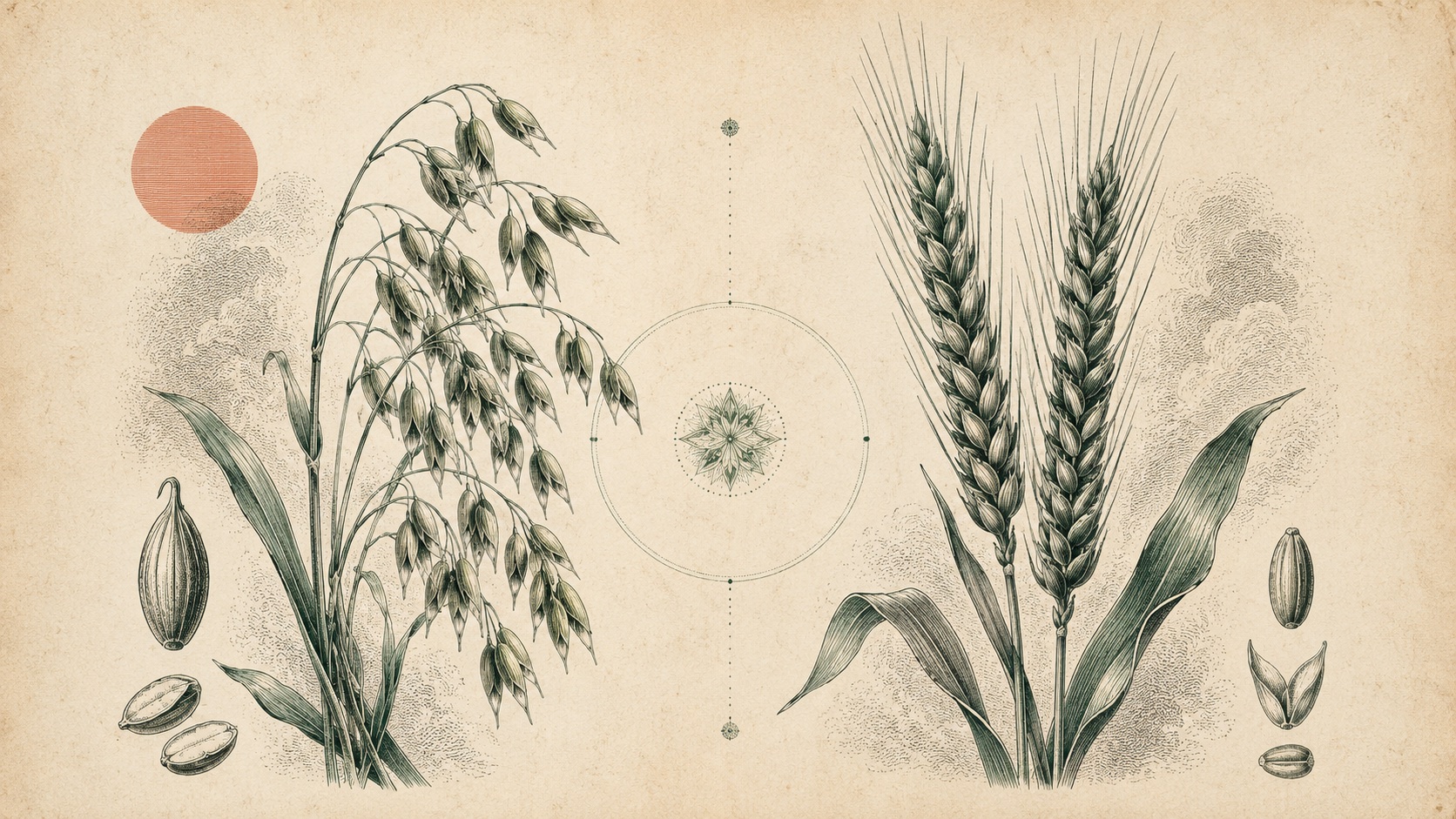
Soluble fiber dissolves into a gel that softens stool; insoluble fiber stays intact, adds bulk, and speeds transit. Most whole foods contain both, and psyllium (a soluble fiber) has the strongest evidence for constipation.

Fiber gets talked about as though it were a single substance, a virtuous beige powder you are meant to consume more of. It is not one thing. It is two, and they behave so differently that the very same bowl of bran can rescue one person from constipation and leave another bloated and worse off. Knowing which is which is the difference between relief and a mistake.
The split is simple once you see it. Some fiber dissolves in water and some does not, and that single property — dissolves or not — determines almost everything each type does on its way through you.
The two fibers: A gel and a broom
Soluble fiber dissolves. In the gut it draws in water and turns into a soft gel, the way oats thicken into porridge, and that gel slows digestion, softens stool, and gives loose stool something to hold onto. Insoluble fiber does the opposite: it passes through largely intact, adding bulk and scraping the walls like a broom, speeding things along. Healthline draws the same line — one holds water, the other adds mass.
Most whole foods carry both, in different ratios. Oats, beans, apples, and psyllium lean soluble; wheat bran, whole grains, nuts, and the skins of vegetables lean insoluble. This is why “eat more fiber” is imperfect advice: it matters which one, and for what.
Soluble fiber is a gel. Insoluble fiber is a broom. “Eat more fiber” ignores the difference.
Which one for constipation: It depends on the problem
For a hard, dry, difficult stool, soluble fiber is often the better starting point, because the gel it forms pulls water in and softens what has become too firm. For a sluggish gut that simply is not moving, insoluble fiber’s bulk can be the nudge that gets the muscular waves going. In practice, the two work best together — and the single most evidence-backed option, shown in randomized trials to relieve chronic constipation, is psyllium, a soluble fiber that behaves a little like both.
The everyday sources are unglamorous and effective. Johns Hopkins points to the usual suspects — whole fruits, vegetables, legumes, and whole grains — which deliver a mix of both fibers along with the water and nutrients that make them work. A supplement can help, but food does the job with fewer trade-offs.
The fermentation dividend: Feeding the microbiome
Soluble fiber has a second job that insoluble mostly skips. Because it is fermentable, the bacteria in the colon feast on it, and in return they produce short-chain fatty acids — compounds like butyrate that feed the cells lining the gut and appear, in a growing body of research, to matter well beyond digestion. In that sense soluble fiber is not only your food; it is your microbiome’s food, which is part of why a well-fed gut tends to be a well-behaved one.
That fermentation is also the source of soluble fiber’s main side effect. The same bacterial feast that produces those useful acids produces gas, which is why a sudden surge of beans or a heavy dose of a fiber supplement can leave you bloated. The gas is not a sign of harm. It is a sign of a microbiome enthusiastically doing its job, faster than you gave it time to adjust to.
How to add it: Slowly, and with water
This is where most people go wrong. Confronted with the advice to eat more fiber, they pour in a mountain of bran overnight and drink nothing extra to match — and end up with exactly the hard, effortful, gassy result they were trying to escape. Insoluble fiber without enough water can cement rather than loosen. The gentler path is to build up over a couple of weeks, not a couple of days, and to drink more as you do.
For most adults the target lands somewhere around 25 to 35 grams a day, and most fall well short of it, closer to half. But the number matters less than the manner. A steady, mixed intake of fiber from real food, added at a pace your gut can keep up with, does more good than a heroic supplement dumped in all at once.
The IBS caveat: When bran is the wrong tool
For sensitive guts, the two fibers are not interchangeable. People with irritable bowel syndrome often tolerate soluble fiber — the gentle gel of psyllium or oats — far better than the rough, scratchy bulk of wheat bran, which can aggravate cramping and bloating. It is a useful reminder that fiber is a tool, not a virtue: the right one soothes, the wrong one irritates, and telling them apart is most of the skill.
The fiber gap: Most of us get about half of what we need
For all the attention fiber gets, most people eat strikingly little of it. Health authorities put the target near 25 grams a day for women and 38 for men; the average American manages roughly 15, and by some estimates only about one in twenty adults hits the recommended amount. It is one of the widest gaps between nutrition advice and nutrition reality — and closing even part of it is among the higher-leverage changes most people can make.
The fix is not exotic. Beans and lentils are the densest common source; whole grains, oats, and barley bring both fibers; fruit like berries, pears, and apples with the skin lean soluble; vegetables, nuts, and seeds fill in the rest. A good habit is fiber at every meal rather than a single heroic salad — the gut, and its bacteria, prefer a steady supply to a once-a-day flood.
Supplements can help when food falls short — psyllium is the best studied — but they are a supplement, not a substitute. Whole foods deliver fiber alongside the water, vitamins, and plant compounds that make it work, and in a mix of soluble and insoluble types a single powder rarely matches.
Beyond the bathroom: Cholesterol, blood sugar, and staying full
Fiber’s reputation rests on regularity, but its quieter effects may matter more. Soluble fiber’s gel slows the absorption of sugar, blunting the glucose spikes that follow a meal — one reason fiber-rich diets are a cornerstone of preventing and managing type 2 diabetes. The same gel traps some cholesterol and bile and carries them out; the effect is solid enough that the U.S. Food and Drug Administration lets foods rich in oat beta-glucan claim they help lower heart-disease risk.
Fiber also fills you up for few calories. It adds bulk and slows digestion, prolonging fullness after eating — part of why higher-fiber diets are so consistently tied to easier weight control. None of this needs a supplement or a superfood; it is the ordinary consequence of eating plants close to their whole form.
The other reason to go slow: Feed the bacteria, not the bloat
There is one more argument for building up gradually, and it lives in the colon. Fermentable fibers are food for your gut microbes, and a sudden surge gives them more than they can process politely — the byproduct is gas. Add fiber over a couple of weeks rather than overnight, and the community expands to match, turning what would have been bloating into the short-chain fatty acids that feed your gut lining. The discomfort people blame on fiber is usually just the sound of a microbiome catching up.
Not two, but many: The fibers within the fibers
“Soluble” and “insoluble” are the useful headline, but each hides a cast of specific fibers that behave differently. Among the soluble kind: beta-glucan, concentrated in oats and barley, is the one behind fiber’s cholesterol-lowering reputation; pectin, in apples and citrus, forms the gel that sets jam and softens stool; inulin, in chicory root, onions, garlic, and leeks, is a favorite food of beneficial bacteria and a common prebiotic. Psyllium, from husk, is soluble but only lightly fermented, which is why it bulks and softens without much gas — and why it is the go-to for constipation.
One more deserves its own name: resistant starch. It behaves like fiber even though it is technically starch, sliding past digestion in the small intestine to be fermented in the colon. It turns up in legumes, slightly green bananas, and — a genuinely useful trick — in starchy foods cooked and then cooled. A cooled boiled potato, leftover rice, a pasta salad: chilling converts some of their starch into the resistant kind, quietly adding prebiotic fiber to foods most people file as fiber-poor.
The takeaway is not to memorize the list but to draw from it. A plate spanning oats, beans, fruit with skins, onions and garlic, and the odd cooled potato covers most of these fibers without any accounting — which is, again, the case for variety over any single “best” source.
It also reframes the supplement question. A fiber powder can be a sensible bridge — psyllium in particular has the evidence — but each supplement is usually one fiber doing one job. Food gives you the whole ensemble: gel-formers and bulk-adders, fermentable and inert, each feeding a different part of the system. The supplement aisle sells instruments; the produce aisle sells the orchestra.
The long game: Fiber and the colon over decades
The longest-term case for fiber may be the most important. Large reviews by bodies such as the World Cancer Research Fund have concluded that diets high in fiber — whole grains especially — are associated with a lower risk of colorectal cancer, among the most common and most preventable cancers. The mechanisms line up with everything else on this page: fiber speeds transit, so the colon wall spends less time in contact with waste, and its fermentation into butyrate nourishes and calms the cells of that wall. It is the rare dietary change whose payoff shows up both tomorrow morning and, quietly, decades from now.
Which returns to the point. Fiber is two things doing two jobs, and the payoff is in matching the fiber to the problem: gel for the hard and dry, bulk for the slow, both for a gut you would like to keep boringly regular. Where that regularity shows up is in the shape of what arrives and in how often it does — the two gauges fiber quietly sets.